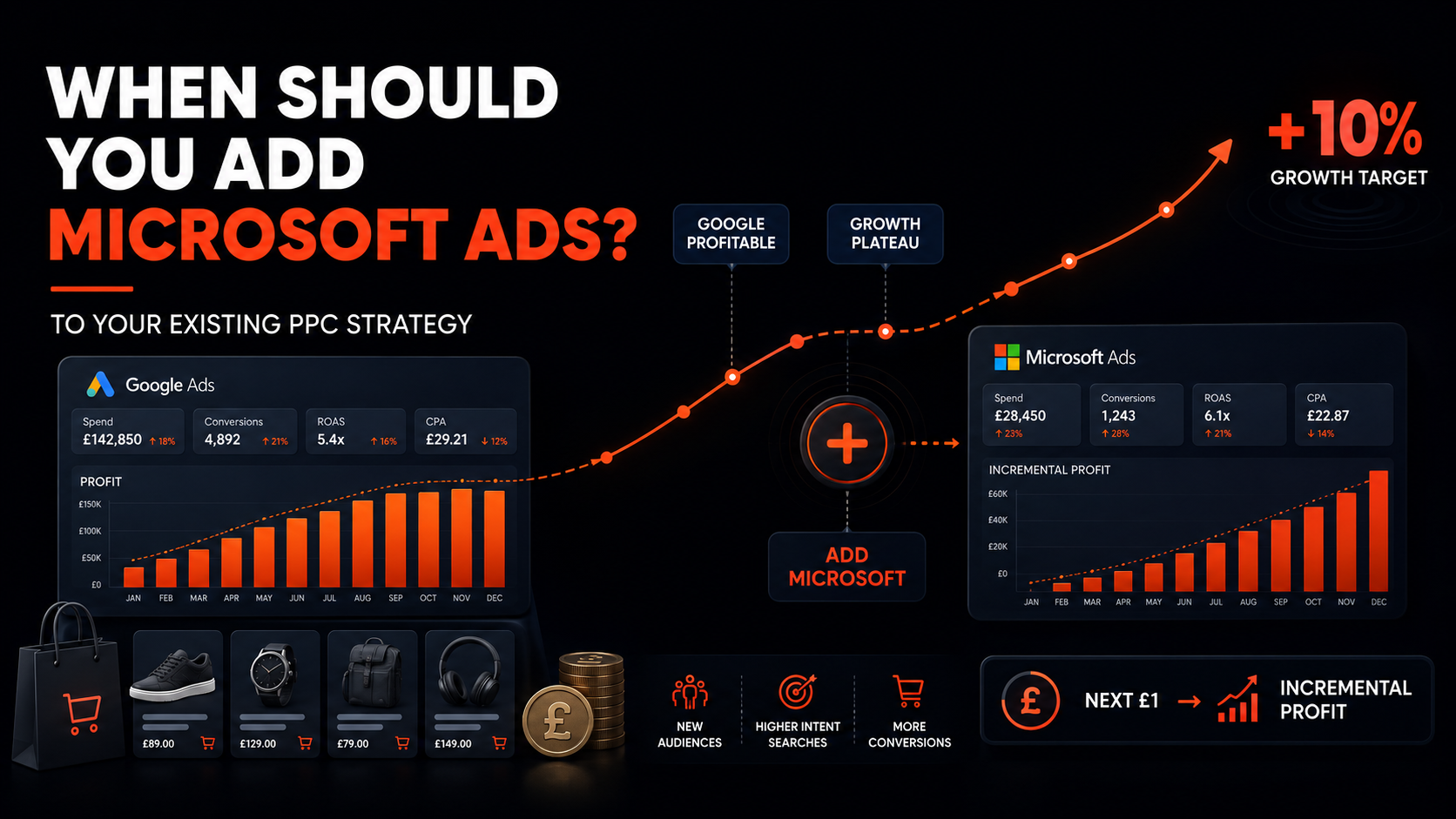
Add Microsoft Ads when Google Ads is already producing reliable, profitable results and the business needs another source of incremental demand—not simply because there is more budget available. It is particularly worth testing when a growth target, such as an additional 10% in year-on-year revenue, can no longer be achieved by scaling Google profitably on its own.
Microsoft Advertising should not be treated as a guaranteed route to another 10% of sales. Its available search demand is smaller than Google’s, and the result will depend on the retailer’s category, audience, product margin, device mix, conversion rate and current paid-search coverage.
The correct question is:
Can Microsoft Ads add customers and contribution profit that our existing PPC strategy is not already capturing?
If the answer can be tested with reliable data and a controlled budget, it may be the right time to add the platform.
The short answer
An e-commerce business should normally add Microsoft Ads when these conditions are in place:
- Google Ads tracking and purchase values are trustworthy.
- Existing Google activity is profitable at a contribution level.
- The business has already captured the most obvious profitable Google opportunities.
- Additional Google spend is producing diminishing marginal returns.
- Products are suitable for active Search or Shopping demand.
- Product feeds, pricing, stock and landing pages are ready.
- The customer base includes a meaningful desktop audience.
- There is enough budget and conversion volume to run a fair test.
- The business can measure new customers and incremental profit—not just platform ROAS.
If Google Ads is still poorly tracked, structurally weak or unprofitable, adding Microsoft usually multiplies the problem. Fix the foundation first.
Why timing matters
Microsoft Advertising can be a useful expansion channel, but introducing it too early can split attention and data before the core PPC programme is working properly.
A retailer with £10,000 per month to invest may achieve a stronger outcome by concentrating initially on Google Search and Shopping, where substantially more demand is available. A retailer already spending £100,000 profitably on Google may have a stronger reason to reserve part of its next growth budget for Microsoft.
The appropriate timing is therefore not based on company size alone. It depends on PPC maturity and marginal return.
| PPC stage | Should you add Microsoft Ads? | Reason |
|---|---|---|
| Tracking is unreliable | No | A second platform will optimise from and report against weak data |
| Google is unprofitable | Usually no | The underlying offer, feed, targeting or conversion problem needs attention first |
| Google is profitable with budget-limited campaigns | Scale Google first | Proven profitable demand may still be available immediately |
| Google is profitable but marginal return is declining | Test Microsoft | A new auction and audience may offer more efficient incremental demand |
| Google is mature and the business needs additional growth | Yes, through a controlled test | Microsoft can diversify acquisition and extend search coverage |
| Microsoft test proves incremental contribution profit | Scale gradually | Increase spend only while marginal economics remain acceptable |
Use the growth gap to frame the decision
Suppose an e-commerce business generated £5 million last year and has a target to grow revenue by 10%. The additional requirement is:
£5,000,000 × 10% = £500,000 of additional annual revenue
The team should not automatically decide that Microsoft Ads will supply the £500,000. Instead, break the target into evidence-based opportunities:
| Growth source | Estimated additional revenue | Confidence |
| Profitable Google budget expansion | £180,000 | High |
| Conversion-rate improvements | £120,000 | Medium |
| Higher average order value | £60,000 | Medium |
| Microsoft Ads test | £90,000 | Unproven |
| Email and customer retention | £50,000 | Medium |
| Total potential growth | £500,000 | Mixed |
In this illustration, Microsoft is not expected to deliver the whole 10%. It is one workstream intended to close a specific growth gap.
That is the commercially defensible position: 10% is the business objective, not a Microsoft Advertising benchmark.
The current UK opportunity
Google remains overwhelmingly dominant in UK search. StatCounter estimated that in July 2026 Google held 92.62% of combined desktop-and-mobile UK search share, while Bing held 4.74%. On desktop, Bing’s share was materially higher at 10.77%, compared with 85.55% for Google.
Search-engine market share does not translate directly into advertising revenue. It does, however, show why Microsoft’s realistic role is normally incremental rather than transformational.
The desktop difference also provides an important qualification. Microsoft may deserve an earlier test when buyers are likely to research and purchase on laptops or workplace computers. Mobile-led brands may see less available volume.
Microsoft Search advertising can extend beyond Bing to eligible search partners. Microsoft also offers Shopping campaigns using a Microsoft Merchant Center catalogue, and its Google Import tools can reduce the time required to transfer eligible campaign structures.
This makes entry relatively straightforward—but easy setup is not the same as guaranteed performance.
Eight signs it is time to add Microsoft Ads
1. Google Ads is reliably profitable
Before expanding, confirm that Google is profitable after the costs involved in fulfilling an order.
Platform ROAS alone is not enough. Calculate contribution profit after:
- Cost of goods.
- Shipping and fulfilment.
- Payment fees.
- Discounts.
- Expected returns and cancellations.
- Advertising spend.
The starting formula is:
Contribution profit after ads = revenue − variable product and fulfilment costs − ad spend
Microsoft should inherit a proven commercial framework, not merely copied campaigns.
2. Measurement can support another platform
The business should be able to reconcile:
- Orders and revenue reported by the ad platform.
- Analytics purchase data.
- E-commerce platform transactions.
- Refunds, cancellations and returns.
- New and returning customers.
- Product-level margin where available.
If Google reporting is already disputed each month, Microsoft will create another set of incompatible numbers. Resolve purchase tracking, currency, transaction IDs, attribution windows and consent-related data loss before expansion.
3. Google has limited profitable headroom
There is little value in opening a second platform if highly profitable Google campaigns are still constrained by budget.
Check:
- Search lost impression share due to budget.
- High-intent non-brand keywords with profitable missed demand.
- Profitable Shopping or Performance Max product groups that can absorb more budget.
- High-margin categories with low coverage.
- Geographic or device segments with proven returns.
Scale those opportunities first if the next pound remains profitable. Add Microsoft when Google’s additional spend starts entering less efficient auctions or weaker demand.
4. Marginal Google returns are declining
Historic average ROAS does not tell you whether the next budget increase will work.
For example:
| Google investment | Incremental revenue | Marginal ROAS | Contribution margin before ads | Contribution after ads |
| Existing £50,000 | £225,000 | 4.5x | 35% | £28,750 |
| Next £10,000 | £30,000 | 3.0x | 35% | £500 |
The existing Google programme is highly profitable, but its next £10,000 is close to break-even. That is a sensible moment to test whether Microsoft can use some of the growth budget more effectively.
5. Your buyers are commercially relevant on desktop
Microsoft’s stronger UK desktop position does not guarantee sales, but it increases the likelihood of a meaningful opportunity for certain retailers.
Potentially suitable categories include:
- Home improvement and furniture.
- Computing and office products.
- High-value electricals.
- Specialist equipment.
- Considered purchases requiring comparison.
- Products frequently researched during working hours.
- Categories with older or more affluent customer groups.
Use the retailer’s own GA4, CRM and commerce data to check device mix, age profile, order value and conversion rate. Do not rely on a generic description of the “Bing audience.”
6. Your products have clear search intent
Microsoft is most immediately testable when people actively search for the products you sell.
Examples include:
- Exact product and model searches.
- Brand-plus-product queries.
- Category searches.
- Product attributes such as size, colour, material or compatibility.
- “Buy,” “price,” “delivery” and “in stock” terms.
- Shopping searches where image, price and retailer information influence the click.
A product with no meaningful search demand will not become scalable simply because another search engine is added.
7. The feed and website are ready
Shopping performance depends on product and landing-page quality.
Before launch, confirm:
- Product IDs are stable and consistent.
- Titles accurately describe products using relevant attributes.
- GTIN, MPN and brand fields are complete where applicable.
- Prices and sale prices match the website.
- Availability updates promptly.
- Images are clear and compliant.
- Shipping, delivery and returns information is competitive and accurate.
- Product pages load properly and work on desktop and mobile.
- Variant selection and checkout are reliable.
- High-margin and low-stock products can be identified through labels.
Importing a weak feed into Microsoft creates weak Microsoft Shopping campaigns.
8. The team can manage the platform independently
Microsoft should not be treated as a “set and forget” copy of Google.
The team needs capacity to review:
- Search terms and negatives.
- Partner traffic.
- Product approvals and catalogue errors.
- Bid strategies and learning periods.
- Brand versus non-brand performance.
- Search versus audience placements.
- New versus returning customers.
- Product-group profitability.
- Tracking discrepancies.
If nobody owns those tasks, the platform may appear cheap while quietly consuming budget through low-quality demand.
When not to add Microsoft Ads
Delay the launch when any of the following are true.
Google still contains obvious profitable opportunities
If proven campaigns are limited by budget and meet contribution targets, scaling them may offer a faster and more predictable return than opening another platform.
Tracking is incomplete or inflated
Do not let two bidding systems optimise against duplicated transactions, incorrect values or soft actions treated as purchases.
The website conversion rate is falling
A broken checkout, weak delivery proposition, slow mobile experience or out-of-stock catalogue will affect Microsoft as well as Google.
The business is strongly mobile-first
Microsoft may still produce sales, but the available UK opportunity is likely to be smaller where nearly all customers search and buy on mobile.
Margins cannot support a learning period
The channel needs enough time and spend to collect evidence. If every early order must hit a mature target immediately, the test may be too restricted to produce a useful conclusion.
No one can measure incrementality
Adding another platform increases attribution overlap. If the business cannot distinguish genuine growth from reassigned credit, a reported increase may be misleading.
How much budget should the first test receive?
There is no universal amount or percentage. The test budget must be large enough to generate meaningful purchase data without exposing the business to unacceptable loss.
A practical method is:
- Estimate Microsoft’s available monthly click volume for proven queries and products.
- Apply a conservative expected conversion rate.
- Calculate the spend required to reach a useful number of purchases.
- Set a maximum acceptable learning loss.
- Run the test long enough to include normal weekly and payday variation.
For example:
- Estimated qualified clicks: 2,000 per month.
- Expected CPC: £0.90.
- Expected conversion rate: 2.5%.
- Expected orders: 50.
- Estimated spend: £1,800.
- Average order value: £100.
- Expected revenue: £5,000.
- Expected ROAS: 2.78x.
If the retailer’s break-even ROAS is 3.3x, this forecast does not meet the required economics. The business could improve the planned product mix, landing pages or bid strategy—or decide the test is not yet justified.
Set the commercial guardrails first
Define success before launching.
For a product generating £100 in revenue with £38 left after product cost, fulfilment, fees and expected returns, the pre-ad contribution margin is 38%.
Break-even ROAS is:
Break-even ROAS = 1 ÷ pre-ad contribution margin
1 ÷ 0.38 = 2.63x
At 2.63x, advertising has consumed the full pre-ad contribution. The retailer may need a target above 3x to retain an acceptable profit after media.
The launch plan should specify:
- Maximum test spend.
- Target and break-even ROAS.
- Allowable new-customer CPA.
- Required contribution profit.
- Acceptable payback period.
- Minimum purchase volume before a decision.
- Conditions for scaling, holding or stopping.
Start with proven demand—but do not copy blindly
Microsoft provides tools to import eligible Google campaigns, including Shopping activity. That can save time, but the imported account still needs its own commercial decisions.
Start with:
- Profitable non-brand Search themes.
- High-margin, in-stock bestsellers.
- Categories with strong desktop conversion.
- Product groups with reliable Google performance.
- Clear brand separation.
- Relevant negative keywords.
Then review all imported settings, including:
- Budgets.
- Bid strategies and targets.
- Locations and languages.
- Ad schedules.
- Match types.
- Audience settings.
- Search-partner distribution.
- Final URLs.
- Tracking templates.
- Product catalogue associations.
An import is a starting structure, not a completed strategy.
Separate Search from broader audience activity
At launch, keep high-intent search demand visible.
Searchers actively typing product or category queries normally have a different intent from people seeing an ad in a broader audience placement. Blending the two can make it difficult to diagnose why CPA, conversion rate or order quality changed.
Use separate budgets and reporting wherever the available campaign settings allow. This enables the business to answer:
- Is Microsoft Search itself profitable?
- Are Shopping/Product Ads generating qualified sales?
- Are broader audience placements adding new customers?
- Is one traffic source hiding another’s weak return?
Measure Microsoft beyond platform ROAS
The launch dashboard should include:
| Metric | Why it matters |
| Spend | Shows the investment required |
| Clicks and CPC | Explains traffic cost and scale |
| Conversion rate | Indicates traffic and landing-page quality |
| Orders and revenue | Provides transaction volume and top-line return |
| CPA and ROAS | Useful platform diagnostics |
| Contribution profit after ads | Tests real first-order profitability |
| New-customer CPA | Shows whether the platform is adding customers |
| Return and cancellation rate | Protects against low-quality revenue |
| Branded versus non-brand revenue | Exposes demand capture versus acquisition |
| Total store revenue | Checks whether the platform result appears in the business |
| Blended MER | Tracks total revenue relative to total media investment |
| Marginal return | Decides whether the next budget increase is justified |
Report Microsoft separately from Google. A combined “PPC” total can hide whether Microsoft adds value or merely shifts attribution between platforms.
Test incrementality, not just attribution
Microsoft may correctly attribute a purchase to an ad click without having caused the sale.
This is especially relevant for:
- Brand Search.
- Remarketing.
- Returning customers.
- Existing email subscribers.
- Promotional periods.
Watch total-store revenue, direct traffic, organic traffic and new-customer numbers before and after launch. Where volume permits, use matched locations or controlled time periods to assess whether withholding Microsoft activity changes total commercial outcomes.
The business is trying to estimate:
Incremental profit = profit from sales caused by Microsoft Ads − Microsoft investment
This is more useful than asking how much revenue Microsoft claimed.
A practical 90-day launch plan
Before launch
- Confirm Google profitability and remaining headroom.
- Reconcile purchase tracking with commerce data.
- Calculate break-even and target economics.
- Audit the Microsoft Merchant Center catalogue.
- Select high-margin, in-stock product groups.
- Import or rebuild proven campaigns.
- Establish brand, non-brand and traffic-type separation.
- Record the total-store baseline.
Days 1–30: validate
- Confirm ads and products are approved.
- Test purchase tracking and transaction values.
- Review search terms and partner traffic frequently.
- Fix feed, URL, location and query-quality issues.
- Avoid major budget increases from a handful of early sales.
Days 31–60: evaluate
- Compare actual performance with the commercial guardrails.
- Review product and query profitability.
- Separate new from returning customers.
- Assess desktop and mobile performance independently.
- Remove clear waste while protecting enough volume for learning.
Days 61–90: decide
- Estimate incremental revenue and contribution profit.
- Compare Microsoft’s next-pound return with additional Google spend.
- Scale profitable products and queries gradually.
- Hold the budget if performance is promising but volume is insufficient.
- Stop or restructure activity that cannot meet the agreed economics.
What would justify scaling Microsoft?
Scale when the evidence shows that:
- Purchase tracking reconciles closely enough for decisions.
- Search terms and product matches are commercially relevant.
- Contribution profit meets the required threshold.
- New-customer acquisition is acceptable.
- Return and cancellation rates are not materially worse.
- Total business revenue or customer acquisition increases.
- Additional Microsoft budget remains profitable at the margin.
Do not scale simply because the first campaign reports a higher ROAS than Google. A small brand campaign can produce impressive efficiency without creating meaningful growth.
What if Microsoft cannot deliver the extra 10%?
That is not necessarily a failed test.
If Microsoft adds 2–4% profitable incremental revenue, it may still be a valuable part of the growth portfolio. The remaining gap can come from:
- Conversion-rate optimisation.
- Higher average order value.
- Improved product feeds and merchandising.
- SEO and non-brand organic growth.
- Email retention and repeat purchasing.
- New products or regions.
- Paid-social acquisition.
- Better Google marginal performance.
The commercial objective is profitable growth, not forcing one platform to meet an arbitrary share of the target.
The practical conclusion
So, when should you add Microsoft Ads to an existing PPC Ads strategy?
Add it when Google Ads is a proven, profitable foundation, measurement is reliable, and the next stage of growth requires demand that Google cannot supply at the required marginal return. It is especially appropriate when the business has a material desktop audience, products with clear search intent, a strong feed and enough budget to run a controlled test.
If the business wants another 10% in year-on-year revenue, Microsoft may contribute to that target—but it should never be presented as a guaranteed 10% growth lever. Treat the number as a hypothesis to validate through new-customer growth, incremental revenue and contribution profit.
The right time to add Microsoft is not when the business simply has more money to spend. It is when the evidence shows that diversification offers a better chance of creating the next profitable sale.
Frequently asked questions
Should Microsoft Ads only be added after Google Ads?
For most UK e-commerce businesses, yes. Google normally provides much greater search and shopping scale, so it is usually the logical foundation. Microsoft becomes valuable as a complementary source of incremental demand.
Can Microsoft Ads add 10% to e-commerce revenue?
It may contribute towards a 10% growth target, but there is no universal evidence that it will automatically add 10%. The result depends on audience, category, margins, demand and execution.
How much should an initial Microsoft Ads test cost?
The budget should be based on expected click volume, conversion rate, allowable CPA and the number of purchases required for a decision. It must be large enough to generate evidence but capped by an acceptable learning loss.
Should Google campaigns be imported into Microsoft Ads?
Importing proven campaigns can accelerate setup. Every imported budget, bid target, location, query, audience and tracking setting should still be reviewed for Microsoft.
Is Microsoft Ads suitable for mobile-first retailers?
It can still work, but the UK opportunity is more desktop-weighted. Strongly mobile-first retailers should use their own audience data and conservative volume expectations.
How long should the test run?
A 60–90-day framework is sensible for many established retailers, but conversion volume is more important than calendar time. Low-volume accounts may need longer to reach a defensible conclusion.
What is the best success metric?
Incremental contribution profit is the strongest commercial measure. CPA, ROAS and attributed revenue remain useful diagnostics, but they do not prove profitability or causality alone.
Need to decide whether Microsoft belongs in your PPC strategy?
Clubbish helps e-commerce businesses assess paid-search growth through contribution profit, customer acquisition and incrementality—not generic platform promises.
If Google is already working but no longer provides enough profitable headroom to meet the next growth target, book a marketing strategy consultation with Clubbish.