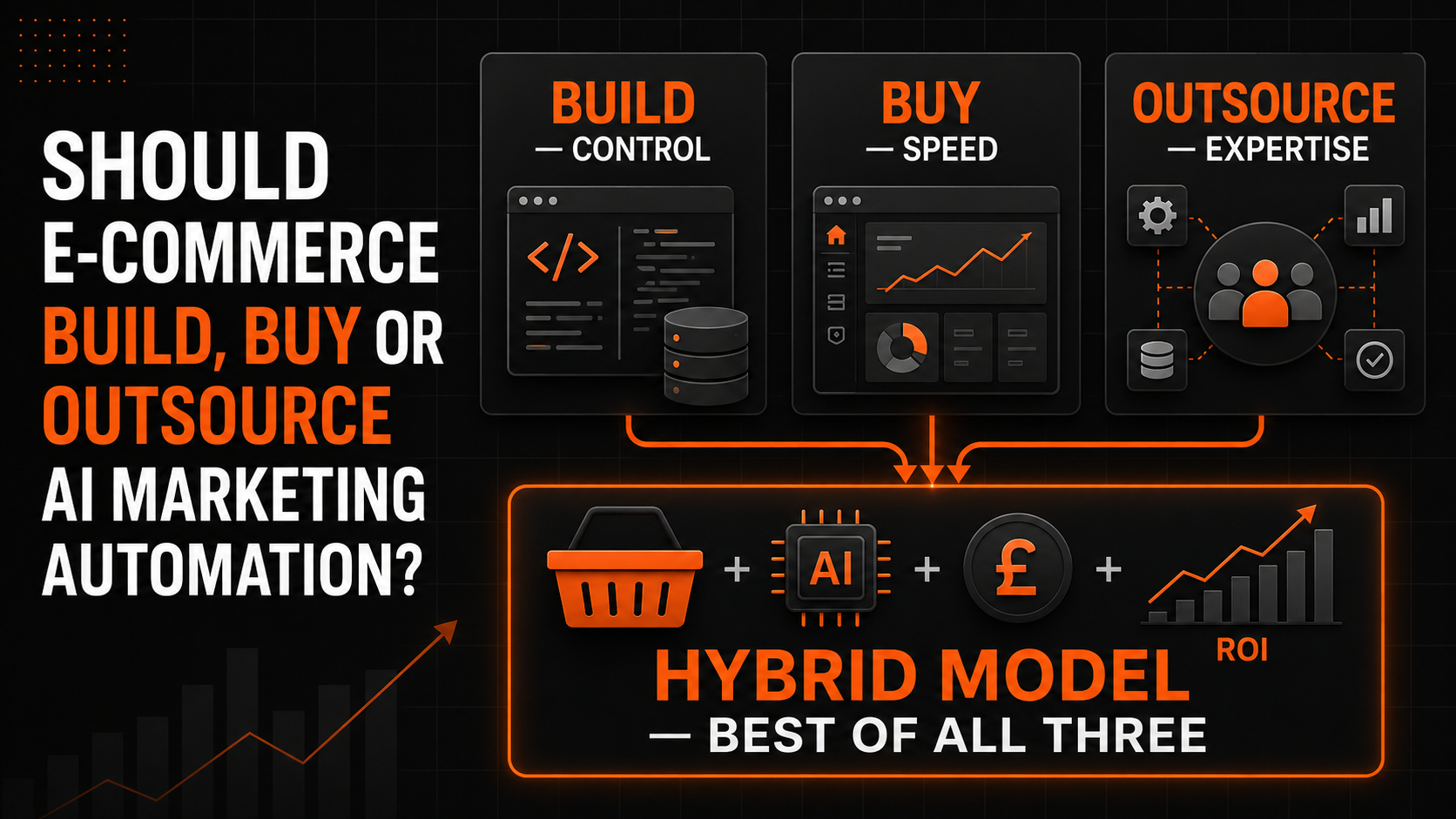
Should an e-commerce business build, buy or outsource AI marketing automation? For most retailers, the strongest answer is a hybrid: buy the established technology, build only the data and decision logic that create genuine competitive advantage, and outsource specialist implementation where internal capability is limited.
Build when the capability is strategically distinctive and the business can maintain it. Buy when the problem is common, proven software exists and speed matters. Outsource when specialist expertise or temporary capacity is required—but never outsource ownership of customer data, commercial targets, measurement or final decisions.
The correct model is the one that delivers the strongest incremental contribution profit at an acceptable total cost, implementation speed and risk. It is not automatically the option with the lowest licence fee, the greatest customisation or the most advanced AI.
The short answer
Use this default decision:
- Buy commodity capabilities such as email automation, reporting, customer-service triage and product-feed monitoring.
- Build proprietary customer, product, stock, margin and lifetime-value logic that materially differentiates the business.
- Outsource discovery, integrations, implementation, specialist development and temporary operational support.
- Keep in-house strategy, commercial ownership, account access, data governance, measurement and approval authority.
For a typical growing e-commerce business, rebuilding a complete marketing-automation platform is rarely commercially sensible. Equally, buying a platform and expecting it to understand the retailer’s margins, stock constraints, customer value and measurement model without configuration is unrealistic.
The best arrangement combines the speed of buying, the differentiation of building and the specialist capability of outsourcing.
How to Decide Whether to Build, Buy or Outsource AI Marketing Automation
To decide whether to build, buy or outsource AI marketing automation, assess six factors:
- Strategic differentiation: Does the capability create an advantage competitors cannot easily copy?
- Speed: How quickly must it begin creating value?
- Internal capability: Can the business design, implement, secure and maintain it?
- Data and control: How sensitive or business-critical are the data and decisions?
- Total cost: What will the option cost over three to five years?
- Reversibility: Can the business change provider, export its data or recover from failure?
The answer should be made at the capability level, not for “AI” as a whole. A retailer might buy an email platform, build a margin-aware product-scoring layer and outsource the integration. It may make a different decision for customer service, forecasting or creative production.
Option one: build AI marketing automation
Building means developing some or all of the data pipelines, rules, models, workflows or customer-facing applications internally or as bespoke intellectual property.
Build when
- The process is strategically differentiating.
- Proprietary customer, product or margin data creates a defendable advantage.
- The workflow is central to the customer experience.
- Existing tools cannot represent important commercial rules.
- Control over data location and model behaviour is essential.
- The business has strong product, engineering, data and security capability.
- Transaction volume is sufficient to justify the investment.
- The expected long-term value exceeds development and maintenance costs.
Potential examples include:
- A proprietary product-recommendation system.
- Margin-aware merchandising.
- A business-specific customer-lifetime-value model.
- Inventory-aware marketing allocation.
- Bespoke demand forecasting.
- A unified customer and product decision layer across multiple markets.
- A system combining returns, stock, delivery cost and repeat purchase to determine which products should be promoted.
Advantages of building
- Deep customisation.
- Greater control over the roadmap.
- Ability to embed proprietary commercial logic.
- Reduced dependency on one application vendor.
- Potential ownership of valuable intellectual property.
- Better fit with complex internal systems.
- Greater transparency where the system is designed well.
Risks of building
- Longer time to value.
- High and uncertain implementation cost.
- Recruitment and retention challenges.
- Ongoing security, monitoring and maintenance obligations.
- Technical debt.
- Dependence on a small number of internal experts.
- Model or workflow deterioration as products and customers change.
- The temptation to rebuild common features that already exist commercially.
The main mistake is comparing a developer’s initial salary or a prototype cost with a vendor’s annual subscription. The prototype is not the operating system. Production requires reliability, access controls, documentation, testing, monitoring, incident response and continuous maintenance.
When building becomes commercially defensible
Use a simple value threshold:
Build advantage = Expected incremental value of proprietary capability − Additional cost and risk of bespoke development
Build only when that advantage is materially positive over the expected life of the system.
If a custom recommendation engine is expected to create £1 million of additional contribution profit over three years and costs £350,000 to build and maintain, the case may be attractive. If the expected value is £80,000 and a credible platform costs £40,000, building is unlikely to be rational.
Option two: buy AI marketing automation
Buying means licensing an existing SaaS platform, AI model, CRM, marketing-automation product or commerce application.
Buy when
- The problem is common across e-commerce businesses.
- A mature product already solves most requirements.
- Speed matters more than complete customisation.
- The capability is not a core differentiator.
- The vendor has credible integrations, support and security.
- Data and configuration can be exported.
- The system can be piloted without a long commitment.
- Commercial performance can be tested against a baseline or holdout.
Good candidates usually include:
- Email and SMS automation.
- Basket and checkout recovery.
- Review requests.
- Back-in-stock notifications.
- Basic customer segmentation.
- Customer-service classification and triage.
- Product-feed monitoring.
- Reporting and anomaly alerts.
- Creative drafting and variation.
- Campaign workflow management.
- Standard product recommendations.
Advantages of buying
- Faster implementation.
- Predictable initial feature set.
- Lower upfront engineering burden.
- Vendor support and product updates.
- Established integrations.
- Easier proof of concept.
- Potentially clearer operating cost.
Risks of buying
- Vendor lock-in.
- Rising usage and seat costs.
- Limited control over roadmap and model changes.
- Generic decision logic.
- Restricted transparency.
- Data-portability problems.
- Dependence on vendor reliability.
- Paying for unused functionality.
- The vendor using data or outputs in ways the business did not expect.
Buying should not mean accepting the vendor’s default measurement. A platform may report attributed revenue, tasks completed or time saved. The retailer still needs to prove incremental contribution profit and verified operational benefit.
Questions to ask a vendor
- What data does the system collect?
- Where is it processed and stored?
- Is customer data used to train shared models?
- Which sub-processors and models are involved?
- How are model or feature changes communicated?
- Can the business export data, prompts, rules and configurations?
- What happens to data when the agreement ends?
- What are the usage limits and overage prices?
- How are errors, incidents and outages handled?
- What audit, testing and security evidence is available?
- Can the platform support a controlled pilot?
- How will performance be measured?
Option three: outsource AI marketing automation
Outsourcing means using an agency, consultant, systems integrator or managed-service provider to select, implement, operate or optimise the technology.
Outsource when
- The business lacks specialist expertise.
- Implementation is complex but not strategically unique.
- The company needs to move faster than internal recruitment allows.
- Integrations, measurement or governance require experienced support.
- The need is temporary or project-based.
- Independent vendor selection is valuable.
- Ongoing technical monitoring is required.
- Internal teams are already at capacity.
Appropriate outsourced work may include:
- Automation and data-readiness audits.
- Use-case prioritisation.
- Vendor evaluation.
- CRM and commerce-platform integration.
- Workflow configuration.
- Measurement and holdout design.
- Quality assurance.
- Governance documentation.
- Specialist model or data development.
- Training and knowledge transfer.
- Ongoing optimisation and monitoring.
Advantages of outsourcing
- Rapid access to specialist capability.
- Lower recruitment burden.
- Experience from comparable implementations.
- Flexible capacity.
- External challenge and validation.
- Faster discovery and setup.
- Support during a temporary transformation period.
Risks of outsourcing
- Loss of internal knowledge.
- Supplier dependency.
- Weak transparency.
- Misaligned incentives.
- Restricted account or data access.
- Uncontrolled subcontracting.
- High change-request costs.
- Strategy being defined by the provider’s preferred tools.
Outsourcing execution does not outsource accountability. The business remains responsible for its customers, data, claims, budgets and regulatory obligations.
What the business must retain
- Administrator ownership of accounts.
- Access to customer and product data.
- Commercial definitions and targets.
- Contribution-margin calculations.
- Consent and preference rules.
- Measurement methodology.
- Approval and rollback rights.
- Documentation and change history.
- Vendor and sub-contractor visibility.
- The ability to transition the work.
Build, buy or outsource decision matrix
| Decision factor | Build | Buy | Outsource |
|---|---|---|---|
| Strategic uniqueness | Strong fit | Weak to moderate fit | Moderate fit |
| Speed to launch | Usually slowest | Usually fastest | Fast with capable partner |
| Deep customisation | Strongest | Limited to platform | Strong within agreed scope |
| Internal technical demand | High | Low to moderate | Lower initially |
| Upfront cost | Usually high | Usually lower | Depends on scope |
| Ongoing cost certainty | Often difficult | Usually clearer | Contract-dependent |
| Data and model control | Potentially strongest | Requires diligence | Requires contractual controls |
| Maintenance responsibility | Internal | Vendor | Shared or provider-led |
| Vendor dependency | Component-level | Platform-level | Provider and platform-level |
| Time to learn internally | High | Moderate | Low unless knowledge transfer is planned |
| Best for commodity process | Usually excessive | Strong fit | Useful for implementation |
| Best for proprietary advantage | Strong fit | Limited | Useful for specialist build support |
The hybrid model is usually strongest
For most e-commerce businesses, the recommended operating model is:
Buy the commodity technology, build the business-specific data and logic, and outsource specialist implementation—while keeping ownership of strategy, accounts, data and measurement.
A retailer might:
- Buy a marketing-automation platform.
- Use an established language or prediction model through an API.
- Build its own margin and customer-value calculations.
- Build rules connecting stock and product returns to promotion eligibility.
- Outsource the initial integration and workflow setup.
- Keep final campaign, pricing and budget decisions in-house.
- Train internal owners to operate and challenge the system.
This approach avoids rebuilding common infrastructure while protecting what makes the business commercially distinctive.
Compare total cost of ownership—not headline prices
Calculate:
Total cost of ownership = Build or licence cost + Implementation + Data preparation + Integration + Training + Human review + Monitoring + Security + Maintenance + Exit cost
Use a three-to-five-year horizon where appropriate. A cheap first-year platform may become expensive as customer records, message volume, API usage or markets grow. A costly build may become economical at scale if it replaces several licences and creates valuable proprietary capability.
Full cost of building
- Product management.
- Engineering and data science.
- Data pipelines and labelling.
- Infrastructure and model usage.
- Security and access control.
- Testing and quality assurance.
- Documentation.
- Monitoring and evaluation.
- Incident response.
- Recruitment and staff turnover.
- Technical debt and replacement.
Full cost of buying
- Subscription and usage fees.
- Implementation and professional services.
- Integration.
- Additional users and environments.
- Data storage.
- Contract increases.
- Internal administration.
- Vendor monitoring.
- Migration and exit.
Full cost of outsourcing
- Discovery and strategy.
- Setup and integration.
- Management fees.
- Creative or content production.
- Reporting and optimisation.
- Change requests.
- Performance incentives.
- Internal supplier management.
- Knowledge transfer.
- Provider replacement.
Worked three-year comparison
Suppose a retailer needs a margin-aware product-recommendation capability.
| Cost over three years | Build | Buy | Outsource managed solution |
| Initial implementation | £180,000 | £35,000 | £60,000 |
| Technology and infrastructure | £90,000 | £120,000 | Included partly |
| Internal people and oversight | £210,000 | £75,000 | £60,000 |
| Maintenance and support | £120,000 | £30,000 | £180,000 |
| Exit or migration allowance | £30,000 | £40,000 | £40,000 |
| Illustrative three-year total | £630,000 | £300,000 | £340,000 |
These figures are illustrative, not market benchmarks.
The bought option appears cheapest, but the decision still depends on value. If the bespoke build creates an additional £600,000 of contribution profit because it uses unique stock, margin and customer data more effectively, the higher cost may be justified. If commercial performance is similar, building is unlikely to be rational.
Calculate:
Net value = Incremental contribution profit + Verified cost savings − Total cost of ownership
And:
ROI = Net value ÷ Total cost of ownership × 100
Assess data, privacy and intellectual property
Before any third party receives customer, product or commercial data, establish:
- Who is the controller and processor.
- What processing instructions apply.
- Whether data is used for model training.
- Where data is stored and processed.
- Which sub-processors are involved.
- Whether prompts and outputs are retained.
- How long data is kept.
- How deletion and subject-right requests are handled.
- Who owns generated content, workflows and configurations.
- Whether outputs can be reused by the vendor.
- What happens when the relationship ends.
The ICO’s AI audit framework advises organisations to perform due diligence when procuring AI systems, datasets or code and to define controller, processor and third-party responsibilities clearly. ICO
Do not accept “the supplier is compliant” as sufficient evidence. The retailer must understand its own use of the system and the risks to customers.
Assess security and supply-chain risk
Buying or outsourcing introduces external dependencies. Building also relies on third-party models, libraries, cloud services and datasets.
The UK National Cyber Security Centre recommends assessing and monitoring AI supply chains throughout the system lifecycle and requiring suppliers to meet the organisation’s software-security standards. NCSC
NIST’s AI Risk Management Framework recommends monitoring risks and benefits from third-party resources and maintaining contingency processes for failures involving high-risk external data or AI systems. NIST AI Resource Center
Ask:
- Which external models, libraries and datasets are used?
- What happens if a model or API becomes unavailable?
- Can the provider change the underlying model without approval?
- What access does the supplier have?
- How are vulnerabilities and incidents disclosed?
- Is there a fallback manual process?
- Can critical actions be stopped independently?
- Are backups and recovery tested?
The correct sourcing decision includes resilience—not just implementation speed.
Keep measurement and commercial ownership in-house
Regardless of the delivery model, the retailer should define:
- The commercial problem.
- Contribution-margin logic.
- Customer and product definitions.
- Incrementality methodology.
- Success criteria.
- Risk thresholds.
- Budget and approval controls.
- Conditions for expansion or rollback.
Measure:
AI automation ROI = (Incremental contribution profit + Verified cost savings − Total programme cost) ÷ Total programme cost × 100
For marketing automation, use holdouts or credible counterfactuals rather than accepting platform-attributed revenue as proof. For operational automation, confirm that hours saved reduce cost, avoid recruitment or create productive capacity.
An outsourced partner can prepare the analysis, but the business must understand and approve the definitions.
Match the sourcing model to business maturity
Small or early-stage e-commerce business
Recommended approach:
- Buy simple established tools.
- Automate reporting, basket recovery, email journeys and feed checks.
- Use a specialist for setup where necessary.
- Avoid custom model development before sufficient data and volume exist.
- Assign an internal commercial owner.
The priority is speed, learning and measurable value—not proprietary infrastructure.
Growing e-commerce business
Recommended approach:
- Buy established CRM, automation and commerce tools.
- Build reliable customer, product, stock and margin data structures.
- Add business-specific rules and measurement.
- Outsource complex integrations or scarce specialist work.
- Develop internal operational capability during implementation.
This stage often gains more from connecting and improving existing systems than adding another disconnected AI product.
Established or enterprise retailer
Recommended approach:
- Buy commodity infrastructure and base models.
- Build proprietary layers where data scale and commercial complexity justify them.
- Use specialist partners to accelerate defined workstreams.
- Maintain internal product, data, security and governance ownership.
- Operate formal supplier and model-risk management.
Potential proprietary areas include customer lifetime value, margin-aware recommendations, forecasting, multi-market personalisation and inventory-aware media allocation.
When each option is wrong
| Situation | Avoid |
| Tracking and customer data are unreliable | Advanced build or platform purchase before fixing measurement |
| The process is standard and widely supported | Expensive bespoke development |
| The capability is a genuine competitive advantage | Total dependence on a generic vendor |
| No internal owner exists | Outsourcing strategy and accountability entirely |
| The vendor will not explain data use or sub-processors | Signing before due diligence improves |
| The workflow affects pricing, eligibility or customer rights | Unsupervised automation |
| Incremental impact cannot be tested | Scaling from attributed revenue alone |
| The business has no exit plan | Long-term lock-in |
| Internal team cannot maintain a custom system | Building because it appears cheaper initially |
| Provider controls all accounts and documentation | Outsourcing without operational control |
Audit before selecting the model
Run a short discovery phase:
- Map the process, systems and manual work.
- Define the commercial problem and baseline.
- Assess data quality, access and consent.
- Classify financial, customer, privacy and security risk.
- Identify what is commodity and what is differentiating.
- Estimate build, buy and outsource total cost.
- Test vendors using real workflows and representative data.
- Pilot the preferred option against a baseline or control.
- Document ownership, security, data and exit terms.
- Decide whether to scale, redesign or stop.
UK government AI procurement guidance recommends assessing the viability of the intended system and considering data, algorithms, transparency and implementation rather than treating AI as a conventional isolated purchase. UK Government
Do not let a vendor select the business problem because its product supports a particular feature.
A practical 90-day decision process
Days 1–30: define and compare
- Identify the use case and commercial outcome.
- Establish the baseline.
- Separate commodity from proprietary requirements.
- Assess internal skills and capacity.
- Build three-year total-cost scenarios.
- Define privacy, security and control requirements.
Days 31–60: evaluate and test
- Shortlist bought and outsourced options.
- Scope the internal-build alternative honestly.
- Run demonstrations with representative workflows.
- Review contracts, data use and exit arrangements.
- Test integrations and output quality.
- Design the commercial pilot.
Days 61–90: pilot and decide
- Launch a bounded pilot.
- Measure incremental contribution profit and verified savings.
- Record internal effort and supplier dependency.
- Test failure, rollback and export processes.
- Confirm internal ownership and knowledge transfer.
- Select the model with the strongest risk-adjusted net value.
Questions for a prospective agency or implementation partner
- Which platforms and models do you recommend, and why?
- Are you commercially connected to any vendor?
- Who owns every account and configuration?
- How will you use and protect our data?
- Which subcontractors will access it?
- How will success be measured incrementally?
- What internal resource will we need?
- How will knowledge be transferred?
- What happens if we end the relationship?
- Can another provider take over without rebuilding everything?
- How are errors, changes and incidents documented?
- What will the first 90 days deliver?
A credible partner should be willing to recommend a simpler conventional automation when AI is unnecessary.
Frequently asked questions
Is building AI marketing automation cheaper than buying it?
Usually not at the beginning. Building can become economical when scale is high and proprietary capability creates substantial value, but the calculation must include engineering, infrastructure, security, monitoring, maintenance and staff continuity.
Who should own an outsourced automation account?
The e-commerce business should own the primary platform accounts, customer data, tracking and administrator access. The provider should receive the permissions required to perform its work.
Can a business outsource AI governance?
Specialists can support privacy, security, testing and documentation, but the business cannot outsource final accountability for its customers, decisions and data.
When should an e-commerce business build a custom model?
Build when unique data, scale and business logic create value that established tools cannot deliver, and when the business can support the model throughout its operational life.
What is the biggest risk when buying AI automation?
The largest risks are often data use, vendor lock-in, changing costs, limited transparency, roadmap dependency and the system receiving credit for value it did not cause.
What is the biggest risk when outsourcing?
The greatest risk is losing knowledge and control. Protect against it through account ownership, documentation, access, measurement standards, knowledge transfer and clear exit provisions.
The practical answer
For most e-commerce businesses deciding whether to build, buy or outsource AI marketing automation, the best starting model is hybrid:
- Buy mature technology for common capabilities.
- Build proprietary data, margin and decision logic.
- Outsource specialist discovery, integration and implementation.
- Keep customer data, accounts, strategy, measurement and accountability in-house.
Build only when the capability is genuinely differentiating and maintainable. Buy when the problem is common and speed matters. Outsource when expertise is scarce, but ensure the provider strengthens internal capability rather than becoming the only party that understands the system.
The final decision should be based on risk-adjusted net value over the full life of the system, not the cheapest first-year price or the appeal of technical ownership.
Book a Strategy Call
If you need to decide whether to build, buy or outsource AI marketing automation, Clubbish can audit your processes, data, internal capability and commercial opportunity—then create a sourcing and implementation roadmap focused on measurable incremental profit and long-term control.