Neither Performance Max nor Standard Shopping is automatically better for profitable e-commerce growth.
Performance Max is often stronger when a retailer has reliable conversion values, sufficient data and quality creative assets—and wants Google’s automation to pursue demand across multiple channels. Standard Shopping is often stronger when the business needs tighter product-level control, clearer diagnosis and more deliberate management of different margins, stock positions or commercial priorities.
The correct choice is not the campaign type that reports the highest Google Ads ROAS. It is the structure that generates the greatest incremental contribution profit within the retailer’s cash-flow, margin and customer-acquisition constraints.
For many established e-commerce businesses, the answer will be a deliberate combination: Performance Max where broader automated reach can scale profitably, and Standard Shopping where control over product economics is commercially valuable.
What is the difference between Performance Max and Standard Shopping?
Performance Max is a goal-based campaign type that can access inventory across Google Search, Shopping, YouTube, Display, Gmail, Demand Gen, Images and Maps. It combines conversion goals, Smart Bidding, Merchant Center product data, creative assets and audience signals to optimise performance across eligible channels.
Standard Shopping is a more focused retail campaign type. It primarily uses Merchant Center product data to show product listing ads on Google Search, the Shopping tab, Google Images and eligible Search Partner sites. Products are organised into groups, providing a more direct way to control catalogue eligibility and bidding.
Google’s current comparison confirms that Performance Max accesses most Google Ads channels and formats, whereas Shopping campaigns access a selected group of Shopping- and Search-related inventory. Google Ads: Performance Max and Shopping ads
| Dimension | Performance Max | Standard Shopping |
|---|---|---|
| Inventory | Search, Shopping, YouTube, Display, Gmail, Demand Gen, Images, Maps and more | Primarily Shopping and Search-related placements |
| Bidding | Automated, conversion-goal and value-led | Supports more direct product-group control and campaign-priority structures |
| Creative | Product feed plus text, image, logo and video assets | Primarily feed-led product ads |
| Reach | Can capture and create demand across multiple Google channels | Concentrates on visible product-search demand |
| Product structure | Listing groups and asset groups | Product groups and ad groups |
| Diagnosis | Broader cross-channel system, now with channel and asset reporting | Generally easier to isolate product-search performance |
| Principal strength | Automated scale and wider reach | Commercial control and clearer product-level management |
| Principal risk | Strong attributed performance may conceal channel mix or non-incremental demand | Excessive fragmentation or restrictive bidding may constrain growth |
The distinction is not “automation versus no automation.” Standard Shopping can also use automated bidding. The meaningful difference is the breadth of inventory, creative formats, decision-making and control available to the advertiser.
How Performance Max works for e-commerce
For a retailer with a linked Merchant Center feed, Performance Max can create Shopping ads directly from product data while also using supplied or automatically generated assets across additional channels.
Google’s systems decide which eligible user, auction, channel, product and creative combination is most likely to produce the conversion value specified by the advertiser. Search themes and audience signals can inform the system, but they are not traditional keyword targeting.
Current Performance Max controls include:
- Listing groups to include or exclude products
- Asset groups to organise related products, messages and creative
- Search themes
- Brand exclusions
- Campaign-level negative keywords
- Final URL expansion controls
- Customer-acquisition goals
- Account-level placement exclusions
- Asset, asset-group, product and channel reporting
Google describes Performance Max as a way for performance advertisers to access Google Ads inventory from one campaign and optimise across channels with Smart Bidding. Google Ads: About Performance Max
That breadth creates its opportunity and its risk. The system can find conversions beyond conventional product searches, but the advertiser gives Google more freedom over where and how the budget is deployed.
How Standard Shopping works
Standard Shopping uses Merchant Center feed attributes rather than keywords to determine which products may be eligible for a user’s search.
The advertiser can subdivide inventory using attributes such as:
- Item ID
- Brand
- Product type
- Google product category
- Channel
- Condition
- Custom labels
These product groups can carry different bids or be excluded. Custom labels can encode business information that does not naturally exist in the feed, such as margin band, stock depth, season, bestseller status or clearance status.
Google explains that Standard Shopping product groups define subsets of inventory and allow products within each group to share a bid. Google Ads: Manage Shopping product groups
This makes Standard Shopping useful when the business wants media decisions to follow explicit merchandising logic. It can also make it easier to see how visible product-search demand responds to bid, price, promotion and feed changes.
When Performance Max is usually the better choice
Performance Max is more likely to succeed when the business has the data, creative and operational foundations to support automation.
Conversion tracking is commercially reliable
Purchase events should carry deduplicated transaction IDs, accurate values and the correct currency. Cancelled orders, refunds and duplicate tracking should not inflate performance. If product margins vary materially, the value passed to Google should ideally reflect that commercial difference rather than treating £1 of low-margin revenue as equal to £1 of high-margin revenue.
The account has useful conversion volume
Automation needs enough representative data to distinguish valuable demand from noise. A new retailer with very few purchases may find that a broad system has limited evidence on which to make decisions.
There is no single conversion threshold that guarantees success for every catalogue. The practical test is whether each campaign receives enough consistent value data to learn without being fragmented across too many structures.
The feed is accurate and descriptive
Product titles, descriptions, categories, identifiers, attributes, images, prices and availability should help Google understand each item and match it to relevant demand.
Performance Max cannot compensate indefinitely for weak product data. A poor feed gives the system poor commercial ingredients.
Creative assets are strong
Performance Max can serve beyond Shopping inventory. High-quality images, video, logos, headlines and descriptions therefore matter when the objective includes broader discovery and customer acquisition.
A feed-only approach may still serve, but it reduces the formats and messages available to the campaign and limits the retailer’s control over how the brand appears beyond product ads.
The business wants to extend beyond existing product searches
Standard Shopping is principally a demand-capture mechanism. Performance Max can reach shoppers during research, browsing, video consumption and other moments across Google properties.
That can support growth when the brand has a compelling product, creative story and sufficient margin to invest before the final purchase click.
The commercial target is clear
PMax is most valuable when the system is optimising towards an outcome the business genuinely wants: profitable revenue, valuable new customers or another well-defined commercial goal.
If Google is told only to maximise gross sales value, it may prioritise high-revenue products regardless of margin, returns or existing customer status.
When Standard Shopping is usually the better choice
Standard Shopping often wins when control and diagnosis matter more than cross-channel expansion.
Margins vary sharply across the catalogue
A retailer may sell low-margin electronics, high-margin accessories, clearance products and exclusive ranges in the same feed. Combining them under one broad objective can direct spend towards the products that generate the most attributable revenue—not necessarily the most profit.
Standard Shopping makes it straightforward to structure campaigns and product groups around economic differences. Performance Max can also be segmented by listing groups and campaigns, but too many small PMax campaigns may dilute data and weaken automation.
Stock position must influence spend
The business may want to protect low-stock products, accelerate overstocked lines or prioritise items with reliable availability. Custom labels and product groups make these merchandising rules explicit.
The team is diagnosing a profitability problem
When revenue or ROAS deteriorates, a narrower campaign can provide a cleaner view of product-search demand. It reduces the number of channels and creative formats that could explain the change.
Tracking is not yet trustworthy
Broad automation built on unreliable purchase values creates false confidence. Standard Shopping cannot repair poor measurement, but its tighter scope can reduce complexity while the team fixes conversion tracking and commercial reporting.
The retailer wants a product-search benchmark
Standard Shopping can act as a useful benchmark for high-intent product advertising. This does not automatically make it a perfect experimental control—auction conditions and campaign interactions still matter—but it can provide a more interpretable view than a campaign spanning most Google inventory.
Creative resources are limited
A retailer with a good feed but weak brand creative may be better placed to strengthen its product-search activity before expanding into image, video and display-led formats.
Performance Max is no longer simply a black box
Early criticism of Performance Max often focused on limited visibility and control. Some of that criticism remains relevant, but the platform has developed.
Google now lists reporting and control options including:
- Channel performance reporting
- Asset-level metrics
- Asset-group reporting
- Search themes
- Negative keywords
- Brand exclusions
- Placement reports
- Product-level reporting
These additions make PMax more diagnosable than its earliest versions. They do not make it equivalent to manually controlling every auction, nor do they prove incrementality.
The correct position is more nuanced: Performance Max provides increasing visibility, but it remains a cross-channel automated system whose aggregate ROAS can combine very different types of demand.
What does “profitable growth” mean?
Neither campaign type is profitable merely because Google Ads displays a high ROAS.
ROAS is:
ROAS = Attributed revenue ÷ ad spend
It does not automatically include:
- Cost of goods
- Fulfilment and packaging
- Delivery subsidies
- Payment-processing fees
- Discounts
- Returns and refunds
- Agency, creative and feed-management costs
- The difference between new and returning customers
- Whether the sale would have happened without the ad
For campaign selection, calculate contribution profit after advertising:
Contribution profit after ads = Revenue − variable product and fulfilment costs − expected returns − advertising spend
The better campaign is the one that creates more incremental contribution profit at an acceptable payback—not the one with the most attractive platform metric.
Calculate the break-even ROAS
The basic formula is:
Break-even ROAS = 1 ÷ pre-ad contribution margin
If a £100 order leaves £30 after product cost, fulfilment, payment fees, delivery support, discounting and expected returns, the pre-ad contribution margin is 30%.
Break-even ROAS = 1 ÷ 0.30 = 3.33x
At 3.33x, the campaign covers those variable costs and advertising spend but contributes nothing further towards fixed overhead or profit.
| Pre-ad contribution margin | Break-even ROAS |
| 20% | 5.00x |
| 25% | 4.00x |
| 30% | 3.33x |
| 40% | 2.50x |
| 50% | 2.00x |
| 60% | 1.67x |
A single catalogue-wide target can therefore be dangerous. If Performance Max or Standard Shopping shifts spend between products with different margins, the same reported ROAS may produce a different profit outcome.
A worked comparison
Assume two campaigns each spend £25,000.
| Metric | Performance Max | Standard Shopping |
| Ad spend | £25,000 | £25,000 |
| Attributed revenue | £100,000 | £112,500 |
| Platform ROAS | 4.0x | 4.5x |
| Pre-ad contribution margin | 40% | 32% |
| Pre-ad contribution | £40,000 | £36,000 |
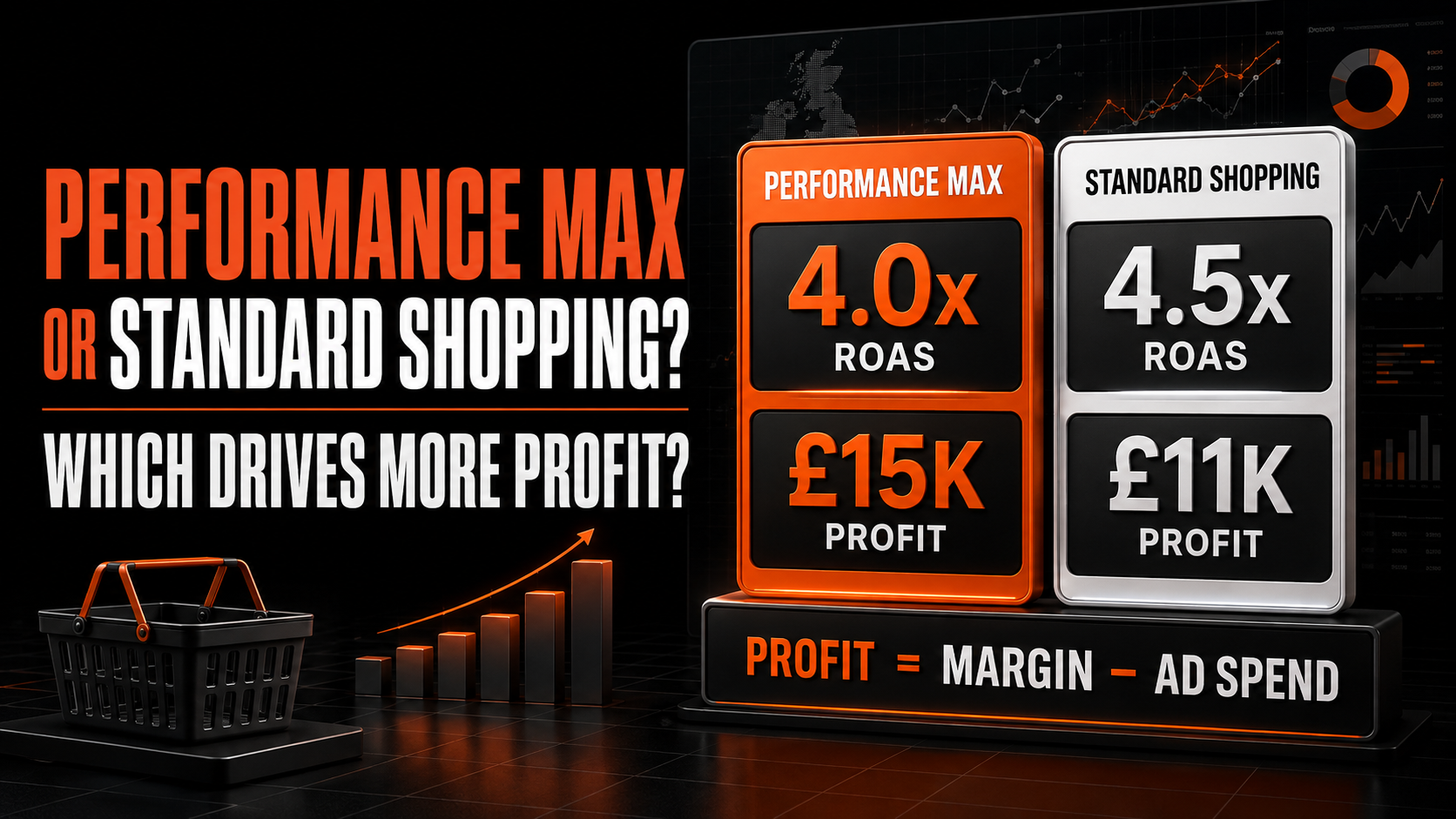
| Contribution after ads | £15,000 | £11,000 |
| New customers | 600 | 350 |
Standard Shopping appears to win on revenue and ROAS. Performance Max generates £4,000 more contribution after advertising and substantially more new customers because its product mix has a stronger margin.
Now reverse the assumptions. If PMax’s reported value is dominated by branded searches and returning customers who would probably have purchased anyway, its incremental profit may be lower than the table suggests.
The example shows why campaign type cannot be judged from one account column.
Compare new-customer acquisition
Performance Max is often used to find new demand, while Standard Shopping commonly captures shoppers already expressing product intent. That difference should be visible in the measurement framework.
Track:
- New-customer orders
- New-customer revenue
- New-customer acquisition cost
- First-order contribution
- Repeat-purchase rate
- Payback period
- Predicted and realised customer lifetime value
Google Ads provides customer-acquisition goals that can assign additional value to new customers or focus bidding towards them. These settings are useful only when customer status is accurately identified and the assigned value reflects actual economics.
A 3x campaign acquiring profitable new customers may be strategically stronger than a 5x campaign harvesting repeat purchases, provided the payback assumptions are grounded in observed retention rather than optimistic forecasts.
Brand demand can distort the comparison
Performance Max can serve in areas that overlap with branded demand. Standard Shopping can also capture branded product searches. Neither campaign type should automatically receive full strategic credit for every branded conversion.
Segment or test:
- Brand versus generic search demand
- New versus returning customers
- Existing-customer lists
- Branded products versus third-party brands
- Remarketing-heavy audiences
- Total store performance as paid activity changes
Brand exclusions, negative keywords and campaign structure can help shape delivery, but they do not turn attribution into causality.
If PMax reports an extra £100,000 of revenue while total store revenue remains broadly unchanged, it may have absorbed credit from other channels or captured existing intent. Conversely, if Standard Shopping looks efficient because it targets only brand-heavy product searches, it may not represent scalable customer acquisition.
Feed quality matters more than the campaign label
Both campaign types depend on Merchant Center product data.
Prioritise:
- Accurate product titles using meaningful attributes
- Correct GTIN, MPN and brand identifiers
- Specific Google product categories and product types
- High-quality primary and additional images
- Accurate price, sale price and availability
- Variant-level data
- Shipping and returns information
- Landing pages that match the feed
- Custom labels for margin, seasonality, stock and commercial priority
A retailer should be able to answer:
- Which products are eligible?
- Which products receive spend?
- Which products generate revenue?
- Which products generate contribution profit?
- Which products are returned?
- Which products acquire valuable customers?
If those questions cannot be answered, changing from Standard Shopping to PMax is unlikely to solve the underlying management problem.
Use product economics in campaign structure
Catalogue segmentation should reflect meaningful business differences rather than arbitrary website categories.
Useful dimensions include:
- Contribution-margin band
- Stock depth and replenishment reliability
- Bestseller or strategic-product status
- New, mature or clearance lifecycle
- Return-rate band
- Price band
- New-customer acquisition performance
- Seasonal demand
- Brand restrictions
For example, a retailer might use:
- Performance Max for high-stock, healthy-margin products with broad appeal and strong creative.
- Standard Shopping for low-margin branded goods requiring tight control.
- A separate PMax campaign for a strategic new range with a protected test budget.
- Exclusions for products that cannot sustain the minimum commercial return.
Avoid creating a campaign for every small category. Segmentation should create a genuine difference in budget, target, creative or commercial treatment.
Can Performance Max and Standard Shopping run together?
Yes, but the relationship needs to be planned.
When campaigns are eligible for the same impression, Google states that overlapping campaigns interact through the normal auction principles, including Ad Rank. Google Ads: How Performance Max interacts with other campaigns
Google also notes in migration guidance that running PMax and Shopping for the same products can leave Standard Shopping spending on some surfaces and may prevent PMax from optimising fully. Google Ads: Performance Max setup guidance
For a purposeful mixed structure:
- Use feed labels or listing/product exclusions to minimise accidental overlap.
- Assign distinct product sets or commercial roles.
- Keep conversion goals and value logic documented.
- Avoid assuming campaign-priority settings will create a clean PMax-versus-Standard hierarchy.
- Monitor product-level spend across both campaign types.
The objective is not to make two campaigns fight for identical inventory. It is to use each where its strengths solve a distinct commercial problem.
How to test Performance Max against Standard Shopping
Do not migrate an entire catalogue based solely on an industry case study or Google recommendation.
Define the decision metric
Choose the primary outcome before the test:
- Incremental contribution profit
- New-customer contribution profit
- Profit-adjusted conversion value
- Revenue at a defined minimum margin
- Customer acquisition at an acceptable payback
Platform ROAS can remain a supporting operational measure.
Choose a comparable scope
Possible designs include:
- Comparable product categories
- Matched geographic regions
- Staged catalogue cohorts
- A platform-supported campaign experiment where available
- A time-based switchback with careful seasonality controls
Avoid comparing PMax during peak season with Standard Shopping during a weaker trading period.
Hold commercial variables stable
Account for:
- Price and promotions
- Stock availability
- Product launches
- Website changes
- Delivery offers
- Competitor activity
- Creative changes
- Other paid-media spend
Allow sufficient conversion volume
The test needs enough purchases and time to absorb conversion delay and ordinary volatility. A seven-day comparison for a low-volume retailer is rarely sufficient for a strategic conclusion.
Reconcile attributed and store revenue
Compare Google Ads results with GA4, commerce-platform revenue, new-customer data, refunds and total store performance.
Judge marginal performance
If PMax spends more, assess the return on the additional spend rather than comparing only the two average ROAS figures.
How to interpret Google’s uplift claims
Google reports that advertisers moving from Standard Shopping to Performance Max achieved an average 25% increase in conversion value at a similar ROAS. Google Ads: Retail guidance
This is relevant evidence that PMax can unlock value at scale. It is not a guaranteed forecast for an individual retailer.
Before applying an aggregate result to a budget decision, ask:
- Were the advertisers comparable in catalogue, market and conversion volume?
- Was conversion value revenue or profit?
- How much came from new customers?
- Was the uplift incremental to the wider business?
- Did total revenue and contribution profit rise?
- Did branded or remarketing credit change?
- How were returns handled?
Use the claim as a rationale to test PMax—not as the business case by itself.
A practical decision framework
Score each condition according to the retailer’s current reality.
| Business condition | Lean towards PMax | Lean towards Standard Shopping |
| Reliable value and purchase tracking | Strong fit | Also suitable |
| Limited or unstable conversion data | Higher risk | Easier starting point |
| Need for broad cross-channel reach | Strong fit | Limited |
| Major margin variation by SKU | Requires careful segmentation/value inputs | Strong control use case |
| Need to diagnose product-search profitability | Possible with current reporting, but broader | Strong fit |
| Strong image and video assets | Strong fit | Less dependent |
| Feed-only creative resources | Constrains broader formats | Natural fit |
| Need to prioritise stock or product groups | Possible through structure and labels | Direct control |
| New-customer growth objective | Strong potential with correct settings | Can capture new demand but narrower reach |
| Concern about channel incrementality | Requires testing and reconciliation | Narrower, but still requires testing |
No single row should decide the account. The decision follows the combined economics, data maturity and growth objective.
A sensible structure for an established retailer
A commercially balanced account might use:
Performance Max growth portfolio
- Healthy-margin, well-stocked products
- High-quality creative assets
- Accurate purchase and customer values
- A profit-informed target
- New-customer settings where appropriate
- Brand exclusions when the objective is non-brand growth
Standard Shopping control portfolio
- Low-margin or price-sensitive products
- Products requiring distinct bids or budgets
- Categories being diagnosed
- Strategic inventory with explicit merchandising rules
- A narrower product-search benchmark
Search campaigns alongside both
Use keyword-based Search for priority queries, brand management, specific category intent and messages that require direct copy control. PMax is designed to complement Search rather than make keyword strategy irrelevant.
What to report each month
Platform performance
- Spend
- Impressions and clicks
- CPC
- Orders and conversion rate
- Conversion value
- ROAS
- Product and channel distribution
Commercial performance
- Settled revenue after refunds
- Pre-ad contribution margin
- Contribution profit after ads
- New-customer orders and CAC
- New-customer ROAS
- Return rate
- Payback period
- Repeat-purchase value
Incrementality and business impact
- Total-store revenue and profit
- Blended MER
- Brand versus non-brand demand
- Direct and organic movement
- Test-versus-control outcomes
- Marginal return from additional spend
Do not let the PMax-versus-Standard decision become a platform debate disconnected from the profit and loss account.
Questions marketing directors should ask
- What precise commercial role does each campaign play?
- Are we optimising towards revenue, margin or customer value?
- Which products receive spend, and what contribution margin do they generate?
- How much attributed revenue comes from brand demand?
- What proportion of orders comes from new customers?
- Are product values deduplicated and reconciled with the commerce platform?
- How are returns and cancellations reflected?
- Does PMax’s channel mix support the stated growth objective?
- Where does Standard Shopping control materially improve profit?
- What is the marginal return on additional budget?
- How will we test incrementality?
- What evidence would cause us to reallocate budget?
Common mistakes
Moving everything into Performance Max at once
A wholesale migration removes the ability to understand which products, structures or controls caused the change. Stage the transition and preserve a meaningful comparison where practical.
Treating Standard Shopping as obsolete
Standard Shopping remains useful where transparent product-group control supports a commercial purpose. Newer automation does not eliminate the need for merchandising discipline.
Using the same ROAS target for every product
Different margins and return rates create different break-even points. One target can overfund revenue-rich, profit-poor products.
Supplying poor creative to PMax
If a campaign is eligible across visual channels, weak assets can constrain reach or create a poor brand experience.
Over-segmenting PMax
Excessive campaign fragmentation can reduce the data available to each automated system. Separate campaigns only when the business will apply a genuinely different budget, goal, target or creative treatment.
Judging PMax only by attributed ROAS
Cross-channel reach, branded demand and remarketing can make platform results look stronger than the incremental business effect.
Ignoring the feed
Campaign settings cannot fully compensate for weak product titles, inaccurate stock, missing identifiers or poor imagery.
The recommendation
For a retailer with reliable tracking, strong feed data, sufficient conversion volume, healthy creative and a genuine growth objective, Performance Max should normally be tested as the scalable automated option.
For a retailer with sharp differences in product economics, limited data, a need for product-search diagnosis or strong requirements around stock and bidding control, Standard Shopping remains commercially valuable.
For many mature e-commerce businesses, the best structure is not a winner-takes-all decision:
- Use Performance Max for product sets where cross-channel automation can pursue incremental, profitable growth.
- Use Standard Shopping where the value of direct commercial control exceeds the value of broader automation.
- Use exclusions and feed labels to give each a distinct job.
- Judge both through contribution profit, customer acquisition and incrementality.
The question is not whether Performance Max is technically more advanced than Standard Shopping. It is whether the additional automation produces more profitable business outcomes than the control it replaces.
Frequently asked questions
Is Performance Max better than Standard Shopping?
Performance Max can be better for scalable, cross-channel growth when conversion data and creative are strong. Standard Shopping can be better when a retailer needs tighter product control and a clearer view of product-search economics.
Does Performance Max replace Standard Shopping?
No. Both campaign types remain available, and each can serve a different commercial purpose. Retailers should select them according to economics, data maturity and growth objectives.
Can Performance Max and Standard Shopping advertise the same products?
They can overlap, but doing so may make delivery and diagnosis harder. A purposeful mixed account normally gives each campaign a distinct product set or role using feed labels, listing groups and exclusions.
Which campaign normally has the better ROAS?
There is no universal winner. Standard Shopping may report a stronger ROAS when it concentrates on high-intent demand, while PMax may produce more total value through broader reach. Neither result proves greater incremental profit.
Is Performance Max suitable for a new e-commerce store?
It can be, but a new store often has limited conversion history, immature creative and uncertain product economics. Start with reliable tracking, a strong feed and controlled budgets; avoid expecting automation to manufacture evidence that does not yet exist.
How long should a Performance Max test run?
Long enough to accumulate meaningful conversion volume, account for conversion delay and cover normal demand variation. The appropriate period depends on the retailer’s sales cycle and volume; define it before launch rather than stopping the test after a few volatile days.
What should determine the ROAS target?
Use pre-ad contribution margin, fixed-profit requirements, new-customer value and acceptable payback. Do not copy a generic industry benchmark.
What matters more: campaign type or product feed?
The feed and conversion data are foundational to both. A strong campaign structure using poor product information and unreliable values will remain commercially weak.
Build a profitable Google Shopping strategy
If your team is unsure whether Performance Max or Standard Shopping should receive the next part of the e-commerce budget, Clubbish can help evaluate the decision using product-level economics, customer acquisition and incremental contribution—not platform ROAS alone.
Our outcome-driven approach connects Google Ads structure with feed quality, margin, stock, conversion data and wider store performance.
Book a strategy call to build a Google Shopping structure designed for profitable, measurable growth.