
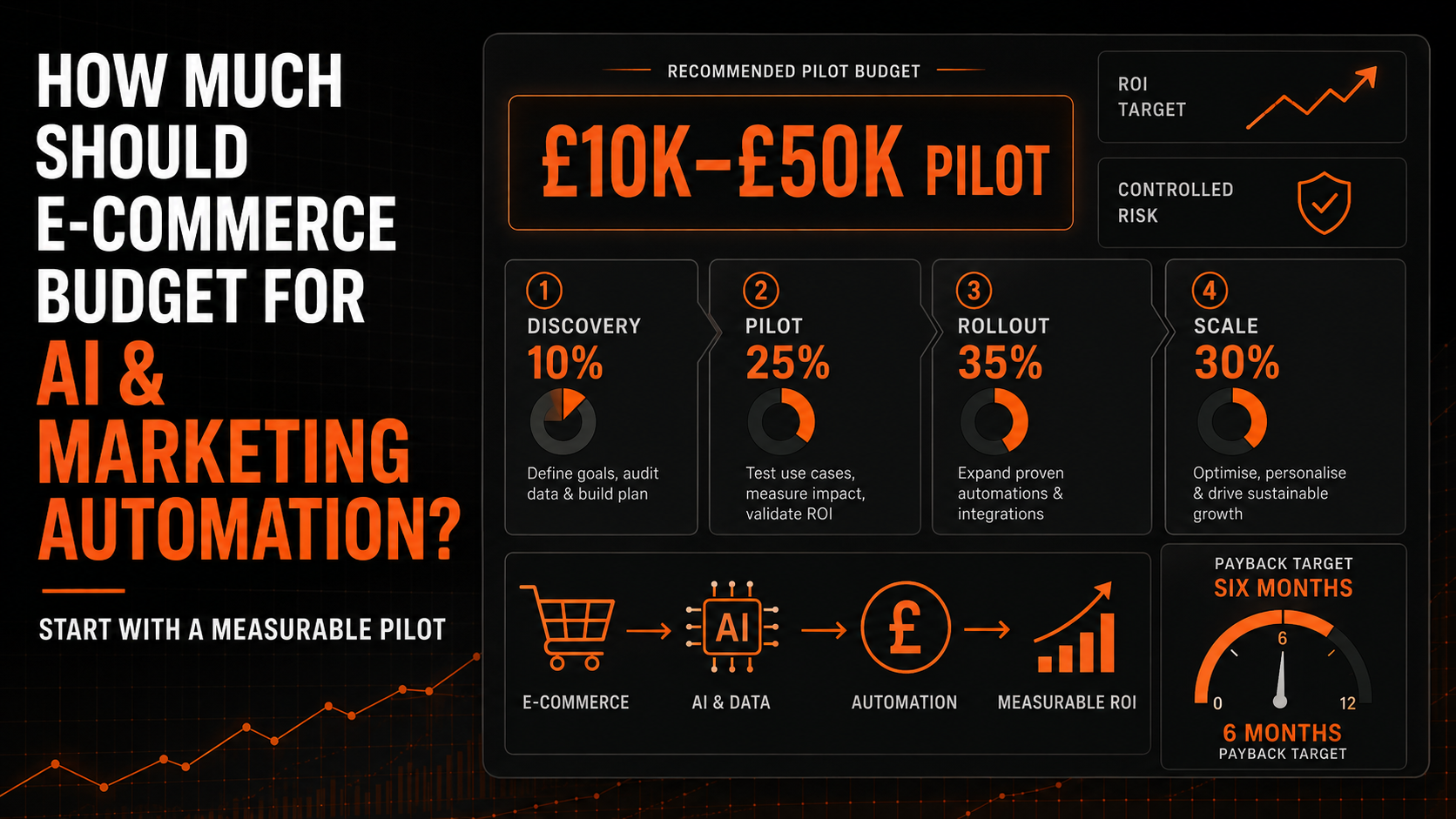
How much should an e-commerce business budget for AI and marketing automation? There is no universal percentage, but a sensible first investment is usually a focused £10,000–£50,000 pilot, or roughly 5–10% of the existing marketing-technology and automation budget, provided it is enough to test one commercially meaningful use case properly.
Growing retailers running several proven workflows may invest approximately £1,500–£7,500 per month, while established multi-channel businesses with customer-data, catalogue, personalisation and service requirements may spend £7,500–£30,000+ per month. These are planning ranges—not market benchmarks or automatic recommendations.
The right budget is the smallest investment capable of proving a valuable outcome and the largest amount the business can safely scale while the incremental contribution profit and verified cost savings remain above the full cost of ownership.
Do not set the budget from vendor pricing, competitor activity or a fashionable percentage of revenue. Set it from the use case, data readiness, implementation cost, risk, expected benefit and acceptable payback period.
The short answer
For most e-commerce businesses, use this sequence:
- Audit the process, data and commercial opportunity.
- Ring-fence a controlled pilot budget.
- Include software, implementation, people, governance and ongoing operation.
- Test one or two measurable use cases.
- Compare incremental contribution profit and verified savings with total cost.
- Release further budget only when predefined financial and risk thresholds are met.
A practical phased allocation is:
- 5–10% of the programme budget: Discovery and readiness.
- 20–30%: Controlled pilot.
- 30–40%: Rollout of the proven use case.
- Remaining budget: Scale and additional use cases after evidence is established.
This prevents a retailer from committing its entire annual budget to a platform before proving that the data, workflow and customer experience are ready.
Start with the business case—not the budget percentage
The budget should follow a documented commercial problem.
Weak case:
“We need to invest in AI because competitors are doing it.”
Stronger case:
“Automated customer-service triage will reduce repetitive contacts by 25%, release 40 staff hours per week and maintain customer satisfaction and complaint rates within agreed limits.”
Another stronger case:
“An automated win-back programme will create at least £6,000 of incremental monthly contribution profit, measured against a customer holdout, with payback within six months.”
Before discussing technology, define:
- The exact process being improved.
- Current time, cost, errors and performance.
- Expected incremental revenue or saving.
- The customer and operational risks.
- The data and integrations required.
- The implementation and running costs.
- The decision owner.
- The maximum acceptable payback period.
- The conditions for expansion or rollback.
If the leadership team cannot describe the business outcome clearly, it is too early to approve a substantial platform budget.
Practical budget ranges by business maturity
The following are useful planning guidelines for UK e-commerce businesses, not universal market averages.
| Business position | Typical scope | Indicative budget |
|---|---|---|
| Early exploration | Existing tools, reporting automation, one simple customer journey | £250–£1,500 per month |
| Focused commercial pilot | Discovery, integration and one measurable use case | £10,000–£50,000 total |
| Growing e-commerce business | Several workflows, CRM/email integration, feeds, reporting and review | £1,500–£7,500 per month |
| Established retailer | Customer data, catalogue, personalisation, service and multi-channel automation | £7,500–£30,000+ per month |
| Enterprise or complex multi-market business | Data infrastructure, governance, custom models, extensive integrations and dedicated team | £30,000+ per month |
These ranges may include technology and management but not necessarily major data engineering, custom development, internal salaries or media costs. A £500-per-month product can require £20,000 of integration and data preparation. A £10,000-per-month platform can still be poor value if the business cannot use most of its capability.
Business size is not the only determinant. Budget also depends on:
- Transaction and customer volume.
- Product-catalogue size.
- Number of markets and languages.
- Existing technology stack.
- Data quality and identity resolution.
- Margin and repeat-purchase economics.
- Internal technical capability.
- Customer and regulatory risk.
- Required response time and reliability.
- Degree of human review.
The same automation may be worth £5,000 to one retailer and £500,000 to another because the volume of eligible decisions and value of each improvement are different.
Should the budget be a percentage of revenue or marketing spend?
Percentages are useful as a sense check, but they should not drive the investment case.
Possible first-year planning ranges include:
- 0.1–0.5% of annual revenue for a focused programme where the business has limited prior automation.
- 5–10% of the existing marketing-technology and automation budget for initial exploration and a controlled pilot.
- A higher share of the technology budget only when several use cases are proven and the business has the people, data and governance to operate them.
Avoid treating 10%, 15% or any other number as a universal target. Gartner’s 2026 CMO Spend Survey reports that surveyed CMOs allocated 15.3% of their marketing budgets to AI, while only 30% said they were ready to scale AI capabilities. That is evidence of current investment pressure—not proof that 15.3% is appropriate for an individual e-commerce business. Gartner also reports total marketing budgets averaging 7.8% of company revenue in 2026. Gartner
Your own margins, volume, data readiness and opportunity cost are more important than a cross-industry average.
Build the total cost of ownership
Do not approve the budget from the software subscription alone.
Calculate:
Total first-year investment = Software + Implementation + Data + Integration + Training + Human review + Governance + Ongoing management + Contingency
Software and infrastructure
- Platform licence.
- User seats.
- API and model usage.
- Data storage and processing.
- Additional email or SMS charges.
- Cloud and integration tools.
- Testing and sandbox environments.
Implementation
- Process mapping.
- Workflow design.
- Data cleansing.
- Customer and order-data integration.
- Product-catalogue synchronisation.
- Tracking and event configuration.
- Prompt, rule and model configuration.
- Testing and quality assurance.
- Migration from existing tools.
People
- Internal project leadership.
- Technical and data resource.
- Marketing and merchandising time.
- Training.
- Human approvals and quality review.
- Customer-service involvement.
- Agency or consultancy support.
- Procurement and vendor management.
Governance and risk
- Privacy assessment.
- Security testing.
- Contract and legal review.
- Data Protection Impact Assessment where required.
- Documentation.
- Monitoring and incident response.
- Model or workflow evaluation.
- Accessibility and customer-experience review.
Failure and exit
- Error correction.
- Customer compensation.
- Incorrect discounts or refunds.
- Wasted media spend.
- Business interruption.
- Contract termination.
- Data export and migration.
- Replacement implementation.
Add a contingency of approximately 10–20% of implementation cost for an unfamiliar or integration-heavy project. The right allowance depends on uncertainty; it is not a rule that replaces proper scoping.
Budget by use-case complexity
Low-cost, high-measurability use cases
These are normally the best starting investments:
- Reporting and anomaly alerts.
- Product-feed checks.
- Stock-out advertising suppression.
- Basket and checkout recovery.
- Back-in-stock notifications.
- Review requests.
- Delivery and order-status responses.
- Customer-service classification and routing.
- Creative briefing and first drafts.
- Campaign naming, tagging and data collection.
They use stable triggers, can often be reversed and have clear metrics such as hours saved, errors prevented, incremental contribution profit or resolution cost.
Budget priority: fund first when the baseline is reliable and the opportunity is material.
Medium-investment use cases
These often require CRM, catalogue, customer-identity or data-warehouse integration:
- Replenishment journeys.
- Win-back programmes.
- Product recommendations.
- Customer segmentation.
- Personalised merchandising.
- Margin-informed product promotion.
- Automated audience creation.
- Customer propensity or churn scoring.
- Cross-sell and upsell programmes.
- Paid-media recommendations and approval workflows.
They need stronger consent, data quality, identity resolution and incremental testing.
Budget priority: fund after the foundation is proven.
High-investment and high-consequence systems
- Custom customer-data platforms.
- Real-time cross-channel personalisation.
- AI-driven budget allocation.
- Automated pricing and discount decisions.
- Demand and inventory forecasting.
- Agentic customer service.
- Multi-market orchestration.
- Custom recommendation or propensity models.
- Automated decisions affecting customer eligibility.
These may create substantial value, but implementation, monitoring and failure costs are higher. They should follow lower-risk pilots and require stronger governance, access controls and human oversight.
Budget priority: fund only when the commercial case, data and operating model are mature.
A recommended first-year budget structure
For a programme with a £100,000 first-year budget, a sensible starting structure might be:
| Investment area | Allocation | Purpose |
| Discovery and process audit | £8,000 | Prioritise opportunities and define requirements |
| Data and integration | £22,000 | Create reliable customer, product and performance inputs |
| Technology and usage | £20,000 | Licences, APIs and infrastructure |
| Pilot implementation | £20,000 | Configure and test one or two use cases |
| People and training | £10,000 | Ownership, adoption and quality review |
| Governance and security | £8,000 | Privacy, contracts, testing and controls |
| Measurement and experimentation | £7,000 | Baselines, holdouts and commercial reporting |
| Contingency | £5,000 | Limited allowance for unexpected work |
| Total | £100,000 |
This is an example, not a template to copy blindly. A retailer with strong data but no internal implementation capacity may spend more on delivery. A business handling sensitive customer decisions may need more governance. A simple rules-based programme may require much less technology.
The important point is that the platform licence receives only part of the budget. Data, people, measurement and control determine whether the platform creates value.
Protect the budget with stage gates
Release investment in stages rather than signing off the entire amount at once.
| Stage | Share of programme | Evidence required to continue |
| Discovery | 5–10% | Valuable process, realistic benefit and feasible data |
| Pilot | 20–30% | Working system, reliable measurement and acceptable quality |
| Controlled rollout | 30–40% | Positive incremental economics and stable guardrails |
| Scale | Remaining budget | Marginal benefit remains above marginal cost |
At each gate, leadership should decide:
- Proceed.
- Proceed with changed scope.
- Pause and repair readiness gaps.
- Stop and reallocate the remaining budget.
This protects the company from sunk-cost thinking. Spending £20,000 on a weak pilot is not a reason to commit the remaining £80,000.
Balance proven automation and experimentation
Once a business has several established workflows, divide ongoing funding into:
- 70% proven automation: Reliable workflows producing established value.
- 20% optimisation: Better integrations, data, customer segments and conversion.
- 10% experiments: New AI capabilities, vendors and higher-uncertainty use cases.
This 70/20/10 model is a planning framework, not a universal benchmark. A cautious retailer may use 85/10/5. A digitally mature business with strong experimentation capability may use 60/25/15.
The principle is to protect proven commercial value while preserving enough budget to learn.
Use ROI and payback to set the budget ceiling
Calculate:
Automation ROI = (Incremental contribution profit + Verified cost savings − Total investment) ÷ Total investment × 100
And:
Payback period = Initial implementation cost ÷ Average monthly incremental profit and verified savings
The budget ceiling should reflect:
- The minimum required ROI.
- Maximum payback period.
- Confidence in the expected benefit.
- Cash-flow constraints.
- Contract duration.
- Technology and vendor risk.
- Alternative uses of capital.
If a system costs £3,000 per month, the business might require at least £6,000 of verified monthly benefit to generate a 100% operating ROI before implementation costs. Whether that is sufficient depends on the capital cost, risk and next-best investment opportunity.
Worked example: a £2 million e-commerce business
Suppose a retailer generates £2 million in annual revenue and spends £300,000 on marketing. It is considering an automated retention and customer-service programme.
First-year cost
| Cost | Amount |
| Software | £14,400 |
| Implementation and integration | £12,000 |
| Training and governance | £4,000 |
| Ongoing human review | £9,600 |
| Additional monitoring and creative | £5,000 |
| Total first-year investment | £45,000 |
The pilot estimates:
- £45,000 of incremental contribution profit.
- £12,000 of verified customer-service saving.
Therefore:
Total measurable benefit = £45,000 + £12,000 = £57,000
Net first-year benefit = £57,000 − £45,000 = £12,000
First-year ROI = £12,000 ÷ £45,000 × 100 = 26.7%
Benefit-to-cost ratio = £57,000 ÷ £45,000 = 1.27
The project may justify controlled expansion if its payback, customer experience, quality and data-protection outcomes remain acceptable. It should not automatically receive more budget solely because the ROI is positive; leadership should compare the marginal return on expansion with other opportunities.
Worked example: a smaller £20,000 pilot
A growing retailer tests reporting automation, feed monitoring and one win-back journey.
Cost
- Software and API usage: £4,000.
- Integration and configuration: £7,000.
- Internal time and training: £4,000.
- Measurement and monitoring: £3,000.
- Contingency: £2,000.
- Total: £20,000.
Result
- Incremental contribution profit: £16,000.
- Verified operational saving: £11,000.
- Total benefit: £27,000.
- Net benefit: £7,000.
- ROI: 35%.
If the quality guardrails pass, the next budget should be tied to a clear expansion hypothesis—for example, applying the same proven journey to another customer segment—rather than a general instruction to “do more AI.”
Account for internal people even when no invoice exists
Internal resource is still an investment.
Include time from:
- Marketing leadership.
- E-commerce management.
- CRM and lifecycle marketing.
- Analytics.
- Development and IT.
- Data protection and security.
- Customer service.
- Merchandising.
- Finance and procurement.
A six-month project that consumes substantial leadership and development capacity may delay other profitable work. Include that opportunity cost in the decision, even if it does not appear as an external payment.
Do not assume AI removes people from the process. Early systems often increase review, correction and training work before they reduce it.
Budget for measurement
A business cannot prove ROI if it allocates everything to technology and nothing to evaluation.
Ring-fence approximately 5–10% of the programme budget for:
- Baseline collection.
- Event and revenue reconciliation.
- Holdout or control design.
- Dashboard and cohort reporting.
- Incrementality analysis.
- Quality testing.
- Risk and incident monitoring.
The exact percentage depends on scale and complexity. Measurement may cost more for multi-market personalisation than for a simple reporting workflow.
Every pilot should have:
- A primary financial measure.
- Customer and quality guardrails.
- A credible comparison group or baseline.
- A defined test period.
- Minimum data requirements.
- A named owner.
- A rollback plan.
NIST’s AI Risk Management Framework recommends measuring system performance under conditions similar to deployment and monitoring behaviour once the system is in production. NIST
Budget for governance and risk
Governance is part of the operating cost, not an optional legal add-on.
The required budget grows when a system:
- Uses large volumes of personal data.
- Profiles customers.
- Makes high-impact decisions.
- Publishes customer-facing claims.
- Changes prices, discounts or budgets.
- Connects to many internal systems.
- Uses multiple external vendors or models.
- Operates across countries.
- Has a high cost of error.
Budget for privacy, security, human oversight, documentation, model or workflow monitoring and incident response.
The ICO’s AI and data-protection risk toolkit is designed to help organisations reduce risks to individuals’ rights and freedoms. ICO
The UK government’s AI procurement guidance also recommends placing procurement within a wider AI-adoption strategy rather than treating the purchase as an isolated tool decision. UK Government
Avoid vendor lock-in and uncontrolled usage costs
Before signing, clarify:
- Minimum contract and renewal terms.
- Usage caps and overage prices.
- Price changes as volume grows.
- Access to data and configuration.
- Export formats.
- Ownership of prompts, workflows and outputs.
- Use of customer data for vendor training.
- Model or sub-processor changes.
- Support and service levels.
- Exit assistance and deletion.
Model and API costs can grow with message volume, product count, tokens, users or automated actions. Build three scenarios:
- Base usage.
- Expected growth.
- Peak or promotional demand.
An inexpensive pilot can become an expensive production system when volume increases. The budget should show the unit cost at each scale.
When should the budget increase?
Release more investment when the pilot demonstrates:
- Incremental contribution profit.
- Verified cost reduction or productive capacity.
- Acceptable payback.
- Reliable data and output quality.
- Stable customer outcomes.
- No material increase in complaints, refunds or opt-outs.
- Effective human oversight and rollback.
- A scalable operating model.
- Positive marginal economics for the next stage.
The next budget should fund a defined hypothesis. For example:
“An additional £25,000 will expand the proven replenishment programme into two categories expected to generate £45,000 of incremental contribution profit within 12 months.”
That is better than increasing the budget because adoption is high or a platform dashboard reports more attributed revenue.
When should the business pause or reduce investment?
Do not expand when:
- The baseline is unclear.
- Benefits are attributed rather than incremental.
- Data is incomplete or inaccurate.
- The vendor cannot explain how customer data is used.
- Human review exceeds the expected saving.
- The system increases complaints, refunds or unsubscribes.
- Outputs or recommendations are unreliable.
- Costs rise sharply with volume.
- The business cannot export its data and configuration.
- No one owns ongoing monitoring.
- The project is driven by fear of missing out.
Stopping a weak use case is a successful governance decision. Reallocate the remaining budget towards a better-measured opportunity.
A practical 12-month funding plan
Months 1–2: audit and prioritise
- Map processes, cost and commercial opportunities.
- Assess data, technology and governance readiness.
- Select one or two use cases.
- Define costs, thresholds and measurement.
- Shortlist vendors only after requirements are clear.
Months 3–5: controlled pilot
- Configure the minimum viable workflow.
- Protect a control or holdout group.
- Test normal and failure scenarios.
- Record human review and correction time.
- Monitor customer and risk guardrails.
Months 6–8: evaluate and improve
- Calculate incremental contribution profit.
- Verify cost savings.
- Reconcile all programme costs.
- Improve data, rules and integrations.
- Decide whether to scale, maintain or stop.
Months 9–12: controlled rollout
- Expand only proven workflows.
- Track marginal ROI as volume grows.
- Retain experiment funding for one new use case.
- Review contracts, usage and ownership.
- Set the next annual budget from evidence.
Budget approval checklist
Before approving investment, confirm:
- The business problem is commercially material.
- A baseline exists.
- The full first-year cost is documented.
- Internal people and opportunity costs are included.
- The expected benefit is incremental and margin-adjusted.
- The payback period is acceptable.
- Measurement and governance have dedicated funding.
- Data, privacy and security requirements are understood.
- The vendor’s scaling and exit costs are clear.
- Stage gates and rollback conditions are agreed.
- A named owner is accountable.
- The next-best use of the budget has been considered.
Frequently asked questions
Is £10,000 enough for an AI and automation pilot?
It can be enough for a focused workflow using existing systems, such as reporting, feed alerts or one customer journey. It is unlikely to fund a custom data platform, extensive integration or high-risk autonomous system. Scope must match the budget.
Should AI be funded from the marketing or technology budget?
Often both. Marketing should own the commercial outcome, while technology, data, security and governance costs may sit elsewhere. Create one consolidated business case so costs are not hidden across departments.
Should media spend be included?
Include any incremental media or message cost required by the automation. Keep core advertising spend separate where it would have occurred anyway, but include changes directly caused by the system when calculating incremental profit.
How much should be reserved for ongoing management?
The amount depends on complexity and risk. Budget for monitoring, human review, updates, vendor management and incident response rather than assuming the system will run unattended.
Is a large enterprise platform better value than several smaller tools?
Not automatically. A larger platform may reduce integration complexity, while smaller tools can provide focus and flexibility. Compare total ownership cost, capability used, data portability and measurable commercial return.
How often should the budget be reviewed?
Review spend and risk monthly, make stage-gate decisions after each pilot or rollout phase, and rebuild the annual budget from demonstrated marginal returns rather than automatically renewing the previous allocation.
The practical answer
For most e-commerce businesses, the starting budget for AI and marketing automation should be a focused £10,000–£50,000 pilot or around 5–10% of the existing marketing-technology and automation budget—provided that amount is sufficient to test a meaningful use case with proper data, measurement and controls.
Do not spend the entire budget on licences. Fund process discovery, data, integration, people, training, measurement, privacy, security, monitoring and exit planning.
Increase investment only when the pilot produces incremental contribution profit or verified savings, achieves an acceptable payback and remains within customer and risk guardrails. The correct ceiling is the point where the next pound invested no longer creates enough risk-adjusted incremental value compared with the next-best use of capital.
Book a Strategy Call
If you are deciding how much your e-commerce business should invest in AI and marketing automation, Clubbish can audit your processes, data, technology stack and commercial opportunities—then build a phased budget and implementation roadmap focused on measurable incremental profit.