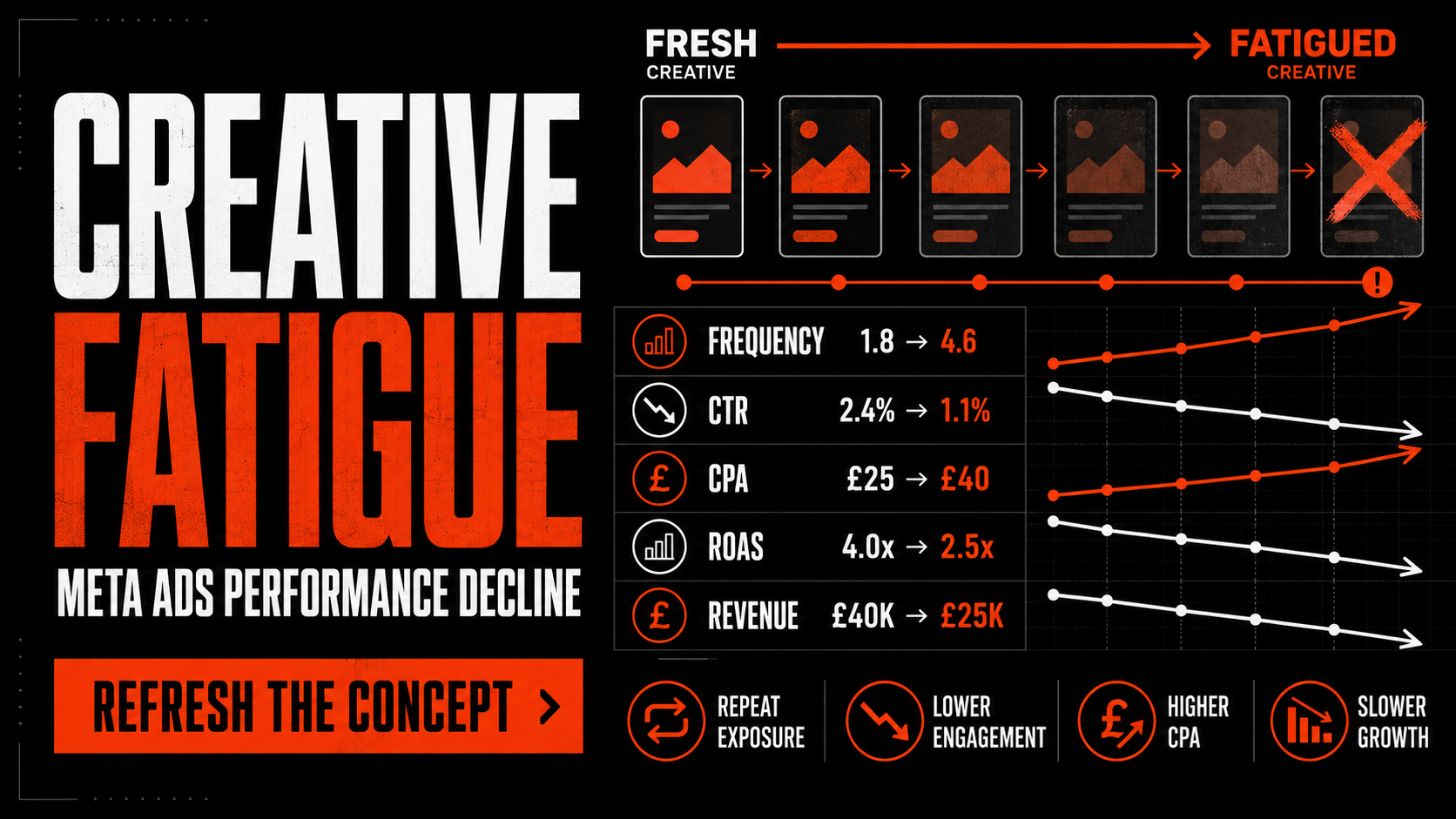
How does creative fatigue affect Meta Ads CPA, ROAS and revenue growth? When customers repeatedly see the same advertising, they can become less likely to notice, engage with or act on it. As responsiveness weakens, click-through rate and conversion rate may fall, CPA can rise, ROAS can decline and revenue growth can stall—even when targeting and budget appear unchanged.
Creative fatigue is not simply an advert becoming old. It is a measurable deterioration caused by the interaction between creative relevance, repeated exposure, audience size, delivery speed, offer strength and customer intent.
The commercial risk is significant. A brand can interpret the rising CPA as an audience or bidding problem, make unnecessary campaign changes and increase budget against the same tired message. The correct response is to identify whether the decline is genuinely creative-specific, introduce meaningfully different concepts and measure whether the refreshed activity restores incremental contribution profit.
What does Meta Ads creative fatigue mean?
Meta describes creative fatigue as occurring when an audience has seen the same creative too many times. However, repetition alone does not establish fatigue. Frequency must be interpreted alongside changes in engagement, conversion and commercial performance.
Creative fatigue results from the interaction between:
- Repeated exposure.
- Audience size and available reach.
- Budget and delivery speed.
- Creative relevance and distinctiveness.
- Offer strength.
- Campaign objective.
- Product demand and seasonality.
- Customer intent and stage of awareness.
A frequency level that is healthy for a small retargeting audience may be inefficient for cold prospecting. Likewise, a broad audience receiving several distinct creative concepts may support far more spend than a narrow audience repeatedly shown one advert.
The central question is not, “How old is this ad?” It is, “Is this creative still generating sufficient profitable response from the customers receiving it?”
The performance chain from fatigue to slower growth
Creative fatigue can produce a commercial chain reaction:
Repeated exposure → weaker attention → lower engagement → more expensive traffic → lower conversion rate → higher CPA → lower ROAS → slower revenue growth
Not every campaign follows every step. CPM may remain stable while CTR falls, or CTR may remain high while the website conversion rate weakens because the creative attracts curiosity rather than qualified demand.
The value comes from understanding where the deterioration begins.
How creative fatigue increases CPA
CPA measures the amount spent to generate each conversion:
CPA = Ad spend ÷ purchases
Suppose a campaign spends £10,000 and generates 400 purchases:
£10,000 ÷ 400 purchases = £25 CPA
After sustained exposure, spend remains £10,000 but purchases fall to 250:
£10,000 ÷ 250 purchases = £40 CPA
CPA has increased by 60%.
This can happen through several mechanisms:
- Fewer people stop to engage with the advert.
- Fewer impressions produce a click.
- Meta needs more impressions to generate the same traffic.
- The clicks come from less responsive users.
- The message no longer creates sufficient purchase intent.
- The remaining responsive customers become more expensive to reach.
Meta may also face weaker auction competitiveness when an advert generates poorer expected engagement or conversion outcomes. However, rising CPA is not proof of fatigue. Auction competition, product availability, a weaker offer, website problems, seasonality and tracking errors can produce the same headline result.
How creative fatigue reduces ROAS
ROAS is calculated as:
ROAS = Attributed revenue ÷ ad spend
If purchase volume falls while spend remains stable, revenue is likely to decline relative to cost.
| Period | Spend | Purchases | CPA | Revenue | ROAS |
|---|---|---|---|---|---|
| Before fatigue | £10,000 | 400 | £25 | £40,000 | 4.0x |
| After fatigue | £10,000 | 250 | £40 | £25,000 | 2.5x |
The campaign has lost £15,000 of attributed revenue at the same budget. If the business responds by increasing spend, delivery may generate even more repetition or expand into less responsive demand, accelerating the decline.
ROAS can also fall because the customer and product mix changes. A tired advert may continue attracting returning customers familiar with the brand while failing to acquire new customers. Alternatively, Meta may shift delivery towards products with lower average order value or weaker margins.
This is why creative-level ROAS should be reviewed alongside new-customer share, product margin, contribution profit and total-store performance.
How creative fatigue constrains revenue growth
Revenue growth requires the advertising to continue finding or creating qualified demand. Fatigued creative reduces the amount of valuable response available from each additional impression.
The result can look like this:
| Stage | Meta spend | Revenue | Average ROAS | Marginal outcome |
| Stable creative | £20,000 | £80,000 | 4.0x | Profitable growth |
| Early fatigue | £25,000 | £90,000 | 3.6x | Next £5,000 produces £10,000 |
| Severe fatigue | £30,000 | £92,000 | 3.07x | Next £5,000 produces only £2,000 |
The account’s average ROAS may still appear viable, but the marginal return has collapsed.
Marginal ROAS = Additional revenue ÷ additional spend
For the final increase:
£2,000 additional revenue ÷ £5,000 additional spend = 0.4x marginal ROAS
The problem is not merely that one advert has become less efficient. The campaign has lost its capacity to turn additional investment into profitable revenue.
To understand how creative fatigue affects Meta Ads CPA, ROAS and revenue growth, monitor the relationship between exposure, engagement, conversion and marginal profit—not each metric in isolation.
Frequency is a warning signal, not a universal rule
Meta defines frequency as the average number of times an audience was shown an advert. It is calculated as:
Frequency = Impressions ÷ reach
If a campaign delivers 500,000 impressions to 200,000 people:
500,000 impressions ÷ 200,000 people reached = 2.5 frequency
There is no universal rule that an advert must be paused at frequency three, four or any other fixed number. The same frequency can produce very different outcomes depending on:
- Whether the audience is prospecting or retargeting.
- The period over which frequency is measured.
- Purchase frequency and consideration time.
- Creative variety within the campaign.
- Product price and customer familiarity.
- Whether response metrics remain commercially healthy.
A frequency of four with stable contribution profit can be healthier than a frequency of two with a collapsing conversion rate.
Directional review ranges
These are diagnostic prompts, not automatic rules:
- Cold prospecting: Investigate when frequency rises while CTR, conversion rate or new-customer CPA deteriorates.
- Warm audiences: Higher repetition may be acceptable because customers have prior awareness or intent.
- Retargeting: Frequency can be materially higher, but incremental value and contribution profit should determine whether repetition remains worthwhile.
- Narrow high-spend audiences: Fatigue may appear quickly because available reach is limited.
- Broad audiences with diverse creative: Greater spend may be sustainable if the concept mix remains relevant.
Always specify the reporting window. A weekly frequency of three is different from a frequency of three accumulated across three months.
Meta’s creative-fatigue status may appear late
Meta provides creative-fatigue recommendations in Ads Manager. Its current guidance states that a Creative fatigue status can appear when cost per result reaches at least twice that of adverts run in the past.
That threshold represents severe deterioration rather than an ideal early-warning point. A business should not wait for CPA to double before responding.
Monitor the combined trend:
- Frequency rising.
- CTR falling.
- CPC increasing.
- Website conversion rate falling.
- CPA rising.
- ROAS and contribution profit declining.
Meta’s diagnostic is useful confirmation, but the brand’s own baseline and profit threshold should trigger action earlier.
The warning signals to monitor
| Signal | What it could indicate | What to check next |
| Frequency rising | The same audience is receiving more exposure | Audience size, spend growth and concept variety |
| CTR falling | The hook or message is losing attention | First frame, headline, format and audience relevance |
| CPM rising | Auction pressure or weaker expected performance | Competition, relevance and placement mix |
| CPC rising | Each visit is becoming more expensive | CTR, CPM and click quality |
| Landing-page view rate falling | Slow pages or low-quality clicks | Page speed, accidental clicks and placement |
| Conversion rate falling | Reduced purchase intent or a website issue | Offer, stock, price, checkout and traffic quality |
| CPA rising | More spend is required per order | Funnel stage causing the deterioration |
| ROAS falling | Revenue is declining relative to cost | AOV, product mix and purchase volume |
| New-customer share falling | Delivery may be harvesting existing demand | Prospecting structure and customer exclusions |
| Revenue flattening | Additional impressions are no longer creating growth | Marginal ROAS and total-store results |
The most convincing pattern is sequential: frequency rises first, engagement then weakens and CPA subsequently increases. If frequency is stable but conversion rate suddenly falls across every creative, the website, offer or demand may be the more likely cause.
Diagnose creative fatigue correctly
Compare each creative with its own baseline
Audience, product, format and offer economics vary. Compare the advert’s recent performance with its earlier stable period using consistent attribution and reporting windows.
Review:
- Spend and impressions.
- Reach and frequency.
- CPM, CTR and CPC.
- Landing-page views.
- Website conversion rate.
- Purchases, CPA and ROAS.
- New-customer CPA.
- Contribution profit.
Do not compare a broad prospecting video directly with a product retargeting carousel and call the difference fatigue. Their roles and natural response rates differ.
Compare tired and fresh creative in the same conditions
If one older concept deteriorates while a new concept remains healthy in the same audience and period, fatigue becomes more likely.
Meta offers A/B testing to compare advertising strategies while changing variables such as creative, text, audience or placement. Where volume supports it, use a controlled creative test instead of launching an unstructured mix and attributing every improvement to the newest advert.
Check whether the decline is creative-specific
Ask:
- Did only one advert decline?
- Did all adverts with the same hook decline?
- Did every campaign decline simultaneously?
- Did the change begin after a budget increase?
- Did a promotion end or a competitor launch an offer?
- Did stock, price or delivery change?
- Did the checkout or tracking implementation change?
If every creative weakens at the same time, investigate broader causes before rebuilding the entire creative programme.
Rule out the problems that look like fatigue
Auction competition
Seasonal peaks, competitors and market demand can raise CPM across the account. If frequency and CTR are stable while CPM rises, the auction may explain more of the CPA increase than fatigue.
Website and checkout issues
A slow mobile page, broken product selector, unavailable bestseller or payment failure can reduce conversion rate for all adverts. Check landing-page and checkout performance by device.
Offer fatigue
Customers may have seen the same promotion, price or proposition repeatedly. Changing the video without changing the commercial reason to buy may not restore response.
Product and stock mix
If bestsellers go out of stock, Meta may send customers to weaker products. The creative can remain engaging while revenue and ROAS decline.
Tracking errors
Missing or duplicated Purchase events can create false performance changes. Verify Meta Pixel and Conversions API values, currency, event IDs and deduplication.
Budget-driven audience expansion
A substantial budget increase can push delivery into more marginal demand. The timing may resemble fatigue even when the advert’s response within its original audience remains stable.
Refresh the concept—not just the file
Changing a background colour, caption or button may produce a technically new asset without giving customers a new reason to pay attention.
Meaningful creative diversification can test a different:
- Customer problem.
- Desired outcome.
- Product use case.
- Opening hook.
- Demonstration.
- Objection.
- Proof point.
- Customer story.
- Offer or bundle.
- Creator or presenter.
- Visual format.
- Level of customer awareness.
For example, a skincare brand might move from “20% off today” to:
- A product-demonstration concept.
- A dermatologist or expert explanation.
- A customer transformation story.
- A routine-comparison advert.
- An objection-led message about sensitive skin.
- A value-led bundle rather than a discount.
Each concept reaches a different motivation. That creates more potential demand than several cosmetic edits to the same sale advert.
Build a continuous creative pipeline
Do not wait for every winning advert to collapse before producing replacements. By the time Meta shows a formal fatigue warning, the account may already have lost meaningful profit.
A practical pipeline includes:
- Research: Collect customer reviews, objections, support questions, search queries and sales insight.
- Concept development: Turn those insights into distinct hooks and commercial hypotheses.
- Production: Create assets suited to feed, Stories, Reels and other relevant placements.
- Testing: Give each concept enough spend and time to be evaluated.
- Promotion: Move proven concepts into scalable activity without unnecessary editing.
- Iteration: Build new hooks, proof and formats from what worked.
- Retirement or recovery: Pause persistent losers and retain learnings for future seasonal reuse.
Track creative by concept rather than file name alone. If five assets express the same message, the team should be able to assess whether the overall concept is tiring.
Suggested creative scorecard
| Area | Metric |
| Attention | Three-second views, hook rate or thumb-stop proxy |
| Engagement | Link CTR and relevant engagement |
| Traffic quality | Landing-page views and cost per landing-page view |
| Conversion | Purchase conversion rate and CPA |
| Commercial value | AOV, new-customer CPA and contribution profit |
| Saturation | Reach, frequency and audience penetration |
| Scale | Spend and marginal contribution as delivery increases |
Use metrics appropriate to the format and objective. A video-view metric does not replace purchase profitability.
Expand audiences carefully
If a small audience is receiving intense repetition, broader delivery can create additional reach. Test:
- Broader prospecting.
- Adjacent customer needs.
- New geographic areas.
- Different product categories.
- New-customer activity separated from retention.
- Additional placements with properly adapted assets.
Meta warns that low audience size can contribute to higher cost per result or fewer optimisation results. However, audience expansion can also reduce traffic quality. Judge it using new-customer CPA and contribution profit.
Do not simply increase budget against the same narrow audience. That can accelerate repetition before it creates meaningful new demand.
Adapt creative to placements
One asset does not always work equally well in every environment. Meta allows creative to be customised across placements, and its flexible-media tools are designed to diversify assets and connect versions with relevant audiences.
Consider:
- Vertical video for Stories and Reels.
- Clear product recognition in the opening frames.
- Safe text placement around interface elements.
- Captions or visual communication without sound.
- Feed imagery that remains understandable at a glance.
- Landing-page continuity with the creative promise.
Automation can help distribute variations, but it does not replace the need for genuinely different commercial concepts.
Improve the offer and landing page
Sometimes creative fatigue is partly offer fatigue. Customers may understand the advert perfectly but no longer find the reason to buy compelling.
Test:
- Bundles and multipacks.
- Free-delivery thresholds.
- Credible time-limited promotions.
- Payment options.
- Guarantees and returns reassurance.
- Product comparisons.
- Reviews and customer evidence.
- Category- or use-case-specific landing pages.
- Upsells and complementary products.
The advert and landing page must make a consistent promise. High CTR with weak purchase conversion may indicate that the advert generates attention without enough qualified intent—or that the site fails to fulfil the expectation.
Measure the commercial effect of fresh creative
A new advert is not successful merely because CTR improves. Measure whether it restores profitable growth.
Track:
- CPA by concept.
- New-customer CPA.
- Attributed and marginal ROAS.
- Average order value.
- Contribution profit after advertising.
- Return and refund rate.
- Incremental revenue and profit.
- Total-store revenue and blended MER.
A fresh prospecting concept might report lower ROAS than a tired retargeting advert but create more new customers and greater incremental contribution profit.
Contribution profit = Revenue − cost of goods − fulfilment − payment fees − discounts − returns − ad spend
Use Meta reporting to optimise creative within the platform, then validate business impact using store revenue, customer-level data and controlled testing where investment is material.
A 30-day creative-fatigue recovery plan
Week 1: Diagnose
- Establish the stable baseline for frequency, CTR, CPA, ROAS and conversion rate.
- Separate prospecting, retargeting and existing-customer activity.
- Check stock, offer, website, auction and tracking changes.
- Group assets by creative concept.
Week 2: Produce meaningful challengers
- Select three to five distinct customer insights.
- Create materially different hooks, proof and formats.
- Adapt assets for relevant placements.
- Keep current profitable winners live.
Week 3: Test
- Use controlled budgets and consistent audiences.
- Avoid simultaneous targeting, bidding and landing-page changes.
- Allow enough purchases to interpret performance.
- Compare both attention metrics and commercial outcomes.
Week 4: Scale and document
- Promote concepts that meet CPA and contribution targets.
- Retire persistent underperformers.
- Record the customer problem, hook, format and outcome.
- Schedule the next wave before the new winners fatigue.
The purpose is not a one-off rescue. It is to establish a repeatable supply of qualified demand.
Common creative-fatigue mistakes
- Pausing every advert at a fixed frequency.
- Waiting for Meta’s formal fatigue status before acting.
- Changing colours and calling it a new concept.
- Replacing all winning creative simultaneously.
- Judging new creative on CTR without purchase economics.
- Increasing budget into an already saturated audience.
- Ignoring offer, stock and website problems.
- Comparing prospecting and retargeting with the same ROAS expectation.
- Producing too many variations without enough spend to test them.
- Treating Meta-attributed revenue as incremental profit.
Frequently asked questions
What is a good frequency for Meta Ads?
There is no universal good frequency. It depends on the audience, reporting period, objective, product and creative variety. Investigate when rising frequency coincides with weaker engagement, conversion and profit.
How do you know whether an advert is fatigued?
Compare the advert with its earlier baseline. Fatigue is more likely when frequency rises before CTR or conversion rate falls and CPA increases, particularly when fresh creative remains healthy in the same conditions.
Should you pause a fatigued advert immediately?
Pause or reduce it when deterioration is persistent and commercially material, but avoid reacting to one poor day. Introduce tested replacements so the campaign is not left without proven creative.
How often should Meta Ads creative be refreshed?
Use performance signals rather than a fixed calendar. Higher-spend campaigns and narrow audiences may require more frequent new concepts. Maintain a continuous pipeline so replacements are available before performance fails.
Can a new creative reset frequency?
A new asset can provide a fresh message, but audience-level exposure still matters. Cosmetic variants may not restore attention if the concept and offer remain unchanged. Broader reach or meaningfully different creative may also be required.
Does creative fatigue affect retargeting?
Yes. Retargeting audiences are often smaller and can receive high repetition quickly. They may tolerate greater frequency because intent is higher, but incremental value and contribution profit should determine whether continued exposure is worthwhile.
The practical answer
Creative fatigue affects Meta Ads CPA, ROAS and revenue growth by weakening the response generated from each impression. As customers repeatedly encounter the same message, engagement and conversion can decline, increasing acquisition costs and reducing the campaign’s capacity to turn additional spend into revenue.
Do not diagnose fatigue from frequency alone. Monitor frequency alongside CTR, CPM, website conversion rate, CPA, new-customer acquisition and contribution profit. Rule out auction, tracking, product and website issues; then introduce genuinely different concepts before deterioration becomes severe.
Sustainable Meta growth requires a continuous supply of relevant creative—not permanent dependence on yesterday’s winning advert.
Book a Strategy Call
If creative fatigue is increasing your Meta Ads CPA or limiting revenue growth, Clubbish can audit your creative performance, audience saturation, tracking and commercial returns—then build a testing pipeline designed to generate profitable new demand.