
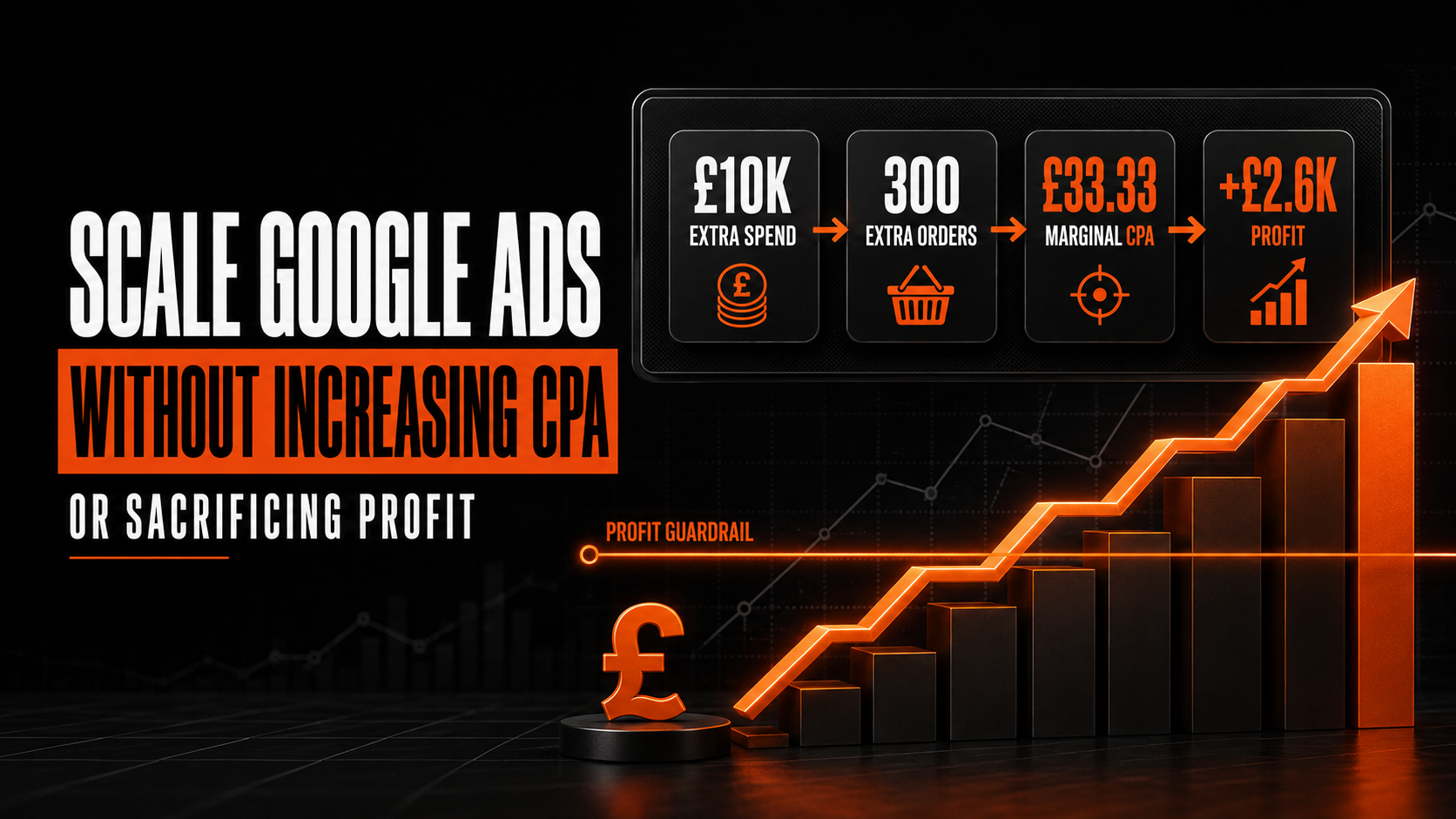
You can scale Google Ads without increasing CPA or sacrificing profit only while additional qualified demand is available at your required economics.
The objective is not to force more budget through the same campaigns. It is to increase the amount of profitable demand the account can reach, improve conversion rate and order value, give Google better commercial signals, and spend more only where the next pound invested produces sufficient incremental contribution profit.
There is no technique that guarantees unlimited growth at a fixed CPA. As a campaign moves beyond the most efficient customers and auctions, diminishing returns are normal. The practical goal is to delay that decline, identify where profitable headroom exists and stop scaling before additional volume destroys margin.
For marketing and e-commerce directors, the central question should therefore be:
How much additional Google Ads spend can we deploy before marginal customer acquisition stops meeting our profit requirement?
Start with the economics, not the Google Ads account
Before increasing a budget, establish what the business can afford to pay for an order or new customer.
An allowable CPA should be derived from the contribution available before advertising:
Allowable CPA = Revenue − cost of goods − fulfilment − payment fees − delivery subsidy − expected returns − required contribution
Suppose a typical first order produces:
| Item | Value |
|---|---|
| Order revenue | £100 |
| Cost of goods | −£42 |
| Fulfilment and packaging | −£7 |
| Payment fees | −£3 |
| Delivery subsidy | −£5 |
| Expected returns and discounts | −£8 |
| Pre-ad contribution | £35 |
The absolute break-even CPA is £35. At that acquisition cost, the first order makes no contribution beyond covering the variable costs and advertising.
If the business requires £10 contribution after advertising, the operational target CPA becomes:
Target CPA = £35 − £10 = £25
That £25 target is more defensible than copying the account’s historic CPA or an industry benchmark. It links the media decision to the business model.
CPA is not always the correct scaling constraint
CPA works best when orders and customers have broadly similar value.
In e-commerce, that is often not true. A £25 CPA may be excellent for a £300 high-margin order and unsustainable for a £45 low-margin order. It may also be rational for a genuinely new customer with strong repeat value but excessive for a returning customer who would probably have purchased anyway.
Use the measure that reflects the commercial objective:
| Situation | Better primary guardrail |
| Similar order values and margins | CPA |
| Varying basket values with stable margin percentage | ROAS |
| Different margins or return rates by product | Profit or contribution-value return |
| Customer acquisition objective | New-customer CPA and payback |
| Repeat-purchase business | Customer contribution value and LTV |
| Channel-budget decision | Incremental contribution profit and blended MER |
Google describes value-based bidding as optimising towards conversion value within a budget or using a target ROAS, rather than simply maximising conversion volume. Google Ads: Value-based bidding
For a retailer with meaningful product-level differences, profit-informed values are usually more useful than telling Google that every purchase has equal commercial importance.
Average CPA versus marginal CPA
The most important scaling distinction is between average and marginal performance.
- Average CPA is total spend divided by all conversions in the period.
- Marginal CPA is the cost of the additional conversions generated by the increase in spend.
Suppose a campaign initially spends £20,000 and generates 800 orders:
Average CPA = £20,000 ÷ 800 = £25
The budget increases by £10,000 and total orders rise to 1,050. The account now shows:
New average CPA = £30,000 ÷ 1,050 = £28.57
That number looks close to the original result. But the additional £10,000 produced only 250 additional orders:
Marginal CPA = £10,000 ÷ 250 = £40
If the allowable CPA is £30, the incremental budget is unprofitable even though the blended campaign CPA still looks acceptable.
Historic efficient conversions can conceal weak new spend. Every scaling decision should therefore ask what the extra budget produced—not only what the full campaign averaged.
Is the campaign genuinely budget constrained?
The safest scaling opportunities are normally profitable campaigns that are losing eligible demand because of budget, not campaigns that merely have an editable budget field.
For Search, examine:
- Search impression share
- Search lost impression share due to budget
- Search lost impression share due to rank
- Exact-match impression share
- Impression share by high-intent keyword group
- Profitable search terms not receiving full coverage
Google defines Search lost impression share due to budget as the percentage of time an ad did not show on the Search Network because the campaign had insufficient budget. Google Ads: Impression share data
This is evidence of available eligible impressions—not proof that all the missing impressions will convert at the current CPA.
A campaign may be budget limited because it includes a large pool of poor queries. Increasing the budget simply allows more waste. Confirm that existing search-term quality, conversion rate, product economics and marginal returns are sound before releasing the constraint.
For Shopping and Performance Max, assess product-level opportunity, stock, feed quality, market demand and performance forecasts. Do not assume that a recommendation to increase the budget is a profit forecast.
Identify the safest places to scale
Look for growth pockets where the account already demonstrates both commercial value and missed demand.
Profitable non-brand Search demand
High-intent generic category, product, model and use-case searches can provide relatively clear expansion opportunities. Separate them from brand terms so existing awareness does not make acquisition performance appear stronger than it is.
High-margin product groups
Segment the catalogue by pre-ad contribution margin. A lower reported ROAS can be more profitable when it promotes products with stronger margins.
Products with strong stock depth
Do not scale a bestseller that will be unavailable next week. Prioritise products that can support sustained demand without damaging fulfilment or customer experience.
High-value customer segments
Some categories, locations or acquisition sources may generate higher repeat purchase, lower returns or larger baskets. Validate the pattern at meaningful volume before assigning more value.
Geographic pockets
Regions with attractive shipping economics, strong conversion and limited coverage can be tested individually. Factor in delivery cost, taxes, currency and return behaviour.
Underdeveloped product queries
Long-tail product attributes, compatibility terms and specific use cases may expand reach without moving immediately into broad, weak intent.
Improve the conversion signal before expanding
Google can optimise only towards the data and values it receives.
If each purchase is reported as equal—or transaction values are inaccurate—the bidding system cannot reliably distinguish a commercially valuable order from a weak one.
Check that:
- Purchase is the primary conversion action used for bidding.
- Transaction IDs prevent duplicate purchases.
- Actual order values and the correct currency are passed.
- Test, cancelled and fraudulent orders are excluded.
- Returns and refunds are incorporated into commercial reporting and, where practical, conversion adjustments.
- New customers can be separated from returning customers.
- Relevant offline or delayed outcomes are imported where available.
- High-margin products or high-value customers receive defensible value signals.
- Micro-conversions do not distort purchase-focused bidding.
Google states that Target ROAS can optimise towards values such as sales revenue or profit margins, while Maximise Conversion Value seeks the greatest conversion value subject to the daily budget. Google Ads: Conversion values and bidding
The system should receive the closest practical representation of value—not whichever number is easiest to track.
Scale by improving conversion rate
Increasing conversion rate creates more orders from the same traffic and gives the business greater tolerance for auction costs.
The relationship is:
CPA = CPC ÷ conversion rate
If average CPC is £1.00 and conversion rate is 2%, CPA is:
£1.00 ÷ 0.02 = £50
If conversion rate rises to 2.5% at the same CPC:
£1.00 ÷ 0.025 = £40
That 25% relative improvement in conversion rate reduces CPA by 20%. The business can then generate more orders at the same traffic cost or tolerate some CPC inflation while remaining within the original CPA ceiling.
Prioritise landing-page tests that address genuine buying friction:
- Product availability and delivery dates
- Mobile speed and usability
- Price and promotional clarity
- Product imagery and video
- Reviews and social proof
- Specifications, sizing and compatibility
- Returns and warranty information
- Payment methods
- Checkout errors
- Trust signals
- Product comparison
- Filters and internal search
Do not treat conversion-rate optimisation as cosmetic button testing. For e-commerce, merchandising, stock, price, delivery and product confidence usually matter more.
Scale by increasing average order value
Higher average order value can increase the amount available for customer acquisition—provided the extra revenue carries sufficient margin.
Potential levers include:
- Product bundles
- Relevant cross-sells
- Quantity incentives
- Free-delivery thresholds
- Premium variants
- Complementary accessories
- Subscription or replenishment options
- Post-purchase offers
Suppose pre-ad contribution margin remains 35%:
- A £100 order creates £35 before advertising.
- A £120 order creates £42 before advertising.
If the business requires £10 contribution after ads, allowable CPA rises from £25 to £32.
However, an AOV increase created entirely by aggressive discounting may reduce contribution rather than improve it. Measure contribution pounds per order, not basket value alone.
Scale through better product-feed coverage
For Shopping and Performance Max, feed improvement can create relevant demand without simply raising bids.
Optimise:
- Product titles using meaningful brand, model, type, size, colour and material attributes
- GTIN, MPN and brand identifiers
- Google product categories and retailer product types
- Variant-level data
- High-resolution images
- Price and sale-price accuracy
- Availability and landing-page consistency
- Shipping information
- Custom labels for margin, stock, season and strategic priority
A stronger feed can improve relevance and make products eligible for more suitable searches. It also helps the team segment and protect profitable inventory.
Review search terms and product performance together. Expansion is safer when new queries map to products that convert and generate contribution, not simply to technically relevant catalogue items.
Scale Search without opening the floodgates
Search expansion should move from evidence to adjacent opportunity.
Mine converting search terms
Promote consistently valuable queries into deliberate keyword and ad-group structures where that adds control. Preserve negatives and landing-page relevance.
Expand long-tail intent
Add category modifiers, use cases, recipient terms, attributes, compatibility, materials and problem-led searches that indicate purchase intent.
Test broader matching with guardrails
Broad match can discover demand when paired with strong conversion signals and Smart Bidding. It can also expose the account to weak queries. Test it within controlled campaigns, with search-term review and predefined commercial thresholds.
Separate brand and non-brand
Scaling branded demand often reallocates credit rather than acquiring new customers. Protect the brand where commercially justified, but report it separately from generic acquisition.
Improve ad-to-page alignment
Match the advert, product selection and landing page to the query’s intent. Better relevance can improve click quality and conversion rate without requiring a larger bid.
Scale Shopping and Performance Max profitably
Do not place the full catalogue into one campaign and expect automation to understand every commercial priority.
Use product data and structure to separate meaningful economic groups:
- High-margin versus low-margin
- High-stock versus constrained stock
- New versus mature products
- Bestseller versus long-tail
- Low-return versus high-return
- New-customer drivers versus repeat-purchase products
- Core versus clearance
Apply different budgets, value inputs or targets only where the business genuinely wants different treatment. Excessive fragmentation can reduce learning data and create operational complexity.
For PMax, improve asset groups and supply strong images, video, headlines and descriptions. Scaling across visual inventory requires more than a technically valid feed.
Create demand rather than repeatedly buying the same demand
Some accounts stop scaling because they have captured most of the available high-intent search volume.
At that point, growth may require broader activity that creates or influences demand:
- Performance Max beyond product listings
- Demand Gen or YouTube
- Meta advertising
- SEO and content
- Email and customer retention
- Digital PR and creators
- New product and category development
- Geographic expansion
These activities may not preserve last-click CPA immediately because they operate earlier in the customer journey. Evaluate them using controlled tests, assisted behaviour, new-customer growth, branded-search development and total contribution—not by forcing every channel into the same last-click expectation.
Paid Search is excellent at capturing existing intent. It cannot create unlimited search demand by itself.
Increase budgets gradually and deliberately
Large simultaneous changes make performance harder to interpret.
A controlled process is:
- Select one campaign, product group or market with proven contribution profitability and evidence of available demand.
- Record the baseline: spend, orders, CPA, revenue, contribution profit, new-customer mix, AOV and conversion rate.
- Define the allowable marginal CPA or minimum marginal contribution return.
- Increase the budget in a measured step appropriate to the campaign’s volume and stability.
- Avoid changing the bid strategy, conversion goal, creative and targeting at the same time.
- Allow for conversion delay and normal volatility.
- Calculate the outcome from the additional spend separately.
- Continue only while marginal economics meet the threshold.
“Gradual” should not be treated as a universal fixed percentage. A high-volume stable campaign can absorb a different change from a campaign producing only a few weekly conversions. Use the size of the existing budget, conversion volume, sales cycle and commercial risk to determine the step.
Google notes that Smart Bidding may need one to two conversion cycles to learn after conversion-goal or action changes. Google Ads: Bidding guidance
That is a reason to plan changes carefully—not a reason to ignore obviously faulty tracking or uncontrolled spend.
Use targets without strangling growth
A target CPA or target ROAS is a guardrail, not a promise.
If the target is unrealistically restrictive:
- The campaign may enter too few auctions.
- Spend may remain below budget.
- Valuable customers may be missed.
- Reported efficiency may look excellent while absolute profit stagnates.
If the target is too loose:
- The system may pursue expensive marginal demand.
- CPA can rise rapidly.
- Low-margin revenue may absorb budget.
- Payback can exceed the business’s tolerance.
Google’s value-based bidding guidance recommends setting achievable ROAS targets informed by historical data and tailoring targets according to whether the objective prioritises efficiency or growth. Google Ads: Value-based bidding best practices
Commercially, the correct target balances absolute contribution profit, cash flow, customer quality and growth—not ROAS in isolation.
New-customer acquisition changes the equation
Existing and new customers should not automatically carry the same acquisition value.
Track:
- New-customer CPA
- First-order contribution
- Time to second purchase
- Repeat-purchase rate
- Twelve-month contribution value
- Payback period
- New-customer ROAS
Suppose a new customer costs £40 to acquire and loses £5 on the first order but historically contributes another £45 within six months. The acquisition may be rational if retention data is reliable and cash flow can support the payback.
The same £40 cost for an existing customer whose order generates only £25 contribution may be wasteful.
Do not use speculative lifetime value to excuse weak acquisition. Base targets on realised cohort behaviour, apply conservative assumptions and update them as customer quality changes.
Protect profit at product level
Account-wide CPA can hide products with very different economics.
Create a product-level view containing:
- Ad spend
- Orders
- Revenue
- Cost of goods
- Fulfilment cost
- Discount rate
- Return rate
- Contribution before and after advertising
- Stock depth
- New-customer rate
Then classify products:
| Product group | Scaling action |
| High margin, high stock, strong conversion | Increase eligible demand and budget |
| High margin, low visibility | Improve feed, query coverage and creative |
| Low margin, strong ROAS | Check absolute contribution before scaling |
| High revenue, high return rate | Reduce reported value or tighten treatment |
| Low stock, strong demand | Protect inventory; avoid scaling into stockouts |
| New-customer gateway product | Evaluate customer value and payback |
| Weak margin and weak conversion | Exclude, repair or deprioritise |
The objective is not to advertise every eligible SKU equally. It is to put budget behind inventory capable of generating sustainable contribution.
Use experiments to distinguish growth from attribution
Google Ads can report more conversions after spend rises without proving that every additional sale was caused by the increase.
Brand Search, remarketing and returning-customer activity can receive credit for demand that already existed. Use experiments and wider business measures where possible.
Google states that Performance Max experiments can A/B test campaign features, settings and campaign comparisons, including measuring incremental conversion or conversion-value uplift. Google Ads: Performance Max experiments
Other practical methods include:
- Geographic holdouts
- Matched-region tests
- Audience exclusions
- Budget step tests
- Time-based switchbacks
- Product-cohort comparisons
- Conversion Lift where eligible
Predefine the decision metric. An experiment designed to protect profit should not be judged only on attributed conversions.
Compare Google Ads with the whole business
Scaling is successful only when the platform increase translates into wider commercial growth.
Monitor:
- Total store revenue
- Total contribution profit
- Blended marketing efficiency ratio
- New-customer volume
- Overall customer acquisition cost
- Direct, organic and email revenue
- Branded-search demand
- Refunds and cancellations
- Cash payback
If Google Ads spend increases by £50,000 and attributed revenue rises by £200,000 while total store revenue barely moves, the platform may have captured more credit rather than created equivalent incremental demand.
That does not mean the ads produced no value. It means the business should not treat attributed ROAS as causal evidence.
A worked scaling example
A retailer has the following baseline:
| Metric | Baseline |
| Google Ads spend | £40,000 |
| Orders | 1,600 |
| CPA | £25.00 |
| Revenue | £160,000 |
| ROAS | 4.0x |
| Pre-ad contribution margin | 35% |
| Pre-ad contribution | £56,000 |
| Contribution after ads | £16,000 |
The business increases spend by £10,000. It generates 300 additional orders and £36,000 additional revenue.
Marginal performance is:
- Marginal CPA: £10,000 ÷ 300 = £33.33
- Marginal ROAS: £36,000 ÷ £10,000 = 3.6x
- Marginal pre-ad contribution: £36,000 × 35% = £12,600
- Marginal contribution after ads: £12,600 − £10,000 = £2,600
The blended CPA rises from £25 to £26.32, but the extra spend remains profitable. Whether to continue depends on the required contribution, customer mix and whether the next increment is likely to deteriorate further.
Now suppose the additional revenue carries only a 25% margin because spend shifted towards weaker products:
- Marginal pre-ad contribution: £36,000 × 25% = £9,000
- Marginal contribution after ads: £9,000 − £10,000 = −£1,000
The same CPA and revenue increase now destroy profit. Product mix matters.
A 90-day scaling framework
Days 1–15: Establish the commercial baseline
- Calculate allowable CPA and break-even ROAS by margin group.
- Reconcile purchase tracking and commerce-platform revenue.
- Segment new and returning customers.
- Add product margin, stock and return-rate classifications.
- Record current marginal performance and conversion delay.
Days 16–30: Remove constraints that do not require more spend
- Fix feed issues.
- Remove duplicate or weak bidding conversions.
- Improve priority landing pages.
- Resolve mobile and checkout problems.
- Refine search terms and exclusions.
- Improve creative assets.
Days 31–60: Test one expansion lever at a time
- Increase budget in proven campaigns.
- Expand high-intent queries.
- Test a high-margin product cohort.
- Trial a new region.
- Introduce a structured broad-match or PMax test where justified.
Days 61–90: Reallocate by marginal profit
- Calculate marginal CPA, ROAS and contribution.
- Compare new-customer quality.
- Review total store impact.
- Scale winners.
- Repair or stop weak tests.
- Set the next budget threshold.
This sequence prevents the business from treating budget as the only growth lever.
What to report during scaling
Weekly operational indicators
- Spend and budget utilisation
- CPC, clicks and impression share
- Search terms and product-group movement
- Conversion rate and AOV
- Orders, CPA, value and ROAS
- Stock and feed issues
- Significant account changes
Monthly commercial indicators
- Marginal CPA and marginal ROAS
- Contribution profit after advertising
- Product-level profitability
- New-customer CPA and revenue
- Refund-adjusted performance
- Blended MER
- Total store revenue and contribution
Quarterly strategic indicators
- Incremental revenue and profit
- Customer payback and realised lifetime value
- Geographic or audience test results
- Demand creation versus demand capture
- Budget allocation by marginal contribution
- Operational capacity to support further growth
Questions directors should ask before approving more budget
- What is the allowable CPA based on contribution economics?
- Does it differ by product or customer type?
- Is the campaign losing profitable demand because of budget?
- What was the marginal CPA of the last budget increase?
- Which products will receive the extra spend?
- Are those products in stock and sufficiently profitable?
- Is purchase value accurate and deduplicated?
- How much revenue comes from new customers?
- How much comes from brand and remarketing?
- What conversion-rate or AOV improvement supports the scale?
- How will incrementality be tested?
- What result will cause the budget to be reduced or reallocated?
Common scaling mistakes
Increasing every campaign budget
Scale proven marginal opportunity, not the entire account equally.
Using historical average CPA as the forecast
The next customers are not guaranteed to cost the same as the customers already acquired.
Loosening targets and increasing budgets simultaneously
This creates two sources of change and can accelerate spend into weaker demand.
Ignoring product margin
Stable CPA can still produce lower profit when the sales mix changes.
Counting returning customers as acquisition success
Separate customer status and assess whether paid media is generating genuinely new value.
Expanding before fixing conversion rate
Buying more traffic for a weak mobile experience or broken checkout amplifies the problem.
Changing campaigns too frequently
Constant edits prevent reliable evaluation and can disrupt automated bidding.
Treating Google’s forecast as a guarantee
Planning tools and recommendations estimate outcomes; they do not incorporate every margin, stock, return or incrementality factor in the business.
The practical answer
You cannot scale Google Ads indefinitely without CPA rising. The most qualified and obvious demand is finite, and marginal auctions usually become more expensive or convert less efficiently.
You can, however, grow considerably before that point by:
- Calculating a commercially valid allowable CPA
- Improving purchase and value signals
- Increasing conversion rate
- Raising contribution per order
- Expanding relevant search and product coverage
- Prioritising high-margin, well-stocked products
- Acquiring more valuable new customers
- Testing budget changes in controlled steps
- Measuring marginal and incremental contribution profit
The KPI to protect is not an unchanged headline CPA at any cost. It is the incremental contribution profit generated by each additional pound invested.
If CPA rises modestly while the business acquires more valuable customers and produces more absolute profit, the scale may be successful. If CPA remains flat while spend moves towards lower-margin products or existing customers, it may not be growth at all.
Frequently asked questions
Can Google Ads be scaled without increasing CPA?
Yes, when untapped qualified demand exists or improvements in conversion rate, order value and targeting offset higher auction costs. It cannot be guaranteed indefinitely because marginal demand normally becomes less efficient.
How quickly should Google Ads budgets be increased?
There is no universal percentage. Use campaign volume, conversion delay, stability and commercial risk. Increase in controlled steps, avoid simultaneous major changes and judge the additional spend against a predefined marginal threshold.
What is a good target CPA for e-commerce?
A good target CPA leaves the required contribution after product cost, fulfilment, fees, delivery, expected returns and advertising. It should be calculated from the business’s economics rather than copied from a benchmark.
Should I use Target CPA or Target ROAS for e-commerce?
Target CPA is most useful when order economics are similar. Target ROAS is usually more appropriate when basket values vary and revenue is a reasonable proxy for profit. Profit-informed conversion values are better when margins and returns differ significantly.
Why does CPA increase when I raise the budget?
The campaign may have already captured the most efficient demand. Additional budget then enters more competitive auctions, broader searches or less certain audiences, causing marginal CPA to rise.
Does a budget-limited campaign always have room to scale?
No. It indicates missed eligible impressions due to budget, but those impressions may be less profitable than the traffic already captured. Check query quality and marginal economics first.
How should I measure Google Ads scaling?
Track marginal CPA, marginal ROAS, incremental contribution profit, new-customer acquisition, payback and total-store performance alongside platform metrics.
Is a higher CPA always bad?
No. A higher CPA can be commercially sensible when it acquires customers or orders with greater contribution and lifetime value. The relevant question is whether the extra cost produces enough additional profit.
Scale Google Ads around profit, not spend
If your Google Ads account has reached an apparent growth ceiling—or additional budget keeps increasing CPA—Clubbish can help identify where profitable headroom exists.
Our outcome-driven approach connects campaign structure with product margin, conversion rate, customer value and incremental contribution, giving marketing and e-commerce directors a clearer basis for scaling decisions.
Book a strategy call to build a Google Ads growth plan that protects profit while increasing commercially valuable demand.