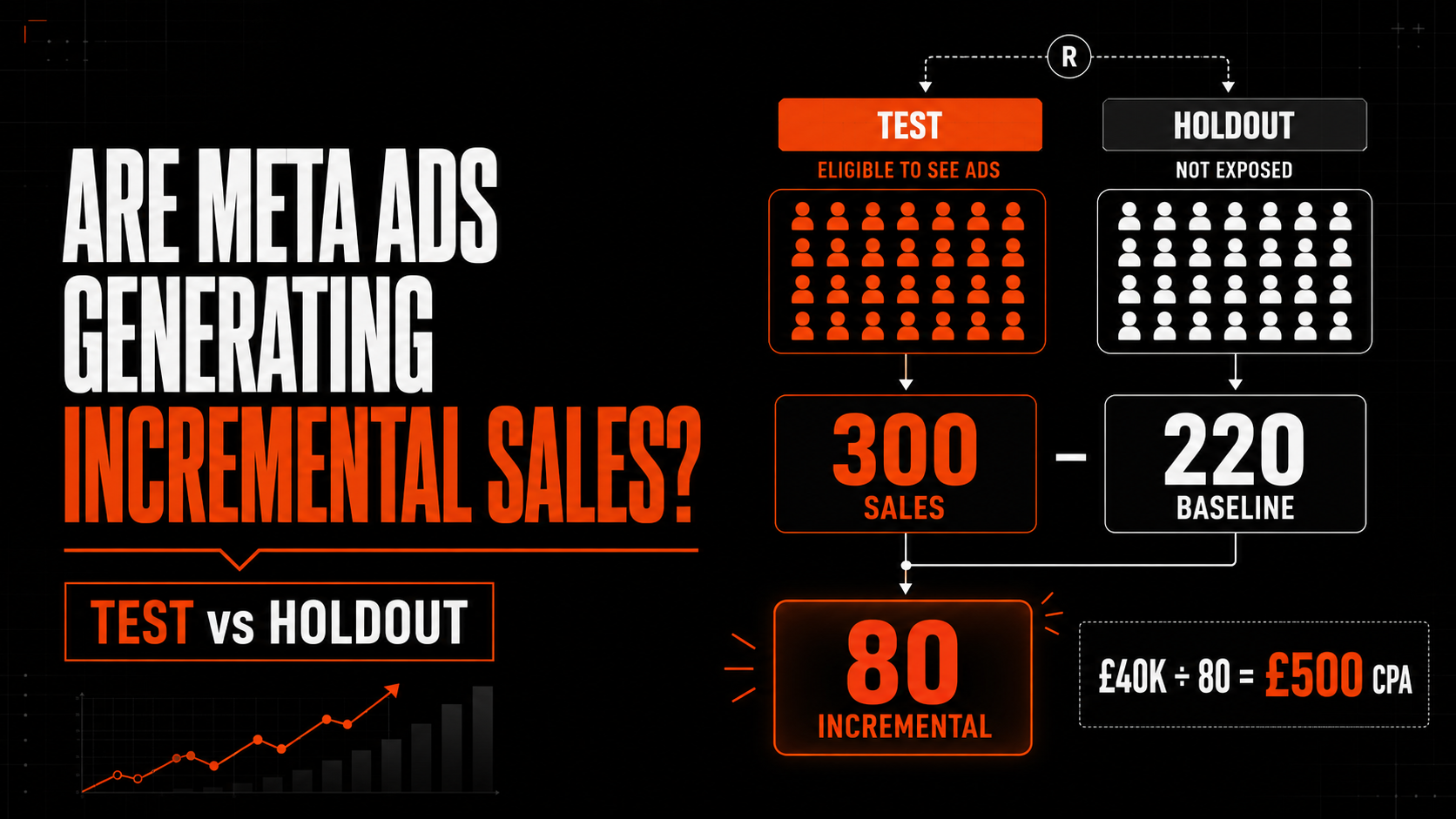
How can you measure whether Meta Ads are generating incremental sales? You need to compare the sales produced when customers were eligible to see your advertising with the sales that would probably have occurred without it. Meta-attributed purchases and ROAS are useful for managing campaigns, but they do not prove that the advertising caused those purchases.
The most reliable answer comes from a controlled incrementality test. Meta Conversion Lift uses randomised test and holdout groups where available. A well-designed geographic holdout can provide an alternative when platform testing is unavailable or when the business wants to measure total-store impact. In both cases, the objective is to create a credible counterfactual: an estimate of what would have happened if the advertising had not run.
For an e-commerce business, the final decision should be based on incremental contribution profit—not simply incremental revenue, attributed ROAS or the number of conversions displayed in Ads Manager.
Attribution and incrementality answer different questions
Attribution asks: “Can this purchase be linked to a Meta advertising interaction?”
Incrementality asks: “Did this purchase happen because of Meta advertising, or would it have happened anyway?”
That distinction matters because Meta may receive credit for customers who:
- Already knew the brand.
- Had previously visited the website.
- Were already planning to purchase.
- Were existing customers ready to reorder.
- Saw or clicked an ad but later converted through direct, organic, email or Google traffic.
- Responded primarily to a promotion, product launch or other marketing activity.
Meta can correctly associate a purchase with an eligible ad interaction without proving that the purchase was caused by the ad. Attribution describes a relationship between touchpoints. Incrementality estimates causation.
To measure whether Meta Ads are generating incremental sales, the business therefore needs more than a dashboard comparison. It needs a test group that can receive the advertising and a comparable control group that cannot.
A simple example
Suppose Meta reports the following monthly performance:
| Metric | Ads Manager result |
|---|---|
| Meta spend | £10,000 |
| Meta-attributed revenue | £30,000 |
| Reported ROAS | 3.0x |
On the surface, every £1 spent appears to have generated £3 in revenue.
You then run a controlled lift test. It estimates that £15,000 of the reported revenue was genuinely additional and would not have occurred without the advertising.
Incremental ROAS = £15,000 incremental revenue ÷ £10,000 Meta spend = 1.5x
Both results can be valid within their own definitions:
- The 3.0x attributed ROAS describes the revenue Meta connected with the ads.
- The 1.5x incremental ROAS estimates the additional revenue caused by the ads.
The second figure is more valuable for deciding whether to increase, maintain or reduce investment.
The most reliable measurement methods
Meta Conversion Lift
Meta Conversion Lift is normally the most direct option when the account and activity are eligible. Meta explains that the experiment creates randomised test and holdout groups designed to measure incremental lift.
- People in the test group have an opportunity to see the selected Meta ads.
- People in the holdout group are withheld from seeing those ads.
- Purchases or another selected outcome are measured across both groups.
- The difference in conversion rates estimates the additional effect of the advertising.
Randomisation is valuable because it helps balance the characteristics that influence purchasing. If the two groups are sufficiently large and the test is executed properly, the primary systematic difference should be eligibility for the ads.
Meta also advises that Conversion Lift results should not be compared directly with ordinary Ads Manager reporting as though they were the same metric. Campaign attribution and experimental lift answer different questions.
How incremental conversions are calculated
If the test and control groups are different sizes, the control result must be scaled to make a fair comparison.
Expected control conversions = Control conversion rate × Number of people in the test group
Incremental conversions = Test-group conversions − Expected control conversions
For example:
| Test component | Result |
| People eligible to see ads | 100,000 |
| Purchases in test group | 3,000 |
| Estimated purchases expected without ads | 2,200 |
| Incremental purchases | 800 |
In this example, the advertising is estimated to have caused 800 additional purchases.
If the campaign spent £40,000:
Incremental CPA = £40,000 Meta spend ÷ 800 incremental purchases = £50
If those incremental purchases produced £80,000 of revenue:
Incremental ROAS = £80,000 incremental revenue ÷ £40,000 Meta spend = 2.0x
These calculations should use the experiment’s properly scaled estimates rather than subtracting raw totals from groups of unequal size.
Geographic holdout testing
A geographic holdout can be useful when user-level Conversion Lift is unavailable, when the business lacks sufficient platform eligibility or when it wants to assess total commercial impact across channels.
The basic process is:
- Select comparable geographic areas using historic revenue, order volume, customer mix, seasonality and media behaviour.
- Continue the selected Meta activity in the treatment regions.
- Reduce or withhold that activity in the control regions.
- Keep pricing, stock, promotions and other marketing as consistent as possible.
- Compare how total orders, revenue and profit change in treatment versus control.
Suppose two groups of regions followed similar sales patterns before the test. During the experiment, sales in the treatment regions rise by 12% while the matched control regions rise by 5%.
A simple directional estimate of Meta’s incremental lift is the additional seven percentage points, subject to the quality of the match and any other differences between the regions.
Geo testing measures store outcomes independently of Meta attribution, but it requires careful design. National media, influencers, television, email, organic social and word of mouth can cross regional boundaries. Customers may also travel, use different delivery addresses or purchase in stores outside their home region.
Use multiple matched regions where possible rather than selecting one city as treatment and another as control. Check whether their historic trends moved together before the test.
Campaign or audience holdouts
A focused holdout can answer a narrower commercial question:
- Does seven-day website retargeting generate incremental orders?
- Does Meta prospecting acquire genuinely new customers?
- Does a catalogue campaign create additional product sales?
- Does an existing-customer campaign increase repeat purchase frequency?
- Does brand-led video advertising increase demand beyond performance activity?
This is usually more actionable than testing whether “Meta works” in general. Prospecting, retargeting and customer-retention campaigns have different audiences, natural conversion rates and risks of over-attribution.
Retargeting is often the first activity worth testing because the audience already contains people who have visited, viewed products or added items to their basket. Many of those customers may have purchased without another ad. A high retargeting ROAS can therefore coexist with low incremental lift.
Time-based tests
Some businesses use on/off tests, switching Meta activity off for a period and comparing sales with an active period. This is easier to execute but less reliable than randomised or matched holdouts.
The result can be distorted by:
- Seasonality and changes in search demand.
- Promotions, discounting and product launches.
- Stock availability and delivery performance.
- Competitor advertising.
- Email and paid-search changes.
- Paydays, bank holidays and weather.
- Delayed conversions caused by advertising before the pause.
Use a time-based test only when stronger methods are not feasible. Select comparable periods, account for lagged effects and avoid drawing a conclusion from a few unusually strong or weak days.
What should an e-commerce incrementality test measure?
Do not stop at incremental purchase count. A complete commercial assessment should include:
| Metric | What it reveals |
| Incremental orders | Additional purchases caused by the advertising |
| Incremental revenue | Additional sales value caused by Meta |
| Incremental new customers | Whether Meta expanded the customer base |
| Incremental CPA | Spend required for each additional purchase or customer |
| Incremental ROAS | Additional revenue divided by Meta spend |
| Incremental contribution profit | Profit after product and variable selling costs |
| Average order value | Commercial quality of incremental orders |
| Return and refund rate | Whether attributed sales remain valuable after purchase |
| Repeat purchase rate | Longer-term quality of acquired customers |
| Payback period | Time required to recover acquisition investment |
Calculate incremental contribution profit
Revenue is not profit. Products with low margins, expensive fulfilment or high returns can create incremental sales without creating a worthwhile financial return.
Use this WordPress-friendly calculation:
Incremental contribution profit = Incremental revenue − cost of goods − fulfilment − payment fees − discounts − expected returns − Meta ad spend
For example, suppose a lift test estimates £100,000 of incremental revenue from £30,000 of Meta spend. The incremental orders carry the following costs:
| Commercial item | Amount |
| Incremental revenue | £100,000 |
| Cost of goods | −£40,000 |
| Fulfilment and payment fees | −£10,000 |
| Expected refunds and returns | −£8,000 |
| Meta spend | −£30,000 |
| Incremental contribution profit | £12,000 |
The campaign produced a positive incremental contribution of £12,000. That is a far more defensible investment result than quoting platform-attributed revenue alone.
Make the test commercially credible
Define the question before selecting the method
Avoid the vague question, “Does Meta work?” Define the decision the test will support.
Examples include:
- Should we increase monthly Meta prospecting spend from £50,000 to £70,000?
- Is retargeting creating enough incremental contribution profit to justify its budget?
- Does Meta acquire new customers more profitably than the next pound spent on Google Ads?
- Does video-led prospecting improve total new-customer revenue?
- Can we reduce branded or existing-customer Meta activity without losing profitable orders?
A precise question determines the campaigns, audience, conversion event, holdout design and commercial success threshold.
Set success criteria before launch
Decide in advance what would justify continuing or scaling:
- Incremental ROAS above the break-even threshold.
- Incremental CPA below the allowable acquisition cost.
- Positive incremental contribution profit.
- A minimum number of incremental new customers.
- A defined payback period.
- A minimum confidence level and sufficiently narrow uncertainty range.
Do not change the success metric after seeing the result. Post-test goal selection encourages the team to find a favourable interpretation rather than make the decision originally planned.
Select the correct conversion event
Use completed purchases when the question concerns incremental sales. Landing-page views, product views and add-to-basket events can diagnose the funnel, but they do not prove that Meta generated revenue.
Before testing, confirm that:
- The Meta Pixel records genuine completed purchases.
- Conversions API and browser events are correctly deduplicated.
- Dynamic order value and currency are accurate.
- Test, cancelled and duplicate orders are excluded or identified.
- Product IDs match the store and catalogue where required.
- The business can connect purchase data with refunds, margin and customer type.
Poor conversion tracking creates a precise-looking experiment around an unreliable outcome.
Ensure the test has sufficient power
Incremental lift may be small relative to the natural volume of sales. If the account produces too few purchases, random variation can be larger than the effect the business is trying to detect.
Meta’s published best-practice guidance has referenced well-powered studies involving at least $10,000 of campaign spend, a 10% holdout and more than 500 total conversions. Treat these as platform guidance rather than permanent eligibility rules: requirements and recommendations can change, and the appropriate sample depends on baseline conversion rate and expected lift.
Check the current options inside Meta Experiments and use a power calculation or specialist support for high-value decisions. An inconclusive test is not evidence that Meta has no effect. It means the experiment could not distinguish the effect confidently from normal variation.
Keep the experiment stable
Avoid simultaneously changing:
- Campaign budgets and bid strategies.
- Targeting and audience exclusions.
- Creative and offer.
- Website design or checkout.
- Pricing and promotional activity.
- Product availability and delivery promises.
- Other major marketing investment.
Normal optimisation may sometimes be allowed within the defined treatment, but large uncontrolled changes make interpretation harder. Record every material event during the test.
Prevent contamination
A valid holdout requires a meaningful difference in Meta exposure between treatment and control. Contamination occurs when control customers are reached by excluded campaigns or when treatment customers are counted in the wrong group.
Review:
- Other Meta accounts or campaigns targeting the same audience.
- Agency and in-house activity running simultaneously.
- Cross-border targeting and broad location settings.
- Existing-customer lists and catalogue retargeting.
- National promotions that affect both groups differently.
- Shared devices, travel and cross-region purchases.
The goal is not a perfectly sealed laboratory. It is a difference in exposure strong enough to measure credibly.
Account for effects on other channels
Meta advertising can influence behaviour that later appears in Google Search, organic traffic, direct visits, email sign-ups or marketplace purchases. A customer may see an Instagram ad, search for the brand two days later and buy through a Google ad.
When Meta is withheld, Google brand searches or direct sales might fall. That does not mean Google or direct traffic caused all the original demand. Equally, if store revenue remains stable when Meta is removed, Meta may have been receiving credit for customers who found another route to purchase.
During the test, monitor:
- Total-store orders and revenue.
- New-customer revenue.
- Branded and non-branded Google Search activity.
- Direct and organic traffic.
- Email subscriptions and assisted sales.
- Marketplace and retail-store sales where relevant.
- Total marketing spend and blended MER.
The correct outcome is the change in the whole business, not merely a decline in Meta-reported conversions.
Use Meta reporting for the right purpose
Meta Ads Manager remains valuable for:
- Comparing creative performance.
- Monitoring delivery, frequency, CPM and CTR.
- Evaluating landing-page and purchase conversion rates.
- Identifying campaigns that require operational attention.
- Informing bidding and budget allocation within the platform.
However, Ads Manager should not be treated as the final proof of causal revenue. Meta states that Conversion Lift results and standard campaign reporting are designed for different measurement purposes.
Senior reporting should show four complementary views:
| Reporting view | Management question |
| Meta-attributed ROAS | Which Meta activity receives credit under the platform’s rules? |
| Shopify or store revenue | How many orders and how much revenue did the business record? |
| Blended MER and contribution profit | Did total marketing investment produce acceptable commercial performance? |
| Incremental ROAS and profit | How much additional value did Meta appear to cause? |
No single dashboard answers all four questions.
How to interpret the result
Strong and profitable lift
If the experiment finds credible positive lift and incremental contribution profit exceeds the required threshold, Meta has evidence to support continued investment. Scale gradually because the return on additional spend may be lower than the return measured at the tested budget.
Positive lift but weak profit
Meta may be creating additional sales that do not cover advertising and variable costs. Improve product mix, conversion rate, average order value, offer and customer value—or reduce the acquisition cost. More incremental revenue is not automatically better business.
No statistically clear lift
An inconclusive result can mean:
- Meta produced little or no incremental effect.
- The true lift was smaller than the test could detect.
- The test did not run long enough or generate enough conversions.
- Treatment and control were contaminated.
- Tracking or matching reduced measurement quality.
- Other business changes created excessive noise.
Review the confidence interval and test quality before declaring that Meta “does not work.” Decide whether a larger or more focused follow-up test is commercially justified.
Negative lift
Negative estimates can occur through random variation, poor test design or genuine adverse effects. For example, excessive frequency, a confusing offer or poor audience selection could theoretically suppress performance. First check data quality, exposure, operational changes and uncertainty before making a major budget decision.
A practical e-commerce testing framework
- Reconcile the purchase data. Verify Meta Pixel, Conversions API, Shopify and GA4 purchase counts, values and transaction IDs.
- Segment the activity. Separate prospecting, retargeting, existing customers and new-customer acquisition.
- Define one decision. State exactly which budget or campaign question the test must answer.
- Choose the strongest feasible method. Use Meta Conversion Lift when eligible; otherwise use a carefully designed geographic or audience holdout.
- Set profit guardrails. Predefine incremental CPA, incremental ROAS, contribution profit and payback requirements.
- Estimate the required sample. Make sure spend and conversion volume can detect a commercially meaningful lift.
- Run a stable test. Keep targeting, pricing, promotions, stock and other media as controlled as practicable.
- Measure the business outcome. Analyse total orders, revenue, new customers, contribution profit and cross-channel changes.
- Document uncertainty. Report the estimate, confidence level, range and limitations—not just a single headline number.
- Scale the marginal return. Increase budget only while additional spend continues to generate acceptable incremental contribution profit.
Common incrementality mistakes
- Treating Meta-attributed ROAS as proof of causation.
- Using an ordinary before-and-after comparison without a control.
- Testing all Meta activity when the real question concerns retargeting or prospecting.
- Using add-to-basket events as the primary sales outcome.
- Ignoring refunds, returns and product margin.
- Allowing other Meta campaigns to reach the holdout group.
- Changing promotions, budgets and creative midway through the test.
- Declaring zero impact from an underpowered or inconclusive result.
- Comparing Meta Conversion Lift directly with Ads Manager as if the measures should match.
- Scaling from an average result without checking the return on the next pound spent.
Frequently asked questions
What is an incremental sale from Meta Ads?
An incremental sale is a purchase that occurred because of Meta advertising and would not otherwise have happened during the measurement period. It is different from an attributed sale, which Meta associates with an eligible ad interaction under its reporting rules.
Can Shopify or GA4 measure Meta incrementality?
Shopify records orders and GA4 helps analyse customer journeys, but neither proves incrementality through ordinary attribution reporting. They provide essential outcome data for a controlled experiment. The causal estimate comes from comparing treatment with a credible holdout.
Is Meta Conversion Lift better than a geo test?
Randomised user-level Conversion Lift is generally the stronger method when eligible and properly powered. Geo testing can be valuable for total-business measurement or where user-level testing is unavailable, but geographic matching and spillover require careful management.
How long should a Meta incrementality test run?
There is no universal duration. It depends on spend, purchase volume, normal conversion lag and the size of lift the business needs to detect. The test should run long enough to collect sufficient data without extending so far that seasonality and operational changes undermine comparability.
Should retargeting be tested separately?
Yes. Retargeting audiences already have a high natural likelihood of purchasing, which creates a significant risk of over-attribution. A separate holdout can show whether retargeting creates additional orders or mainly receives credit for customers already close to conversion.
What if incremental ROAS is lower than Meta’s reported ROAS?
That is common and not automatically evidence of faulty reporting. Attributed ROAS includes purchases associated with ads, while incremental ROAS attempts to isolate purchases caused by them. Budget decisions should prioritise incremental contribution profit.
The practical answer
The most credible way to measure whether Meta Ads are generating incremental sales is to compare a group that can receive the advertising with a comparable group deliberately withheld from it. Use Meta Conversion Lift where available, or a properly designed geographic or audience holdout where it is not.
Validate purchase tracking first, define success before the test and measure incremental orders, revenue, new customers and contribution profit. Keep the experiment stable, account for cross-channel effects and report uncertainty honestly.
The number that matters is not the revenue Meta claims. It is the revenue and profit that disappear—or remain—when the advertising is withheld. That difference provides the strongest available evidence of Meta’s real commercial contribution.
If your business is investing heavily in Meta but cannot prove what the channel adds beyond attributed sales, Clubbish can audit the measurement setup, design a commercially focused incrementality test and translate the results into a profitable budget decision.