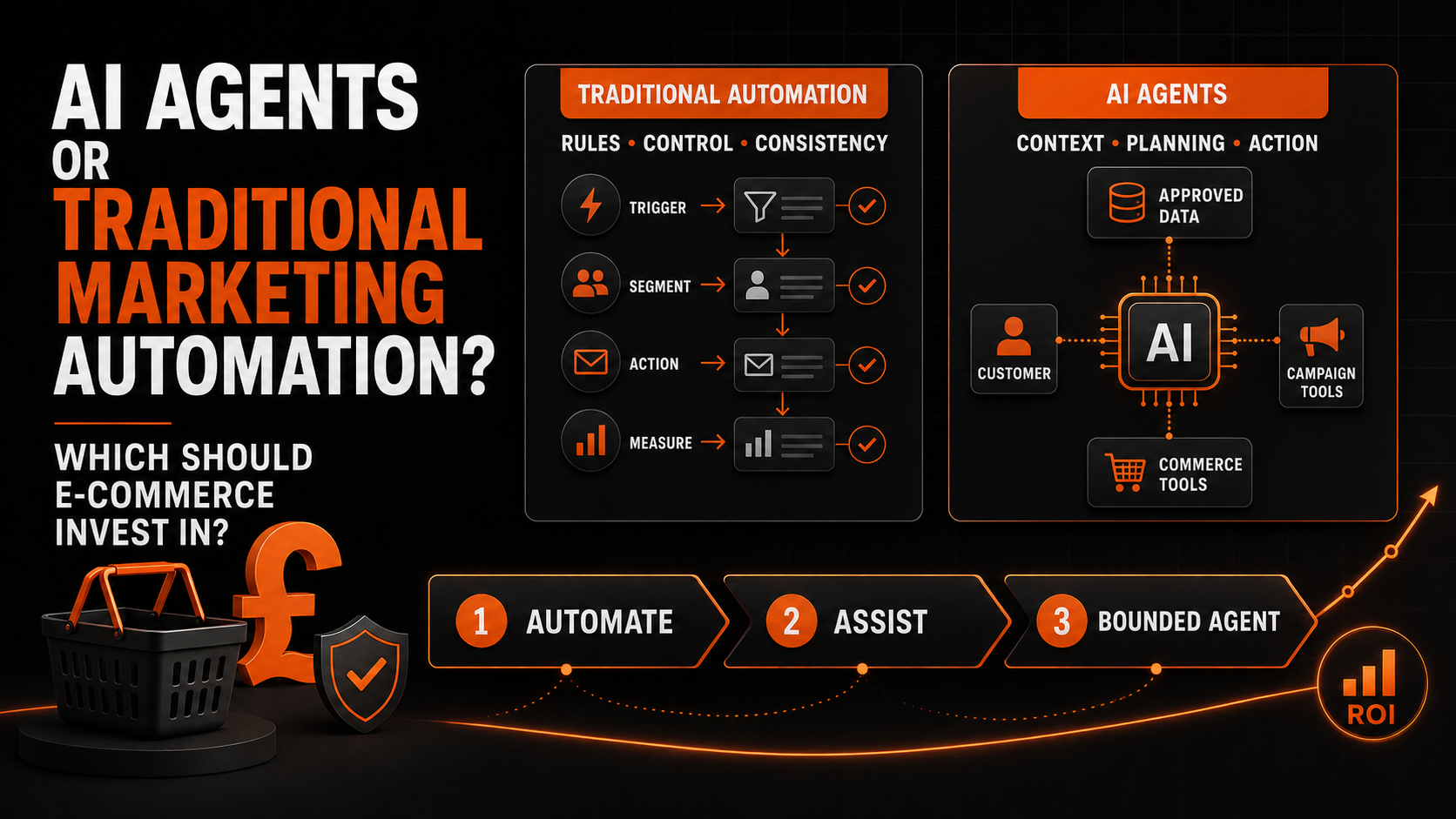
Should an e-commerce business invest in AI agents or traditional marketing automation? For most retailers, the right answer is to invest in traditional automation first, add AI assistance to improve analysis and decision-making, and introduce bounded AI agents only where a process genuinely requires interpretation, planning or multi-step action.
Traditional marketing automation is normally better for predictable, high-volume workflows. AI agents become valuable when fixed rules cannot handle the context, exceptions or coordination required. The additional autonomy must produce enough incremental contribution profit or verified cost saving to justify its higher implementation, monitoring and risk-management costs.
The objective is not to use the most advanced technology. It is to use the simplest reliable system capable of producing the required commercial outcome.
The short answer
Use:
- Traditional automation for fixed triggers, predictable decisions and consistent execution.
- AI-assisted automation for classification, summarisation, recommendations and drafting with human approval.
- Bounded AI agents for multi-step work requiring context and tool use within strict permissions.
- Human-led decisions for high-impact financial, legal, brand or customer outcomes.
For a typical e-commerce business, that means:
- Automate basket recovery, order updates, stock alerts, reporting and suppression rules conventionally.
- Use AI to analyse customer feedback, classify enquiries, investigate anomalies and propose creative or campaign actions.
- Use agents selectively for bounded tasks such as investigating performance changes across several systems or resolving defined customer-service requests.
- Do not give a general-purpose agent unrestricted access to advertising budgets, pricing, customer records, refunds, discounts and publishing systems.
How to Choose Between AI Agents or Traditional Marketing Automation
To choose between AI agents or traditional marketing automation, ask five questions:
- Is the process predictable enough to express as rules?
- Does it require interpretation of unstructured information?
- Must it choose and coordinate actions across several systems?
- What happens if it is wrong?
- Can the additional value of autonomy be measured?
If a fixed trigger and rule can solve the problem reliably, traditional automation is usually the better investment. If the process requires judgement, context, prioritisation or adaptation, AI assistance or a bounded agent may be appropriate.
Complexity should be earned through measurable value—not added because an agent appears more innovative.
What is traditional marketing automation?
Traditional marketing automation uses predefined triggers, conditions, rules and workflows.
Example:
When a customer abandons checkout, wait two hours and send message A. If no purchase occurs after 24 hours, send message B. Stop the workflow immediately when the customer purchases or withdraws consent.
The system does not need to understand the customer’s situation. It executes the logic configured by the business.
Traditional automation commonly handles:
- Welcome journeys.
- Basket and checkout recovery.
- Order and delivery updates.
- Back-in-stock alerts.
- Review requests.
- Replenishment reminders.
- Win-back sequences.
- Consent and suppression rules.
- Product-feed updates.
- Stock-out advertising exclusions.
- Reporting and anomaly alerts.
- Simple customer-service routing.
- Campaign tagging and naming.
Advantages
- Predictable behaviour.
- Clear auditability.
- Easier testing.
- Lower implementation complexity.
- More controllable costs.
- Straightforward rollback.
- Easy explanation to employees and customers.
- Consistent execution at volume.
Limitations
- Rules become difficult to maintain when exceptions multiply.
- It handles unstructured information poorly.
- It may create large, fragile workflow trees.
- It cannot interpret novel situations without prior logic.
- It may treat customers too uniformly.
- Cross-system coordination can require extensive custom rules.
Traditional automation is not obsolete or inferior. A reliable rules-based journey can create more profit than an expensive agent that occasionally makes commercially damaging decisions.
What is an AI agent?
An AI agent is a system that can interpret an objective, assess context, select actions, use tools and complete a sequence of steps with some degree of autonomy.
The UK government describes agentic AI as systems composed of agents that can behave and interact autonomously to achieve objectives. UK Government
An e-commerce agent might:
- Read product, stock, margin and campaign data.
- Identify a sharp increase in spend on a low-stock product.
- Investigate whether the change came from demand, bidding or a feed issue.
- Compare profitable alternatives.
- Recommend or execute an approved response.
- Log the action and monitor the result.
That is materially different from a workflow configured to pause every product when stock falls below five units.
Advantages
- Can interpret unstructured information.
- Can handle more varied cases.
- Can plan multi-step work.
- Can coordinate several tools and systems.
- Can adapt recommendations to context.
- Can reduce manual investigation and decision latency.
- Can support employees across complex workflows.
Risks and limitations
- Variable output.
- Unsupported or incorrect reasoning.
- Tool misuse.
- Unintended actions.
- Cascading errors across connected systems.
- Higher monitoring and security cost.
- Greater difficulty explaining a decision.
- Model and vendor dependency.
- Prompt injection or manipulated input.
- Permissions that exceed the task requirement.
NIST notes that agents can scale autonomous decision-making and actions with limited human supervision, creating both opportunities and new risks around identity and authorisation. NIST NCCoE
Do not confuse AI assistance with an AI agent
Many products are described as “agents” when they are assistants or fixed automations with a language-model interface.
Use four levels:
| Level | What the system does | Example |
|---|---|---|
| Traditional automation | Executes predefined rules | Send a replenishment reminder after 60 days |
| AI assistance | Produces analysis or content | Summarise reviews and draft an email |
| Bounded agent | Chooses from approved actions and tools | Investigate an anomaly and prepare changes for approval |
| Autonomous agent | Plans and executes broad multi-step activity | Reallocate budgets, change offers and publish campaigns |
The commercial and risk profile changes substantially at each level.
A tool that drafts an email does not need permission to select the audience, apply a discount and send it. A system that recommends a budget change does not need the ability to execute the change before its accuracy is proven.
Buy the lowest autonomy level that delivers the required outcome.
When traditional marketing automation is the better investment
Choose traditional automation when the process:
- Has a clear trigger.
- Produces a predictable outcome.
- Requires consistency.
- Uses structured data.
- Has limited exceptions.
- Needs straightforward auditing.
- Must be easy to stop or reverse.
- Can be measured through a simple holdout or baseline.
- Does not require open-ended judgement.
Strong use cases include:
Customer journeys
- Welcome campaigns.
- Basket recovery.
- Post-purchase education.
- Back-in-stock messages.
- Replenishment reminders.
- Review requests.
- Loyalty milestones.
Commerce operations
- Price and stock synchronisation.
- Feed disapproval alerts.
- Out-of-stock product suppression.
- Invalid URL and image checks.
- Promotion start and expiry.
Measurement and governance
- Budget pacing.
- Tracking-error alerts.
- Daily reporting.
- Consent and preference enforcement.
- Customer-contact limits.
- Change logs.
These processes normally benefit more from accurate data and well-designed rules than from autonomous judgement.
When an AI agent may justify investment
An agent may be appropriate when the process requires several of the following:
- Interpretation of natural language, imagery or other unstructured data.
- Selection between multiple valid actions.
- Adaptation to customer or commercial context.
- Coordination of several systems.
- Handling exceptions not easily represented as rules.
- Prioritisation of competing tasks.
- Multi-step investigation.
- Generation and revision of content.
- Continuous feedback and re-planning.
Potential e-commerce uses include:
Marketing-operations agent
- Investigates unusual spend or revenue movement.
- Checks tracking, stock, feeds and recent account changes.
- Produces a prioritised diagnosis.
- Prepares recommended actions for approval.
Customer-service agent
- Interprets the customer’s request.
- Retrieves order and policy information.
- Resolves defined enquiries.
- Escalates uncertainty, complaints or exceptions.
Merchandising agent
- Reviews sales, stock, margin and returns.
- Identifies products needing attention.
- Recommends promotion, suppression or alternatives.
- Requests approval for consequential changes.
Creative-research agent
- Analyses ad performance, reviews and support conversations.
- Identifies customer objections and themes.
- Produces creative briefs and variations.
- Routes claims for human review.
Retention-planning agent
- Reviews customer history, product usage and contact frequency.
- Recommends the next action from an approved set.
- Respects consent, margin and discount rules.
- Leaves final high-value offers for approval.
These are stronger candidates than asking a general agent to “run the marketing.”
A commercial fit matrix
| Business need | Better starting point |
| Send a fixed sequence after an event | Traditional automation |
| Recover abandoned baskets | Traditional automation with optional AI copy support |
| Suppress unavailable products | Traditional automation |
| Enforce consent and contact rules | Traditional automation |
| Summarise customer feedback | AI assistance |
| Classify complex enquiries | AI assistance or bounded agent |
| Investigate a cross-channel performance decline | Bounded agent in recommendation mode |
| Create campaign briefs from several data sources | AI agent with human approval |
| Resolve defined service enquiries across systems | Bounded agent with escalation |
| Change media budgets automatically | Rules first; agent only with strict limits |
| Optimise product pricing | Specialist controlled system, not a general agent |
| Make high-impact customer decisions | Human-led process with AI support |
Compare total cost—not just software fees
Traditional automation usually has more predictable cost. Agentic systems introduce additional expenses.
Calculate:
Total cost = Technology + Integration + Data preparation + Tool usage + Human review + Security + Monitoring + Maintenance + Failure cost
Traditional automation costs
- Platform licence.
- Workflow configuration.
- CRM and commerce integration.
- Message or usage fees.
- Testing.
- Ongoing rule maintenance.
- Reporting and optimisation.
AI-agent costs
- Agent platform or development.
- Model and token usage.
- Tool and API calls.
- Identity and permission management.
- Evaluation datasets.
- Sandboxed testing.
- Human review.
- Continuous logging and monitoring.
- Security testing.
- Incident response.
- Model and prompt updates.
- Rollback and fallback processes.
An agent that reduces ten hours of work but requires eight hours of review, correction and monitoring has created limited operational value.
Worked investment example
An established retailer is comparing a traditional automated retention workflow with a bounded retention agent.
Traditional automation
- First-year technology and implementation: £30,000.
- Incremental contribution profit: £55,000.
- Verified operational saving: £10,000.
Net benefit = £55,000 + £10,000 − £30,000 = £35,000
ROI = £35,000 ÷ £30,000 × 100 = 116.7%
Bounded AI agent
- First-year technology, integration and controls: £70,000.
- Incremental contribution profit: £95,000.
- Verified operational saving: £20,000.
Net benefit = £95,000 + £20,000 − £70,000 = £45,000
ROI = £45,000 ÷ £70,000 × 100 = 64.3%
The agent produces £10,000 more net benefit in absolute terms, but the traditional workflow produces the stronger percentage ROI and has lower implementation risk.
The decision depends on the retailer’s priorities:
- Choose traditional automation if capital efficiency, speed and control matter most.
- Consider the agent if the additional £10,000 net benefit, future scale and strategic capability justify the greater cost and risk.
Do not assume the more advanced option is the better investment.
Use a value-versus-autonomy test
Score each use case from one to five:
- Value of a successful action.
- Frequency of the process.
- Need for interpretation.
- Need for multiple tools.
- Cost of a wrong action.
- Difficulty of reversal.
- Quality of available data.
- Ability to test incrementally.
Then apply this principle:
Required control increases with autonomy × consequence × irreversibility
An agent recommending a subject line has low consequence. An agent changing product prices or issuing refunds has high consequence and may be difficult to reverse.
The use case should move towards greater autonomy only when:
- Accuracy is proven at the current level.
- The next permission creates measurable additional value.
- Monitoring can detect failure quickly.
- The business can stop or reverse the action.
A recommended investment sequence
Stage 1: fix the foundations
Audit:
- Customer and order data.
- Product catalogue.
- Stock and pricing.
- Consent and preferences.
- Conversion tracking.
- Margin and customer-value data.
- CRM records.
- Integration reliability.
- Current manual processes.
Agents are especially sensitive to poor context. If stock, customer status, order value or consent is wrong, an agent can make a confident but commercially damaging decision.
Stage 2: automate predictable work
Use traditional automation for reporting, alerts, customer journeys, feed controls, suppression rules and operational notifications.
Measure incremental revenue, contribution profit, hours saved, error reduction and customer outcomes.
Stage 3: add AI assistance
Allow AI to:
- Classify enquiries.
- Summarise feedback.
- Identify anomalies.
- Recommend audiences.
- Suggest budget changes.
- Draft campaigns.
- Propose bundles or next actions.
Keep human approval for material financial, customer or public-facing actions.
Stage 4: introduce bounded agents
Begin with read-only data and recommendation mode. Add one low-risk execution permission only after the recommendation is consistently accurate.
Example:
- Agent reads campaign, product and stock data.
- Agent identifies a low-stock product receiving high prospecting spend.
- Agent recommends reducing exposure.
- A person approves the change.
- The system logs and monitors the result.
Later, the agent may execute within pre-approved limits while still escalating exceptions.
Stage 5: scale autonomy cautiously
Increase permissions only when the marginal value of autonomy exceeds the additional control and failure costs.
Do not move directly from a chatbot pilot to an agent with broad access to customer data, discounts and budgets.
Keep AI agents inside strong guardrails
The NCSC advises organisations not to grant agents unrestricted access to sensitive data or critical systems and to retain visibility, meaningful human oversight and control. It states that if an organisation cannot understand, monitor or contain an agent’s actions, the system is not ready for deployment. NCSC
Use:
- Least-privilege permissions.
- A unique identity for each agent.
- Read-only access by default.
- Approved tools and APIs.
- Restricted customer and product fields.
- Spending and discount limits.
- Contact-frequency and consent checks.
- Human approval for high-impact actions.
- Complete action logs.
- Output and tool-call validation.
- Sandboxed testing.
- Automatic shutdown and rollback.
- Clear escalation routes.
- Manual fallback processes.
The NCSC’s August 2026 guidance also recommends safeguards, sandboxing and active oversight to limit unintended autonomous activity. NCSC
Protect customers and comply with marketing rules
Agents may process purchase history, behavioural data, profiles and inferred preferences. Before deployment, assess:
- Lawful basis.
- Email and SMS consent or soft opt-in conditions.
- Profiling.
- Data minimisation.
- Customer transparency.
- Retention and deletion.
- Vendor and sub-processor access.
- International transfers.
- Human intervention.
- Objection and opt-out rights.
- Decisions with legal or similarly significant effects.
The ICO explains that marketing emails and texts to individuals generally require specific consent, subject to the limited soft opt-in for existing customers and equivalent opt-out requirements. An agent does not bypass those rules. ICO
Do not permit a general marketing agent to decide customer eligibility, pricing, refunds or access without an appropriate legal, commercial and human-oversight framework.
Measure agents differently from traditional automation
Traditional automation metrics
- Incremental contribution profit.
- Conversion rate.
- Average order value.
- Repeat purchase.
- Recovery rate.
- Cost per resolution.
- Hours saved.
- Error rate.
- Unsubscribe and complaint rate.
Additional agent metrics
- Recommendation acceptance rate.
- Action accuracy.
- Human override rate.
- Escalation rate.
- Unsupported-output rate.
- Unauthorised-action attempts.
- Tool-call failure rate.
- Cost per completed task.
- Time to resolution.
- Customer satisfaction.
- Drift and incident frequency.
Calculate:
ROI = (Incremental contribution profit + Verified cost savings − Total technology and implementation cost) ÷ Total cost × 100
Do not treat platform-attributed revenue as automatically incremental. Use holdouts or controlled tests where practical.
For an agent, report both the commercial outcome and the distribution of errors. A 95% action-accuracy rate may be unacceptable if the remaining 5% includes unauthorised discounts, incorrect customer messages or uncontrolled budget changes.
A practical 90-day pilot
Days 1–30: choose and constrain the use case
- Map the existing process.
- Determine whether rules can solve it.
- Define the additional judgement an agent would provide.
- Establish financial and operational baselines.
- Identify permitted data and tools.
- Define accuracy, cost and risk thresholds.
Days 31–60: run in recommendation mode
- Give the agent read-only access where possible.
- Compare recommendations with human decisions.
- Record errors, overrides and review time.
- Test missing, conflicting and malicious inputs.
- Confirm consent, privacy and security controls.
- Calculate likely unit economics.
Days 61–90: allow one bounded action
- Add one reversible, low-risk permission.
- Use spending, volume and customer limits.
- Maintain human approval above thresholds.
- Test shutdown and rollback.
- Compare incremental benefit with the traditional alternative.
- Decide whether to maintain, scale, redesign or stop.
Investment decision framework
| Finding | Recommended investment |
| Clear trigger and predictable response | Traditional automation |
| Stable rules but variable content | Traditional automation plus AI drafting |
| Unstructured input requires classification | AI assistance |
| Multi-system investigation creates delay | Bounded agent in recommendation mode |
| Agent recommendations are accurate and valuable | Add one controlled execution permission |
| Data is unreliable | Repair the foundation first |
| Wrong actions have high customer or financial cost | Retain human approval |
| Monitoring cannot explain or contain actions | Do not deploy the agent |
| Traditional automation produces stronger net value | Do not add agent complexity |
| Agent creates proven incremental profit at acceptable risk | Scale cautiously |
Frequently asked questions
Are AI agents replacing traditional marketing automation?
No. Agents expand the range of work that can be automated, but fixed workflows remain better for many predictable, high-volume tasks. The two approaches will normally operate together.
Is a chatbot an AI agent?
Not necessarily. A chatbot may simply answer questions. It becomes more agentic when it can plan, use tools, retrieve records and take actions with some autonomy.
Should an e-commerce business allow an agent to change advertising budgets?
Begin with analysis and recommendations. Add execution only after accuracy and incremental value are proven, using strict spend limits, minimum data thresholds, logging and rollback.
Is traditional automation cheaper?
It is generally more predictable and less expensive to control. An agent may justify higher costs when its ability to interpret context and coordinate work creates substantial additional value.
What should the first e-commerce AI agent do?
A strong first use case is a read-only investigation agent that analyses performance, stock, feeds and tracking, then prepares recommended actions for human approval.
Who is responsible when an AI agent makes a mistake?
The e-commerce business remains accountable for the systems it deploys and the impact on customers. Vendors and partners may have contractual responsibilities, but accountability cannot be delegated to the software.
The practical answer
When choosing between AI agents or traditional marketing automation, most e-commerce businesses should use a layered model:
- Traditional automation for deterministic workflows.
- AI assistance for analysis, classification, drafting and recommendations.
- Bounded AI agents for multi-step processes with clear permissions.
- Human approval for consequential financial, legal, brand and customer decisions.
Begin with the most repetitive and measurable process. Introduce an agent only when fixed rules cannot handle the required context or exceptions and the additional autonomy creates demonstrable value.
The question is not whether agents are more advanced. It is whether the business needs autonomous judgement—and whether that judgement produces enough incremental profit to pay for the extra cost, monitoring and risk.
Book a Strategy Call
If you are deciding between AI agents or traditional marketing automation, Clubbish can audit your workflows, data, systems and commercial opportunities—then build a phased automation roadmap that balances measurable growth, efficiency and control.