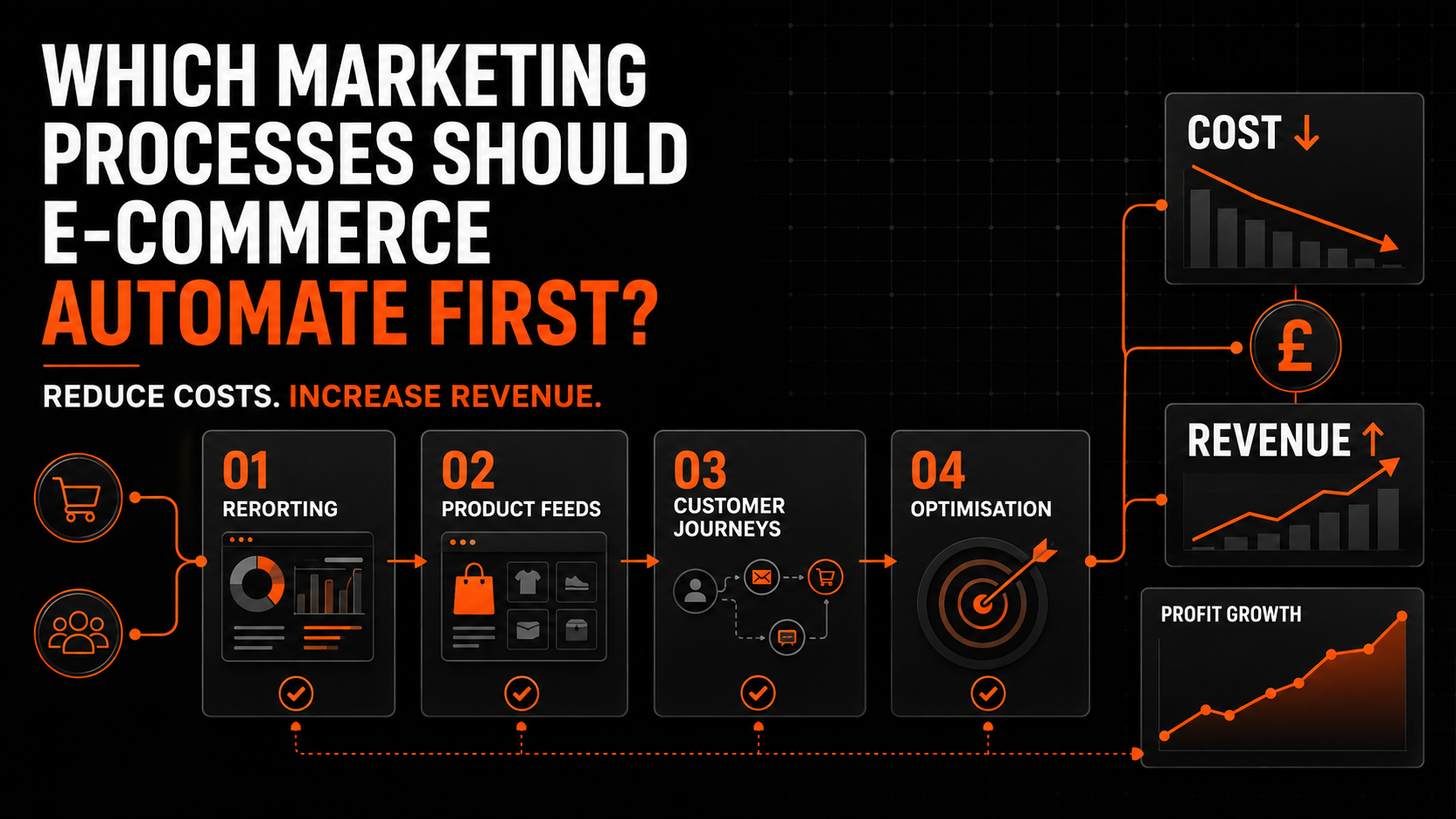
Which marketing processes should an e-commerce business automate first to reduce costs and increase revenue? Start with processes that are repetitive, rules-based, measurable and close to a commercial outcome: reporting and exception alerts, product-feed and stock controls, high-intent customer journeys, customer-service triage and campaign monitoring.
Do not begin by handing strategic decisions to an autonomous AI agent. Begin by automating predictable work, improving the speed and accuracy of decisions, and retaining human approval wherever an error could materially affect customers, budgets, margins or the brand.
The objective is not to automate the greatest number of tasks. It is to create the greatest incremental contribution profit from the least risky and most controllable processes.
The short answer: automate in this order
For most established e-commerce businesses, the most sensible sequence is:
- Tracking, reporting and exception alerts — establish reliable visibility and reduce manual analysis.
- Product-feed, stock and catalogue controls — prevent wasted spend and lost demand caused by incorrect product data.
- High-intent customer journeys — recover baskets, communicate availability and support repeat purchase.
- Customer-service triage — reduce repetitive enquiries while protecting the customer experience.
- Segmentation and personalisation — improve relevance once customer and product data are trustworthy.
- Creative production and testing support — increase testing capacity without removing brand approval.
- Paid-media recommendations — accelerate analysis while keeping consequential changes controlled.
- Bounded automated optimisation — permit selected budget, bid or merchandising actions only after the underlying data and safeguards have been proven.
That order matters. A business should automate visibility before decisions, stable rules before judgement, and reversible actions before high-risk actions.
How to decide what to automate first
The best candidate is not necessarily the process consuming the most time. It is the process with a strong combination of frequency, commercial value, measurability and controllability.
A practical prioritisation formula is:
Automation priority = (Frequency × Commercial value × Measurability) ÷ (Complexity × Risk)
Score each factor from one to five. A high score does not automatically approve the project, but it helps the leadership team compare opportunities using the same logic.
Strong early candidates usually:
- Happen daily or weekly.
- Follow a stable and documented process.
- Have clear triggers, inputs and outputs.
- Consume meaningful employee or agency time.
- Affect revenue, media cost, margin or customer experience.
- Use data that is sufficiently complete and accurate.
- Can be tested against a baseline or holdout.
- Can be reviewed, reversed or stopped quickly.
- Have a named commercial owner.
Weak early candidates depend on subjective judgement, unreliable data or high-impact decisions that are difficult to reverse. An impressive demonstration is not evidence that a process is ready for automation.
1. Automate marketing reporting and exception alerts first
Reporting is often the safest starting point because it removes repetitive data collection without immediately allowing software to alter campaigns or customer experiences.
Useful automations include:
- Daily spend, orders and revenue summaries.
- Blended marketing efficiency ratio reporting.
- Contribution-margin reporting by product or category.
- New-versus-returning-customer performance.
- Budget-pacing alerts.
- Sudden changes in CPA, ROAS, conversion rate or average order value.
- Broken purchase-tracking warnings.
- Discrepancies between advertising platforms, GA4 and the commerce platform.
- Refund and return-rate alerts.
- Stock warnings for products receiving paid traffic.
- Feed disapproval and landing-page error notifications.
- Weekly performance summaries by channel and workstream.
This can reduce spreadsheet work, improve reaction time and create more capacity for commercial analysis. It also exposes whether the business has the reliable data needed for more advanced automation.
Automate collection—not interpretation
The system can identify that revenue fell by 20%, but it should not immediately assume that a campaign is responsible. The cause could be:
- A tracking failure.
- An out-of-stock bestseller.
- A website or checkout error.
- A price or delivery change.
- Seasonality or a promotion ending.
- A change in traffic quality.
- An attribution-setting change.
The best first reporting automation therefore says: “This result is outside the expected range; these are the likely contributing variables; a person must investigate.”
Reporting automation reduces cost when it genuinely replaces manual preparation or enables employees to spend more time on higher-value work. It increases revenue when earlier detection prevents lost sales or wasted media spend.
Measure:
- Reporting hours saved.
- Time from anomaly to investigation.
- Prevented media waste.
- Tracking incidents detected.
- Revenue protected by faster intervention.
- Percentage of alerts that lead to useful action.
Too many low-quality alerts simply create a new administrative burden. Every alert needs an owner, severity, response expectation and closure status.
2. Automate product-feed, stock and catalogue controls
For a retailer using Google Shopping, Performance Max, Microsoft Shopping or Meta catalogue advertising, product data is a revenue system—not merely an administrative feed.
Automate:
- Product-feed synchronisation.
- Price and sale-price updates.
- Availability and stock-status updates.
- Out-of-stock advertising suppression.
- Missing GTIN, MPN, brand and attribute checks.
- Invalid URL and broken-image detection.
- Product disapproval monitoring.
- Promotion scheduling and expiry.
- Margin, stock, bestseller and return-rate labels.
- Feed-to-landing-page consistency checks.
- Product grouping by commercial priority.
Google’s Merchant Center guidance makes clear that product price and availability are shown to potential customers and need to remain current. It recommends automated feed delivery, intraday updates, the Merchant API or structured data where appropriate, while warning that mismatches can cause disapprovals. Google Merchant Center
Use rules that reflect commercial reality
A feed automation should not treat all revenue as equally valuable. Connect product data to:
- Gross or contribution margin.
- Available stock.
- Return rate.
- Delivery cost.
- Seasonal relevance.
- Promotion status.
- Bestseller or strategic-product status.
- Customer lifetime value where a product is strongly associated with repeat purchase.
For example:
If available stock falls below five units, remove the product from prospecting campaigns, retain it in suitable organic listings and notify merchandising. If the product becomes unavailable, direct promotional budget towards the closest profitable, in-stock alternative.
That is a controlled rule with clear inputs and an understandable outcome. It is normally a safer early investment than allowing an AI system to decide how the entire catalogue should be promoted.
Measure:
- Spend on unavailable products.
- Feed approval rate.
- Price and availability mismatches.
- Revenue lost to disapprovals.
- Margin mix of advertised products.
- Time required to resolve feed issues.
- Conversion rate after feed improvements.
3. Automate high-intent customer journeys
Customer journeys are often the first visible revenue automation because the triggers are clear and the outcomes can be measured.
Prioritise:
- Welcome journeys.
- Browse-abandonment reminders.
- Basket and checkout recovery.
- Back-in-stock notifications.
- Price-drop alerts where appropriate.
- Order and delivery updates.
- Post-purchase education.
- Review requests.
- Replenishment reminders.
- Product cross-sell and upsell sequences.
- Loyalty and VIP communications.
- Win-back journeys.
Basket recovery is an obvious candidate because the customer has already demonstrated intent. Baymard’s long-running research currently places average cart abandonment at roughly 70%, although a large share of abandonment is natural browsing and not automatically recoverable. Baymard Institute
The implication is not “send more abandoned-basket messages.” It is to identify recoverable intent while also fixing the checkout barriers that caused the abandonment.
Build suppression and frequency rules
Every customer journey should include rules for:
- Consent and channel eligibility.
- Immediate suppression after purchase.
- Product availability.
- Message frequency.
- Existing service complaints.
- Returns or cancellations.
- Discount eligibility.
- Overlap with other journeys.
- New-versus-existing-customer treatment.
An automated discount sent to someone who would have purchased at full price can reduce profit while appearing to generate revenue. A basket journey that claims every subsequent order may also overstate its impact.
Use a holdout group where possible. Keep a small, representative share of eligible customers out of the automation and compare their orders, revenue and contribution profit with the exposed group.
Measure:
- Incremental conversion rate.
- Incremental revenue per eligible customer.
- Incremental contribution profit.
- Average order value.
- Discount cost.
- Unsubscribe and complaint rates.
- Repeat purchase.
- Customer lifetime value.
4. Automate customer-service triage—not every conversation
Customer service is a strong efficiency opportunity when the business receives large numbers of predictable enquiries.
Appropriate early use cases include:
- Order-status requests.
- Delivery-time questions.
- Returns-policy explanations.
- Product dimensions and specifications.
- Care instructions.
- Stock availability.
- Payment options.
- Basic compatibility questions.
- Subscription or account guidance.
- Routing messages to the correct team.
The first objective should be classification, retrieval and triage, not fully autonomous customer handling.
The system should answer only from approved and current sources. It should escalate when:
- It is uncertain.
- The customer requests a person.
- A refund, replacement or compensation decision is required.
- The customer is angry, distressed or vulnerable.
- A product has safety implications.
- An order is damaged, missing or disputed.
- Personal data or account security is involved.
- The proposed response falls outside approved policy.
A fast but inaccurate answer can increase repeat contacts, refunds, complaints and reputational risk. Cost per conversation is therefore not enough.
Measure:
- First-response and resolution time.
- First-contact resolution.
- Accurate self-service resolution rate.
- Escalation rate.
- Repeat contact.
- Customer satisfaction.
- Refund and complaint rate.
- Cost per successfully resolved enquiry.
- Human time saved after quality review.
5. Automate segmentation and personalisation after the data is ready
Once customer identity, consent, order history and product data are trustworthy, automation can improve the relevance of marketing.
Useful segments include:
- New customers.
- Recent first-time purchasers.
- High-value repeat customers.
- Lapsed customers.
- Customers approaching a likely replenishment date.
- Category browsers who have not purchased.
- Discount-sensitive customers.
- Full-price buyers.
- Customers associated with high return rates.
- Customers likely to need complementary products.
Automation can then vary:
- Product recommendations.
- Message timing.
- Channel selection.
- Content and creative.
- Offer eligibility.
- Contact frequency.
- Suppression rules.
- Loyalty treatment.
Personalisation must improve profit, not just clicks
A recommendation engine may increase click-through rate while:
- Promoting low-margin products.
- Cannibalising an intended full-price purchase.
- Increasing discount dependency.
- Recommending unavailable products.
- Creating repetitive or intrusive experiences.
- Sending existing customers incentives intended for acquisition.
Measure incremental contribution profit by segment, not engagement alone.
If personalisation uses profiling or automated decisions involving personal data, assess the relevant UK data-protection obligations. The ICO explains that automated decision-making and profiling need appropriate safeguards, particularly where decisions produce legal or similarly significant effects. It also notes the right to object to profiling for direct marketing. ICO
6. Use AI to support creative and content production
AI can reduce the time required to develop first drafts and creative variations. Appropriate uses include:
- Product-description drafts.
- Creative briefs.
- Search-ad variations.
- Email subject-line options.
- Social-caption variations.
- FAQ drafts.
- Customer-review summaries.
- Product comparison tables.
- Translation and localisation drafts.
- Content repurposing.
- Creative-performance summaries.
Keep people responsible for:
- Brand positioning and strategic message.
- Product and performance claims.
- Health, safety or regulated statements.
- Promotional conditions.
- Prices and delivery promises.
- Customer testimonials.
- Final publication.
The commercial objective is not “produce ten times more content.” It is to increase the number and quality of useful tests without increasing production cost at the same rate.
Measure:
- Cost and time per approved asset.
- Approval and rejection rate.
- Error and correction rate.
- Number of commercially useful tests launched.
- Incremental conversion or revenue from winning variants.
- Brand and compliance incidents.
If most AI output requires substantial rewriting, the apparent production saving may not exist. Include prompt development, fact-checking, editing and approval time in the cost calculation.
7. Automate paid-media monitoring before budget decisions
Paid media can benefit from faster monitoring and analysis, but advertising errors can consume budget quickly. Begin with recommendations and bounded rules.
Good early automations include:
- Monthly and daily budget pacing.
- Sudden spend alerts.
- Search-term classification.
- Negative-keyword suggestions.
- Product-level profit summaries.
- Creative-fatigue warnings.
- Broken landing-page detection.
- Placement and publisher analysis.
- Out-of-stock product suppression.
- Campaign naming and tagging.
- Change-log generation.
More sensitive actions include altering:
- Budgets.
- Bids or ROAS targets.
- Campaign status.
- Geographic targeting.
- Audience expansion.
- Product inclusion.
- Brand exclusions.
These actions need minimum data thresholds, maximum-change limits and rollback rules. For example:
The system may recommend a budget increase when a campaign has produced at least 50 purchases, remains above its contribution-profit threshold and has available profitable demand. Changes above 10% require human approval.
The exact thresholds must reflect the account’s volume and volatility; they are governance choices, not universal platform rules.
Measure:
- Prevented wasted spend.
- Time from issue to intervention.
- Recommendation acceptance rate.
- Performance after approved changes.
- Marginal contribution profit from additional spend.
- Rollbacks and false-positive actions.
8. Connect inventory and merchandising to marketing
Marketing should not increase demand independently of stock, margin and fulfilment.
Useful automations include:
- Low-stock warnings.
- Advertised-product stock checks.
- Margin-change alerts.
- Slow-moving-product identification.
- High-return-product flags.
- Replenishment forecasts.
- Promotion-readiness checks.
- Seasonal demand alerts.
- Price-competitiveness monitoring.
- Alternative-product recommendations.
This creates a feedback loop between media, merchandising and operations.
For example, if a campaign creates rapid demand for a low-stock product, automation can warn merchandising, reduce prospecting exposure and recommend an in-stock alternative. A human can approve the action when the product has strategic importance or replenishment is imminent.
The purpose is not simply to maximise sales. It is to maximise fulfilable, profitable sales without damaging the customer experience.
What should not be automated first?
Avoid beginning with processes that are high-risk, poorly measured or difficult to reverse:
- Unrestricted advertising-budget changes.
- Fully automated pricing and discounting.
- Customer refunds or compensation without approval.
- Solely automated decisions about customer eligibility.
- Unsupervised publication of product, health or safety claims.
- Mass email or SMS creation without consent and suppression controls.
- AI customer-service answers with no escalation path.
- Full catalogue optimisation before feed quality is fixed.
- Attribution decisions based solely on platform-reported revenue.
- Autonomous agents with broad access to customer data, budgets and publishing systems.
The risk depends on the consequence of being wrong. A system summarising a weekly report has a different risk profile from one changing prices, approving refunds or spending £50,000.
Use four levels of control:
| Automation level | Example | Recommended control |
|---|---|---|
| Visibility | Alert that CPA increased | Human investigates |
| Recommendation | Suggest negative keywords | Human approves |
| Bounded action | Pause an unavailable SKU | Pre-approved rule, alert and rollback |
| High-impact decision | Change pricing or customer eligibility | Formal governance and meaningful human oversight |
When should conventional automation be used instead of AI?
Many valuable e-commerce processes do not need AI.
Use conventional rules when:
- The trigger is known.
- The required action is predictable.
- Exceptions are limited.
- The business needs consistent and explainable behaviour.
- A deterministic rule can solve the problem more cheaply.
Examples include suppressing an unavailable product, sending an order confirmation, warning that spend exceeded a limit or stopping a recovery email after purchase.
Use AI where it creates additional value through:
- Classification.
- Prediction.
- Language understanding.
- Summarisation.
- Recommendation.
- Generating useful variations.
Even then, AI can sit inside a conventional workflow. A model might classify a customer enquiry, while fixed rules determine which queues it can enter and when a person must intervene.
The right question is not, “Where can we use AI?” It is, “What is the simplest reliable method that produces the required commercial outcome?”
Build the data foundation before scaling automation
Before automation influences customers or budgets, verify:
- Purchase events fire once per completed order.
- Transaction values and currencies are accurate.
- Browser and server events are deduplicated.
- Product IDs match across the website, feeds and advertising platforms.
- Customer consent and channel permissions are recorded.
- Refunds and cancellations are available for reporting.
- New and returning customers can be distinguished where needed.
- Stock, price and margin data are sufficiently current.
- Systems have documented owners and access controls.
Meta’s Conversions API documentation, for example, describes event_id as a mechanism used to deduplicate events sent through browser and server routes. Without sound event design, an automated optimisation system may learn from duplicated purchases and inflated revenue. Meta for Developers
Data quality is not a preliminary technical exercise that can be skipped to save time. It determines whether the automation acts on reality.
Measure cost reduction honestly
“Hours saved” is useful operational evidence, but it is not automatically a cash saving.
An automation reduces cost only when saved time results in one or more of the following:
- Lower external or temporary resource cost.
- Avoided recruitment.
- Increased capacity without equivalent headcount growth.
- Reallocation to higher-value work.
- Faster intervention that prevents loss.
- Fewer errors, refunds or service contacts.
Calculate:
Verified annual cost saving = Hours genuinely redeployed or removed × Fully loaded hourly cost
Then subtract:
- Software subscriptions.
- API or usage fees.
- Implementation and integration.
- Data preparation.
- Training.
- Human review.
- Maintenance and monitoring.
- Error correction.
- Vendor and consultancy costs.
An automation that saves £20,000 of labour but costs £18,000 to operate has not created a £20,000 saving.
Measure incremental revenue—not attributed revenue
An automation platform may credit every order that followed a message, recommendation or customer journey. That does not prove those orders would have disappeared without it.
Where volume allows, use:
- Random holdout groups.
- Geographic or customer cohorts.
- Phased implementation.
- Forecast-versus-actual analysis.
- Matched product or audience groups.
Calculate:
Incremental revenue = Revenue with automation − Expected revenue without automation
Then convert revenue into contribution profit:
Incremental contribution profit = Incremental revenue − Cost of goods − Fulfilment − Payment fees − Discounts − Returns − Incremental marketing cost
Finally:
Automation ROI = (Incremental contribution profit + Verified cost saving − Total automation cost) ÷ Total automation cost × 100
This prevents the business from approving an automation because it produced activity, clicks or platform-attributed revenue.
A worked automation example
Suppose an e-commerce business spends £36,000 in year one on reporting automation, customer-journey implementation and ongoing platform costs.
The programme:
- Produces £90,000 of estimated incremental revenue.
- Has a 40% contribution margin before automation costs.
- Creates £12,000 of verified annual capacity saving.
The calculation is:
Incremental contribution profit before automation cost = £90,000 × 40% = £36,000
Total measurable benefit = £36,000 + £12,000 = £48,000
Net benefit = £48,000 − £36,000 = £12,000
Automation ROI = £12,000 ÷ £36,000 × 100 = 33.3%
The result is positive, but management should also examine payback timing, customer outcomes, error rates and whether the benefit persists after the initial year.
A practical 90-day automation plan
Days 1–30: establish visibility and priorities
- Map recurring marketing and customer processes.
- Calculate current time, cost, error and revenue baselines.
- Audit tracking, consent, feeds, stock and margin data.
- Score use cases by value, frequency, measurability, complexity and risk.
- Select no more than two or three initial automations.
- Define owners, guardrails and stop conditions.
Days 31–60: configure and control
- Build reporting and exception alerts.
- Configure one product or stock control.
- Implement one high-intent customer journey or service-triage workflow.
- Create human approval and escalation paths.
- Test normal, missing-data and failure scenarios.
- Establish a control or holdout group where practical.
Days 61–90: measure and decide
- Compare the pilot with its baseline or control.
- Reconcile attributed revenue with store orders and margins.
- Calculate incremental contribution profit and verified savings.
- Review complaints, errors, unsubscribes and manual interventions.
- Scale successful rules gradually.
- Repair, redesign or stop workflows that fail their thresholds.
The decision framework
| Finding | Recommended action |
| Repetitive process, reliable data and clear value | Automate and test |
| Valuable process but poor data quality | Repair the data first |
| Process is inconsistent or undocumented | Redesign it before automation |
| Stable trigger and predictable response | Use conventional automation |
| Judgement or language creates material value | Consider AI with review |
| High-impact and difficult-to-reverse action | Retain human approval |
| Attributed revenue rises but holdout profit does not | Do not scale |
| Cost saving is theoretical rather than realised | Rebuild the business case |
| Errors damage customers or the brand | Stop and redesign |
| Incremental contribution profit is proven | Expand in controlled stages |
Frequently asked questions
Which marketing process should an e-commerce business automate first?
For most businesses, start with reporting, tracking checks and exception alerts. They reduce manual work, improve visibility and reveal whether the data is reliable enough for customer-facing or budget-changing automation.
Should basket abandonment be automated first?
It is often an early revenue opportunity because the customer has demonstrated intent. However, the business should fix checkout friction, use suppression and frequency controls, and measure incremental profit rather than attributing every later order to the journey.
Is AI required for marketing automation?
No. Fixed rules are normally better for predictable tasks such as order confirmations, stock suppression and budget alerts. AI is useful when classification, prediction, language or recommendation creates additional value.
How many processes should be automated at once?
Begin with a small number of use cases that can be measured independently. Launching many interconnected automations at once makes errors harder to diagnose and commercial impact harder to attribute.
How should automation savings be reported?
Report verified cost reduction, avoided recruitment or productive capacity created. Do not present every theoretical hour saved as cash profit. Include implementation, platform, maintenance and human-review costs.
When should an automated process be stopped?
Stop or roll it back when data becomes unreliable, customer harm exceeds tolerance, error rates breach the agreed threshold, costs exceed the expected benefit or incremental contribution profit is not demonstrated.
The practical answer
The marketing processes an e-commerce business should automate first are those with clear triggers, reliable data, repeated manual effort and measurable commercial outcomes.
Begin with reporting and exception alerts, then product-feed and stock controls, high-intent customer journeys and customer-service triage. Add personalisation, creative support and paid-media recommendations once the foundation is proven. Reserve autonomous budget, pricing and customer decisions for carefully governed cases with strong safeguards and rollback controls.
The guiding principle is straightforward: automate the predictable, assist the judgement-heavy and retain human control over the consequential. Scale only when the automation produces verified cost savings or incremental contribution profit.
Book a Strategy Call
If you want to identify which marketing processes your e-commerce business should automate first, Clubbish can audit your workflows, data, technology stack and commercial opportunities—then create a prioritised automation roadmap focused on reducing costs and increasing incremental profit.