
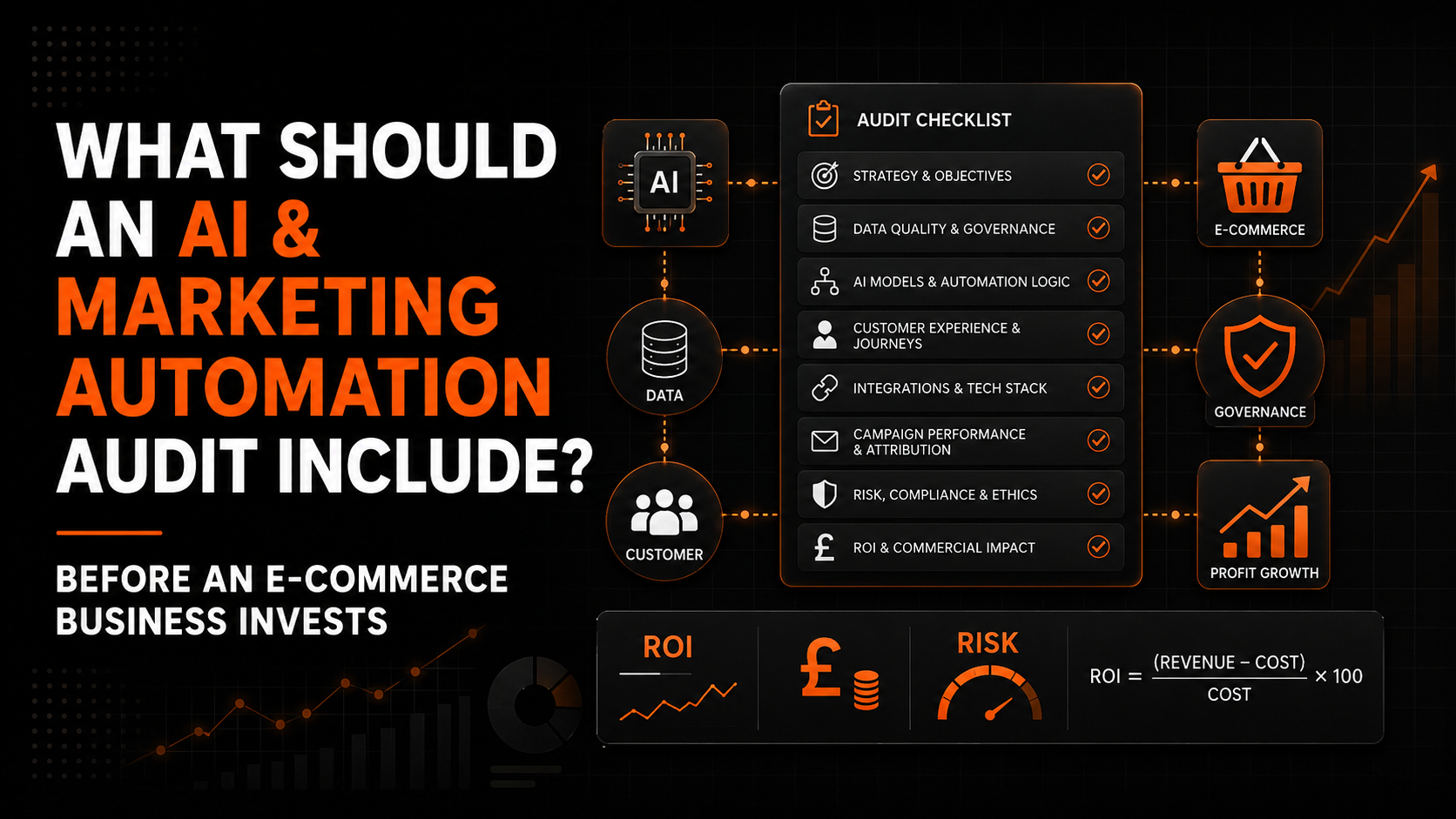
What should an AI and marketing automation audit include before an e-commerce business invests? It should examine the commercial case, existing processes, data quality, technology stack, customer experience, legal and privacy risks, vendor terms, implementation costs and measurement plan.
The key question is not, “Can this process be automated?” It is:
Will this investment create measurable incremental profit without damaging customer trust, brand control, data protection or operational resilience?
An impressive demonstration is not a business case. Before committing budget, an e-commerce company needs evidence that the proposed system solves a valuable problem, has access to reliable and lawful data, can operate safely within existing workflows and can be tested against a credible baseline.
The audit should ultimately give the leadership team one of four decisions:
- Proceed with a controlled pilot.
- Fix the data, process or governance before investing.
- Select a different technology or delivery model.
- Reject the investment because the expected value does not justify the cost and risk.
Start with the commercial problem—not the AI tool
AI and automation projects often begin with a vendor presentation, a tool recommendation or an internal request to “do more with AI”. That reverses the correct order.
Start by identifying a specific commercial or operational constraint. Possible objectives include:
- Increasing e-commerce conversion rate.
- Reducing customer-acquisition cost.
- Increasing average order value.
- Improving repeat purchases and retention.
- Recovering abandoned baskets.
- Increasing email or SMS contribution profit.
- Reducing customer-service workload.
- Improving product recommendations and merchandising.
- Reducing stock-outs or excess inventory.
- Improving campaign analysis and budget allocation.
- Accelerating creative, content or product-feed production.
- Reducing manual reporting and data preparation.
For every proposed investment, document:
| Audit question | What the business must establish |
|---|---|
| What problem is being solved? | The current commercial or operational constraint |
| What will be automated? | The exact task, decision or workflow |
| What is the baseline? | Current revenue, cost, time, error rate or capacity |
| What should improve? | A measurable commercial or operational outcome |
| What will it cost? | Technology, integration, people and ongoing management |
| What is the expected payback? | When incremental value should recover the investment |
| What happens if it fails? | Financial, customer, legal and operational consequences |
| Who owns the result? | Named commercial, technical and approval owners |
Reject vague objectives such as “improve personalisation” or “increase efficiency”. Replace them with testable hypotheses.
For example:
“Product recommendations will increase contribution profit per eligible session by at least 8%, without increasing refunds, complaints or page-load time beyond agreed limits.”
This statement establishes the customer group, outcome, required improvement and guardrail metrics.
Audit the process before automating it
Automation can make a good process faster. It can also scale an inefficient or poorly controlled process.
Map the existing workflow before introducing technology:
- What starts the process?
- Which data is collected?
- Who currently makes the decision?
- What rules or judgement are applied?
- Which systems are updated?
- What reaches the customer?
- Which exceptions occur?
- How are errors discovered and corrected?
- How much time and money does the process consume?
- Which part genuinely requires intelligence rather than a simple rule?
This may reveal that the business does not need an AI agent. A deterministic automation, improved integration, reporting rule or better staff procedure may solve the problem more cheaply and predictably.
Prioritise processes using commercial value and feasibility
Score each proposed use case against:
- Revenue or cost-saving potential.
- Frequency and volume.
- Current manual effort.
- Error and customer-impact risk.
- Data readiness.
- Integration complexity.
- Ability to test the outcome.
- Time to value.
A useful directional calculation is:
Automation priority score = Commercial value × process frequency × implementation feasibility × measurement confidence
This is not a financial formula. It is a structured way to compare opportunities and prevent the most exciting technology from automatically receiving the highest priority.
Audit data quality, ownership and access
AI and automation can process unreliable data faster, but they cannot turn poor inputs into dependable decisions.
Review:
- Product catalogue accuracy.
- Prices, promotions, stock and availability.
- Customer and order records.
- Product margin and fulfilment costs.
- Returns, refunds and cancellations.
- Marketing consent and preference data.
- Website, app and server-side events.
- Customer identifiers and duplicate records.
- Historical campaign and creative data.
- Attribution and conversion definitions.
- Data freshness and update frequency.
- Missing, inconsistent or biased records.
- Data ownership, portability and export access.
For example, a product-recommendation system may appear accurate while recommending unavailable items, low-margin products or variants with high return rates. A marketing-budget agent may optimise towards platform-attributed revenue that is duplicated or does not represent incremental profit.
Establish data lineage
For every important AI output, document:
- Where the data originated.
- How and why it was collected.
- Which consent or lawful basis applies.
- How the data is cleaned and transformed.
- Which model, prompt or rule uses it.
- Where the output is stored.
- Which system acts on it.
- How the action is logged.
- How the decision can be reversed or corrected.
If the business cannot explain where a recommendation, audience, score or automated decision came from, it should not allow that output to act autonomously at scale.
Determine whether sufficient historical data exists
More data is not always better; relevant, accurate and representative data matters more.
Check whether the historical period includes:
- Normal and promotional trading.
- Seasonal demand.
- Product launches and discontinued lines.
- Stock-outs.
- Changes in price and fulfilment.
- New and returning customers.
- Different markets and devices.
- Refund and return outcomes.
Training or evaluating a system on one unusually strong sale period can create recommendations that fail during normal trading.
Map the proposed automation from trigger to outcome
Do not audit only the AI model or software interface. Review the complete system.
A workflow map should show:
- Trigger.
- Data inputs.
- AI or automation step.
- Prediction, recommendation or generated output.
- Business rules.
- Human approval where required.
- Customer-facing or operational action.
- Logging and audit trail.
- Exception handling.
- Escalation route.
- Reversal or rollback.
For example:
New customer completes an order → the system predicts the next-best product → stock, margin and suppression rules are checked → an email is prepared → human approval is applied during the pilot → the message is sent only where marketing permission exists → revenue, profit, complaints and unsubscribes are measured.
This exposes risks hidden by a vendor demonstration.
Audit whether the system can:
- Send email, SMS or push notifications.
- Change advertising bids or budgets.
- Create or publish website content.
- Change prices or promotions.
- Create discount codes.
- Suppress or prioritise customers.
- Recommend unavailable or unsuitable products.
- Modify customer or product records.
- Share data with third parties.
- Trigger fulfilment or service actions.
The greater the financial or customer impact, the stronger the approval thresholds, limits and rollback controls should be.
Decide how much autonomy the system should have
Not every use case requires the same level of control.
| Autonomy level | Example | Appropriate control |
| Advisory | AI highlights declining campaign performance | Human decides what to change |
| Drafting | AI prepares an email or product description | Human reviews before publishing |
| Rules-based execution | Workflow sends an approved message after a known trigger | Pre-approved rules and monitoring |
| Bounded optimisation | System adjusts bids within agreed limits | Caps, alerts and rollback |
| Autonomous action | Agent selects and completes multi-step actions | Strong testing, permissions and continuous oversight |
Begin with the minimum autonomy required to create value. A system does not become more commercially useful merely because it can operate without approval.
For budget changes, pricing, customer suppression, legal claims and high-volume communications, human review or tightly bounded authority may be essential.
Test AI quality and reliability
NIST’s AI Risk Management Framework identifies characteristics of trustworthy AI including validity and reliability, safety, security and resilience, accountability and transparency, explainability and interpretability, privacy enhancement and fairness with harmful bias managed.
An e-commerce AI and marketing automation audit should test:
- Accuracy: Does it generate correct and commercially useful outputs?
- Reliability: Does it perform consistently over time and across markets?
- Freshness: How quickly does it reflect price, stock and customer changes?
- Robustness: What happens with missing, unusual or contradictory inputs?
- Explainability: Can the team understand why an action was recommended?
- Safety: Can it create harmful, misleading or inappropriate content?
- Security: Can users or external inputs manipulate the workflow?
- Fairness: Does performance differ materially across customer groups?
- Resilience: What happens when an API, model or integration fails?
- Monitoring: Who is alerted when quality or behaviour deteriorates?
Do not rely on phrases such as “AI-powered”, “self-learning” or “enterprise-grade”. Request evidence from relevant use cases, test on the company’s own data and define minimum acceptable performance before deployment.
Test failure scenarios—not only normal prompts
Include:
- Missing prices or stock.
- Conflicting customer records.
- Prompt-injection attempts.
- Abusive customer inputs.
- Unsupported languages.
- Product names that resemble prohibited topics.
- Hallucinated discounts or delivery promises.
- API downtime.
- Duplicate triggers.
- Extremely high message or spend volumes.
The test should establish whether the system fails safely and whether the team can intervene quickly.
Calculate the total cost of ownership
The monthly licence is only one component.
Include:
- Software subscriptions and API usage.
- Implementation and integration.
- Data warehouse or customer-data platform costs.
- Feed and catalogue maintenance.
- Agency or consultant fees.
- Internal development and project management.
- Staff training and process redesign.
- Human review and quality assurance.
- Legal, privacy and security review.
- Monitoring and troubleshooting.
- Additional media, email or SMS costs.
- Vendor lock-in and migration.
- Cost of incorrect decisions and customer complaints.
- Contingency for usage growth.
A worked investment example
Suppose a business considers an automated retention programme:
| Investment component | Year-one cost |
| Platform and API fees | £24,000 |
| Implementation and integration | £18,000 |
| Internal staff and training | £12,000 |
| Monitoring, content review and support | £10,000 |
| Total year-one investment | £64,000 |
The pilot estimates £150,000 of incremental revenue. Those orders carry £75,000 of product, fulfilment, payment and return costs.
Incremental contribution before technology = £150,000 − £75,000 = £75,000
Net incremental profit after technology = £75,000 − £64,000 = £11,000
AI and automation ROI = £11,000 net incremental profit ÷ £64,000 investment × 100 = 17.2%
That is very different from claiming the system generated £150,000 of revenue.
Measure incremental value—not attributed activity
The system’s dashboard may claim revenue from customers who would have purchased anyway. Measure against a credible counterfactual.
Use:
- Randomised customer holdouts.
- Matched geographic tests.
- Product or page cohorts.
- Controlled workflow pilots.
- Forecast versus actual with relevant controls.
- Manual-versus-automated processing comparisons.
The commercial calculation is:
Incremental profit = Additional revenue caused by the system − product costs − fulfilment − returns − marketing costs − technology costs
Useful metrics include:
- Incremental contribution profit.
- Revenue or profit per eligible customer.
- Conversion rate.
- Average order value.
- New-customer CPA.
- Repeat-purchase rate.
- Customer lifetime value.
- Payback period.
- Unsubscribe and complaint rates.
- Customer-service resolution time.
- Manual hours saved.
- Automation error and exception rates.
Time saved has value only if it reduces cost, increases capacity or enables higher-value work. Recording 500 saved hours without explaining what the business did with those hours is not a complete ROI case.
Review privacy, profiling and direct-marketing compliance
For a UK e-commerce business, the audit should consider UK GDPR, PECR, ICO guidance and any sector-specific obligations. This is not legal advice; material or uncertain risks should be reviewed by qualified privacy or legal professionals.
The ICO provides an AI and data-protection risk toolkit to help organisations assess risks to individuals’ rights and freedoms.
Establish:
- The lawful basis for collecting and using personal data.
- Whether profiling is taking place.
- What information is provided to customers.
- Whether people can object to direct marketing and related profiling.
- Whether consent is required for email, SMS, cookies or similar technologies.
- Whether data is shared with vendors or used for model training.
- Where data is processed and transferred.
- How long data is retained.
- How access, deletion and correction requests are handled.
- Whether special-category or sensitive data is involved.
- Whether a Data Protection Impact Assessment is required.
- Whether automated decisions could have legal or similarly significant effects.
The ICO states that UK GDPR restricts solely automated decisions, including profiling, that produce legal or similarly significant effects. It also identifies an absolute right to object to profiling for direct-marketing purposes.
Most ordinary product recommendations will not automatically be significant decisions, but the business should assess the actual use case rather than assume the rules do not apply.
Assess customer expectation and trust
Lawful processing can still feel intrusive or inappropriate.
Ask:
- Would customers reasonably expect this use of their information?
- Does the personalisation reveal sensitive or uncomfortable inferences?
- Can the customer understand and control the experience?
- Is the frequency helpful or excessive?
- Does automation make support harder to access?
- Could an error cause embarrassment, discrimination or financial harm?
Customer trust should be a measured guardrail, not a vague brand principle.
Assess vendor, model and platform risk
Before signing, audit the supplier’s:
- Data-processing agreement.
- Subprocessors and underlying model providers.
- Model-training policy.
- Data retention and deletion.
- Security and access controls.
- Service levels and uptime.
- Incident-notification process.
- Export and portability options.
- Intellectual-property terms.
- Liability for inaccurate or harmful outputs.
- Business continuity arrangements.
- Support and escalation.
- Ability to disable or restrict automation immediately.
Ask directly:
- Will our customer or commercial data train models for other customers?
- Is a private or non-training mode available?
- Where is information processed?
- Which data leaves our environment?
- Can we audit prompts, inputs, outputs and actions?
- Can permissions be limited by role and action?
- Can we export workflows, history and configuration?
- What happens to our data if we cancel?
- Can we return the system to human approval instantly?
- What happens if the vendor or underlying model is unavailable?
Government AI-procurement guidance recommends assessing system viability and being transparent about the tools, data and algorithms involved. Commercial organisations can apply the same principle even when the procurement process is less formal.
Avoid hidden vendor lock-in
Understand whether business logic, prompts, training examples, customer segments and workflow history can be moved elsewhere. A cheap pilot can become expensive if all operational knowledge is trapped inside one proprietary platform.
Review integration with the existing technology stack
Map the proposed system against:
- E-commerce platform.
- CRM and customer-service tools.
- Email and SMS platforms.
- Google Ads, Microsoft Ads and Meta Ads.
- GA4 and server-side tracking.
- Product-information management.
- Inventory and order management.
- Data warehouse and BI reporting.
- Consent-management platform.
- Finance and profitability data.
Identify:
- Duplicate functionality.
- Conflicting customer records.
- Competing automation rules.
- API rate and cost limits.
- Authentication and permission risks.
- Timing and data-freshness problems.
- Which system is the source of truth.
An AI agent that reads stale stock data or overwrites CRM fields can create more operational work than it removes.
Test customer experience and brand control
Review customer-facing outputs for:
- Tone of voice.
- Product and pricing accuracy.
- Claims and substantiation.
- Brand terminology.
- Accessibility.
- Cultural and geographic appropriateness.
- Repetition and message frequency.
- Complaint and escalation handling.
- Disclosure where required or appropriate.
Create approved content rules, prohibited claims, escalation categories and examples of acceptable outputs.
Human approval should remain where an error could materially affect:
- Price or discount.
- Customer eligibility.
- Health, safety or financial claims.
- Legal or regulatory information.
- High-value advertising budgets.
- Public brand statements.
- Vulnerable customers.
Design a controlled pilot
Do not move directly from vendor demonstration to business-wide deployment.
A credible pilot contains:
- One defined workflow, customer segment or product category.
- A control or manual comparison.
- A pre-agreed duration.
- Sufficient sample size or transaction volume.
- One primary success measure.
- Secondary guardrail metrics.
- Named owners.
- Human review for material outputs.
- Logging and monitoring.
- A rollback plan.
Example pilot criteria:
| Measure | Example success criterion |
| Incremental contribution profit | Positive and greater than pilot cost |
| Conversion rate | At least 5% relative improvement |
| Average order value | No decline beyond agreed tolerance |
| Refund rate | No material increase |
| Unsubscribe rate | Within agreed tolerance |
| Output error rate | Below the operational threshold |
| Human-review time | Lower than the manual baseline |
| Customer complaints | No material increase |
The actual thresholds should reflect the use case, baseline and risk. Set them before seeing the results.
Build governance and accountability
AI and automation require ongoing ownership after launch.
Assign responsibility for:
- Commercial performance.
- Data quality.
- Model and workflow behaviour.
- Compliance and privacy.
- Customer complaints.
- Content and brand approval.
- Budget and action limits.
- Security and incident response.
- Testing and monitoring.
- Vendor management.
- Renewal and termination decisions.
Maintain:
- An inventory of AI and automation tools.
- Approved and prohibited use cases.
- Data-flow documentation.
- Model, prompt and workflow versions.
- Change logs.
- Test and evaluation results.
- Exception and incident records.
- Human approvals.
- Customer-impact reviews.
NIST structures AI risk management around four functions: govern, map, measure and manage. This is a useful operational principle: define accountability, understand the context, measure performance and risk, then manage the system throughout its lifecycle.
The UK Government’s 2026 AI Management Essentials guidance similarly focuses on helping organisations assess and improve the processes used to manage AI responsibly.
Build monitoring and stop conditions
Define alerts for:
- Spend or message volume exceeding limits.
- Unusual conversion or error rates.
- Stale stock and pricing data.
- Falling model accuracy.
- Increased complaints or unsubscribes.
- Missing logs.
- Security or permission changes.
- Vendor downtime.
- Outputs outside approved categories.
Every automated system needs a clear answer to:
“Who can stop it, and how quickly?”
Document the shutdown process, manual fallback and customer-remediation plan.
AI and marketing automation investment framework
| Audit result | Recommended decision |
| Valuable problem, reliable data and measurable pilot | Proceed with controlled investment |
| Attractive use case but poor data quality | Repair data before deployment |
| Process is inefficient or undefined | Redesign the workflow first |
| Simple rules can solve the problem | Use conventional automation rather than AI |
| Vendor cannot explain data use or model dependencies | Pause procurement until terms improve |
| Customer-facing action lacks review or rollback | Add safeguards before launch |
| Dashboard revenue improves but holdout profit does not | Do not scale |
| Strong low-risk operational saving | Consider phased rollout |
| AI produces inconsistent or unsafe output | Retain human approval or reject the use case |
| Benefits are vague and based on industry hype | Redesign or reject the business case |
A 90-day readiness and pilot plan
Days 1–30: Audit and prioritise
- Map processes and pain points.
- Establish financial and operational baselines.
- Audit data, consent and technology.
- Score potential use cases.
- Select one commercially valuable, measurable pilot.
Days 31–60: Configure and control
- Complete vendor and security review.
- Map the workflow and permissions.
- Create approval, monitoring and rollback controls.
- Integrate only the data needed for the pilot.
- Test normal and failure scenarios.
Days 61–90: Test and decide
- Run the controlled pilot.
- Measure incremental profit and guardrails.
- Review errors, customer impact and staff workload.
- Document lessons and operating costs.
- Scale, revise or stop based on predefined criteria.
The purpose is not to deploy AI within 90 days at any cost. It is to reach a defensible investment decision efficiently.
Final audit checklist
Before investing, confirm that:
- The use case solves a specific and valuable business problem.
- Baseline performance and expected improvement are documented.
- A simpler automation has been considered.
- Data is accurate, sufficient, current and lawfully processed.
- Customer, product, margin and consent data are properly mapped.
- Data lineage and systems of record are documented.
- The full workflow, exceptions and customer actions are understood.
- The AI output can be tested, explained and monitored.
- Human approval and override exist for material actions.
- Vendor data, security, retention and training terms are acceptable.
- Integration risks and ongoing costs are understood.
- UK GDPR, PECR, profiling and automated-decision risks have been assessed.
- Brand and customer-experience guardrails exist.
- A controlled pilot has a baseline or control group.
- Success is measured using incremental contribution profit.
- The business owns its data, configuration and customer relationships.
- A rollback plan and accountable owner are in place.
Frequently asked questions
What is an AI and marketing automation audit?
It is a structured assessment of proposed or existing AI and automation use cases, covering commercial value, workflows, data, technology, customer impact, risk, vendors, costs and measurement.
Should an e-commerce business audit before choosing a tool?
Yes. The audit should define the problem and requirements before vendor selection. Otherwise, the business risks adapting its priorities to the capabilities of whichever tool it sees first.
Does every marketing automation project need AI?
No. Predictable workflows with stable rules may be cheaper, safer and easier to maintain using conventional automation. Use AI where judgement, prediction, language or adaptation creates material additional value.
How long should an AI automation pilot run?
It depends on transaction volume, seasonality and the outcome being measured. The pilot should run long enough to produce a meaningful commercial comparison without extending so long that uncontrolled changes make the result difficult to interpret.
Who should own AI marketing automation?
Ownership should be shared but explicit. A commercial owner is accountable for the outcome, a technical owner for integration and reliability, and appropriate privacy, security and brand owners for their respective risks.
What is the most important ROI metric?
Incremental contribution profit is generally the strongest investment measure because it considers additional revenue, variable costs, marketing costs and technology costs. Time savings and customer outcomes should also be reported where relevant.
The practical answer
An AI and marketing automation audit before an e-commerce business invests should cover the business case, process, data, technology, autonomy, customer experience, privacy, vendor risk, total costs, measurement, governance and rollback controls.
The right question is not whether AI can create more content, make more decisions or send more messages. It is whether the system can generate measurable incremental value safely, lawfully and reliably—with enough transparency for the business to know when it is working and when it should be switched off.
Book a Strategy Call
If you are considering an AI or marketing automation investment, Clubbish can audit your processes, data, technology stack, commercial opportunity and implementation risks—then create a prioritised roadmap focused on measurable incremental profit.