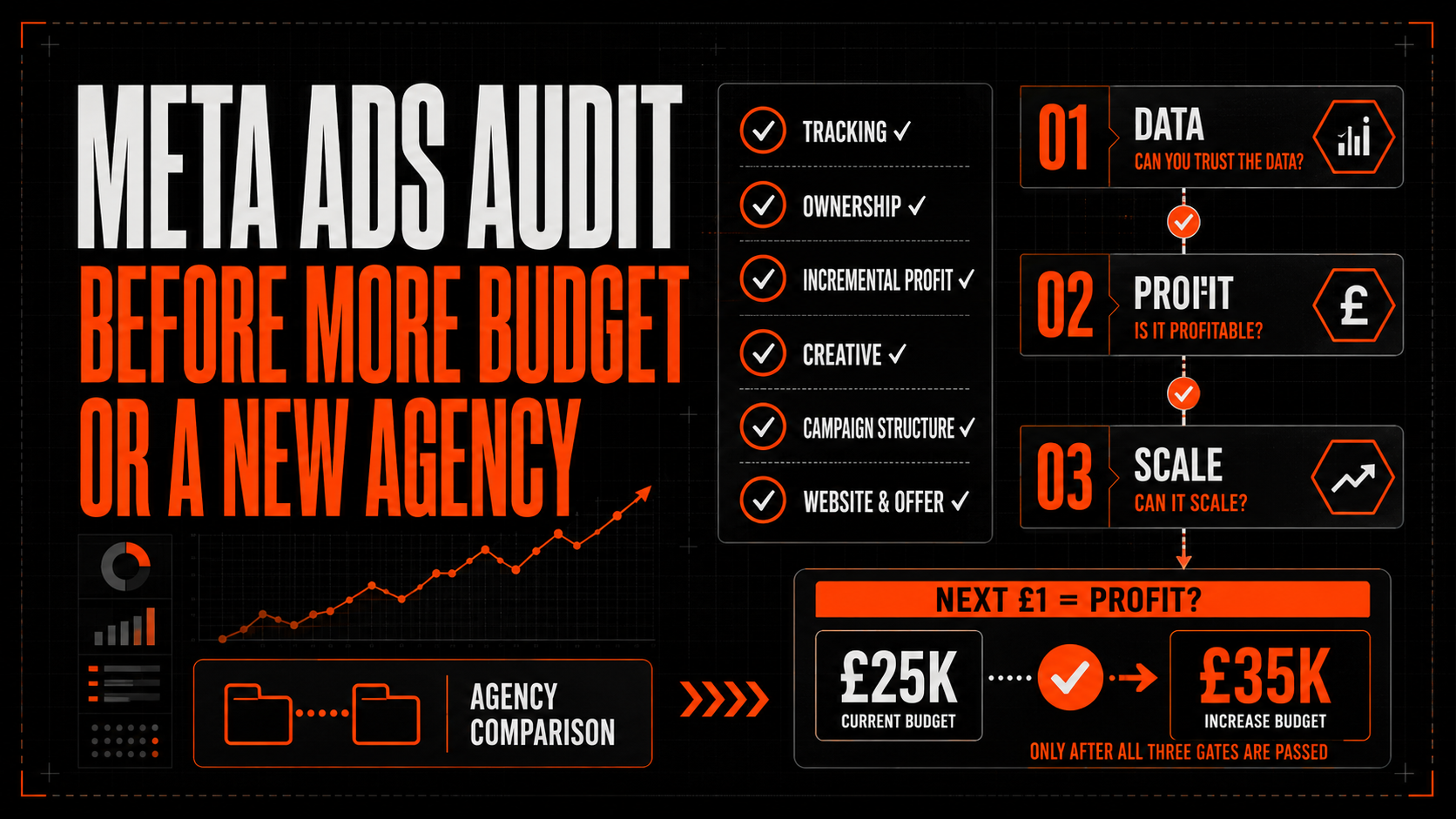
What should a Meta Ads audit include before increasing budget or changing agency? It should establish whether the business owns and controls its advertising assets, whether purchase data is reliable, whether campaigns generate profitable and incremental sales, and whether there is a credible opportunity to scale.
A high Meta-reported ROAS is not enough evidence to increase investment or judge an agency. The platform can attribute revenue to customers who may have purchased anyway, poor tracking can inflate results and an acceptable historic average can conceal unprofitable marginal spend.
The audit should answer three commercial questions:
- Can the performance data be trusted?
- Is Meta generating profitable and incremental business growth?
- Is there a defensible plan for the next pound of budget?
If the answer to any of these questions is unclear, resolve it before committing more budget or moving the account to another agency.
1. Business ownership, access and security
Start with control of the assets. The e-commerce business—not an employee, freelancer or agency—should own the Meta Business Portfolio and the core assets required to operate its advertising.
Meta distinguishes between full control and partial access for business portfolios and assets. Agencies should normally receive appropriate partner access rather than becoming the only party capable of administering the account.
Confirm ownership and access for:
- Meta Business Portfolio.
- Advertising account.
- Facebook Page.
- Instagram account.
- Dataset and Meta Pixel.
- Conversions API integration.
- Product catalogue and commerce assets.
- Verified domain.
- Custom audiences and saved audiences.
- Custom conversions.
- Payment methods, invoicing and spending limits.
- Connected apps, partners and system users.
Document the relevant business, ad-account, dataset, catalogue and page IDs. Review every person, partner, agency, app and integration with access. Remove unexplained or obsolete permissions after the business has confirmed they are no longer required.
Why ownership matters during an agency change
Changing agency should not require rebuilding the ad account, losing historical performance or abandoning the catalogue. Meta provides partner-access processes, and its guidance notes that a catalogue owned by a partner’s Business Portfolio may need an ownership-transfer request.
An ownership problem can delay handover, interrupt campaigns and weaken the new agency’s ability to learn from previous activity. It also creates unnecessary commercial dependence on the outgoing supplier.
The audit should record:
- Who legally and operationally controls each asset.
- Which two or more senior internal users have full control.
- Which agency partners have access and why.
- Whether two-factor authentication and security policies are enforced.
- Whether any asset is owned by an individual account or external portfolio.
- What must be transferred or corrected before a handover.
Do not remove a current agency before replacement access and ownership are safely established. The goal is a controlled handover, not an avoidable loss of delivery or data.
2. Purchase tracking and data quality
Measurement should be the first technical part of the Meta Ads audit. If Meta is receiving incorrect purchase counts or values, every conclusion about campaigns, creative, bidding and agency performance becomes unreliable.
Meta Events Manager provides tools for checking event delivery and diagnostics. Its Test Events tool can be used to verify and troubleshoot browser and app or server event implementations.
Audit the following:
- The correct dataset and domain are connected to the account.
- The Meta Pixel loads on all relevant website pages.
- Purchase fires only after a completed order.
- Purchase value and currency are dynamic and accurate.
- Browser and server Purchase events represent the same real transaction.
- Event names and event IDs support correct deduplication.
- Test orders, declined payments and cancelled checkouts are not counted as valid sales.
- Product IDs match the catalogue where required.
- ViewContent, AddToCart, InitiateCheckout and Purchase form a logical funnel.
- Consent implementation and signal loss are documented.
- Event Match Quality, coverage and data freshness are monitored.
- Event priorities and custom conversions support the intended optimisation.
Meta Pixel and Conversions API deduplication
Many e-commerce stores send the same purchase through the browser-based Meta Pixel and the server-side Conversions API. This can improve signal resilience, but the two messages must be recognised as one commercial event.
Meta’s deduplication guidance requires matching identifiers so the browser and server versions can be treated as the same event. If deduplication fails, one order can appear as two purchases.
For example:
100 real orders + failed browser/server deduplication could create 200 reported Purchase events.
That would make CPA appear half its true level and could approximately double attributed purchase value.
Check Events Manager’s event-deduplication details and run controlled test transactions. For each test order, record:
- Shopify or store order ID.
- Event ID.
- Purchase value.
- Currency.
- Browser event timestamp.
- Server event timestamp.
- Whether Meta treated the two messages as one purchase.
Reconcile Meta with store data
Compare Meta’s results with:
- Shopify or the e-commerce platform.
- Payment-provider transactions.
- GA4 purchase events and transaction IDs.
- Refund and cancellation records.
- Order-management or finance data.
Start with order counts before comparing revenue. If the purchase counts broadly reconcile but values do not, investigate shipping, tax, discounts, currency, refunds and static values.
Meta, GA4 and Shopify will not attribute channel revenue identically. Meta may include click-through and eligible view-through credit; GA4 uses its own reporting model; Shopify offers separate marketing attribution models. The audit should explain normal attribution differences without accepting impossible event totals.
3. Revenue, margin and profitability
Meta ROAS is revenue attributed under the platform’s reporting rules divided by advertising spend. It does not include product cost, fulfilment, payment fees, discounts or returns.
Calculate contribution profit:
Contribution profit after advertising = Revenue − cost of goods − fulfilment − payment fees − discounts − expected returns − Meta spend
Suppose Meta reports £100,000 of revenue from £25,000 of spend—a 4x ROAS. The attributed orders have the following economics:
| Commercial item | Amount |
|---|---|
| Attributed revenue | £100,000 |
| Cost of goods | −£45,000 |
| Fulfilment and payment fees | −£12,000 |
| Discounts and expected returns | −£10,000 |
| Meta spend | −£25,000 |
| Contribution profit | £8,000 |
The campaign is profitable in this illustration, but the available contribution is much smaller than the £100,000 headline.
The audit should segment performance by:
- Product category and margin.
- Return and cancellation rate.
- Average order value.
- New versus returning customers.
- First-order versus repeat-purchase revenue.
- Prospecting versus retargeting.
- Geography and fulfilment cost.
- Discounted versus full-price orders.
- Subscription versus one-off purchase.
Calculate break-even ROAS
Use pre-ad contribution margin:
Break-even ROAS = 1 ÷ pre-ad contribution margin
If £100 of revenue leaves £30 after product and variable selling costs, the pre-ad contribution margin is 30%:
Break-even ROAS = 1 ÷ 0.30 = 3.33x
A reported 3x ROAS would be below first-order break-even in that example. A higher target may be needed to fund overhead and profit.
Where lifetime value supports a lower first-order return, demand customer-cohort evidence and a defined payback period. Do not rely on a blended lifetime-value forecast that hides differences between acquisition sources.
4. Attribution and incrementality
Attribution asks whether Meta can associate a purchase with an ad interaction. Incrementality asks whether the purchase happened because of the advertising.
This matters particularly for:
- Retargeting.
- Existing-customer campaigns.
- High-frequency catalogue activity.
- Promotional periods.
- Strong branded demand.
- Campaigns with unusually high reported ROAS but limited total-store growth.
Review Meta’s attribution settings and compare click-only results with view-inclusive results where the account allows. Document reporting windows, conversion lag and date conventions.
Then compare Meta performance with:
- Total-store revenue.
- New-customer orders and revenue.
- Blended MER.
- Direct and organic traffic.
- Branded Google Search behaviour.
- Email and repeat-purchase performance.
- Total contribution profit.
If Meta-attributed revenue increases while total-store revenue and new customers remain flat, the account may be reallocating credit rather than creating proportional growth.
Test incremental impact
For material investment, the audit should recommend a causal test where feasible. Meta Conversion Lift is designed to estimate incremental effect using test and holdout groups. A geographic holdout can be an alternative when user-level testing is unavailable or when the business wants to evaluate total commercial impact.
Calculate:
Incremental ROAS = Incremental revenue caused by Meta ÷ Meta spend
Preferably, calculate:
Incremental contribution profit = Incremental revenue − variable product and selling costs − Meta spend
Meta notes that Conversion Lift and ordinary Ads Manager reporting answer different questions and should not be expected to produce matching results.
5. Campaign structure and optimisation strategy
The account structure should reflect the commercial strategy without fragmenting data unnecessarily.
Review:
- Campaign objectives.
- Optimisation and performance goals.
- Advantage+ sales campaign configuration.
- Advantage+ campaign budget versus ad-set budgets.
- Prospecting, retargeting and retention structure.
- Existing-customer and recent-purchaser controls.
- New-customer acquisition priorities.
- Audience overlap and unnecessary duplication.
- Geographic and market separation.
- Bid strategies and cost controls.
- Placement configuration.
- Catalogue and product-set structure.
- Campaign spending limits and automated rules.
Meta describes Advantage+ sales campaigns as a more automated approach designed to improve sales-campaign efficiency. Automation is not automatically appropriate for every commercial need. The audit should establish whether it has sufficient signal quality and whether the business retains necessary controls over markets, products, budgets and customer types.
Avoid account fragmentation
Too many campaigns and ad sets can split purchase data, slow learning and make tests inconclusive. Too little separation can hide unprofitable products, markets or returning-customer activity.
Use a distinct campaign or ad set when there is a genuine difference in:
- Objective.
- Margin or product economics.
- Market and currency.
- Customer type.
- Offer or landing page.
- Budget responsibility.
- Test hypothesis.
Do not create separate structures for minor audience differences without a commercial reason.
6. Budget allocation and marginal performance
An account can have a profitable historic average while the latest budget increases lose money.
Calculate marginal CPA:
Marginal CPA = Additional spend ÷ additional purchases
Suppose spend rises from £20,000 to £25,000 and purchases increase from 800 to 900:
Marginal CPA = £5,000 additional spend ÷ 100 additional purchases = £50
The account’s average CPA is approximately £27.78, but the additional budget acquired purchases at £50 each. If allowable CPA is £35, scaling has moved beyond the profitable range.
Audit:
- Budget by prospecting, retargeting and retention.
- Spend by product margin and stock position.
- Campaigns losing impression opportunity while profitable.
- Campaigns consuming spend without contribution profit.
- Daily and monthly pacing.
- Budget and bid changes in Change History.
- Results before and after each significant increase.
- Marginal new-customer CPA.
- Marginal contribution profit.
Budget should increase only where the next pound has a credible opportunity to meet the required economics.
7. Creative strategy and fatigue
Creative determines which customer problems, motivations and awareness levels the account can reach. An audit should evaluate concepts—not only individual ad IDs.
Review:
- Frequency by prospecting and retargeting.
- CPM, CTR, CPC and landing-page view rate.
- Website conversion rate.
- CPA and ROAS by concept.
- New-customer acquisition by creative.
- Creative-fatigue warnings.
- Spend concentrated in a small number of ads.
- Placement-specific formats.
- Hooks, demonstrations, offers, proof and objections.
- Comment quality and negative feedback.
- Production and testing cadence.
- Whether new concepts enter before winners deteriorate.
Group assets by commercial idea. Five minor edits to one discount message are not five distinct concepts.
The audit should identify:
- Which concepts attract profitable new customers.
- Which work primarily in retargeting.
- Which generate clicks but weak purchase intent.
- Which have scalable audience reach.
- Which are fatigued and require replacement.
- Which customer insights should guide the next production cycle.
8. Audience quality and customer acquisition
Review audiences in commercial rather than purely technical terms.
Inspect:
- Audience size and overlap.
- Prospecting and retargeting pools.
- Customer-list freshness and match quality.
- Seed quality for lookalikes where used.
- Exclusion of recent purchasers from acquisition activity.
- Advantage+ audience settings and expansion.
- Reach and frequency.
- New-customer share.
- Lifetime value and repeat purchasing.
- Geographic and demographic performance.
An account can report strong ROAS while primarily selling to returning customers. Measure new-customer CPA separately and compare the resulting cohorts with customers acquired through Google, email and other channels.
The audit should determine whether broader automated delivery is finding additional profitable customers or merely widening exposure without improving total-store outcomes.
9. Catalogue and product-feed health
For e-commerce, the product catalogue is a core advertising input. Meta Advantage+ catalogue ads select relevant products using catalogue data and observed intent.
Check:
- Product approval and diagnostics.
- Catalogue ownership and permissions.
- Item IDs and event-content IDs.
- Product titles and descriptions.
- Price, sale price and currency.
- Availability and stock updates.
- Variants and parent-child relationships.
- Product images and aspect ratios.
- Landing-page URLs.
- Product sets and exclusions.
- Margin, return-rate and stock segmentation.
Poor catalogue data can send customers to unavailable products, show the wrong price or prevent Meta from matching purchase value with the correct item.
Create product sets that support the commercial strategy, such as:
- High-margin bestsellers.
- New products.
- Low-stock exclusions.
- High-return items.
- Seasonal ranges.
- Clearance products.
- Strong repeat-purchase categories.
Do not give every SKU equal access to budget when their economics differ materially.
10. Website, offer and checkout
Meta cannot compensate indefinitely for a weak buying experience. Review the complete journey from advert to purchase:
- Message match between creative and landing page.
- Mobile speed and usability.
- Product information and imagery.
- Price competitiveness.
- Stock and variant selection.
- Delivery costs and dates.
- Returns policy.
- Reviews, guarantees and trust signals.
- Promotion consistency.
- Payment methods and checkout errors.
- Bundles, upsells and AOV opportunities.
- Conversion rate by device, page and campaign.
A high CTR with weak conversion can indicate curiosity rather than qualified purchase intent, a misleading creative promise or a landing-page problem.
The audit should separate media issues from trading issues. Changing targeting will not fix an unavailable bestseller or broken mobile checkout.
11. Reporting and agency accountability
A strong agency should explain what changed, why it changed, what happened afterwards and what it recommends next.
Request:
- Twelve months of account and campaign performance.
- Prospecting versus retargeting results.
- New versus returning customer performance.
- Contribution-profit reporting or a plan to create it.
- Meta, GA4 and Shopify reconciliation.
- Creative-concept and fatigue reporting.
- Change History and budget records.
- A test log containing hypotheses, dates, variables and outcomes.
- Unsuccessful tests and lessons—not only winning examples.
- Automated rules, external tools and integrations.
- A 90-day plan with commercial targets and stop conditions.
Ask the agency:
- How much additional spend can be deployed profitably?
- What is the marginal CPA from recent increases?
- Which campaigns acquire incremental new customers?
- Which products deserve more or less budget?
- Which creative concepts are expanding qualified demand?
- How are returns, margin and lifetime value reflected in targets?
- What evidence supports the next proposed change?
Weak performance in one month does not automatically justify replacing an agency. A repeated absence of measurement discipline, transparency and commercial accountability is more significant.
A 90-day agency improvement plan
When the audit identifies weaknesses but the relationship remains viable, set a structured improvement period.
Days 1–30: Repair the foundation
- Resolve ownership and access.
- Fix Pixel, Conversions API and purchase values.
- Reconcile store and Meta reporting.
- Calculate margin-informed CPA and ROAS guardrails.
- Remove obvious catalogue, audience and budget waste.
Days 31–60: Test the growth hypotheses
- Restructure only where commercially justified.
- Launch distinct creative concepts.
- Improve high-impact landing-page or offer problems.
- Test new-customer acquisition separately.
- Record hypotheses and predefined success measures.
Days 61–90: Prove commercial progress
- Compare marginal performance with the baseline.
- Review new-customer contribution and cohort quality.
- Assess total-store growth and blended efficiency.
- Define the next scaling opportunity.
- Decide whether the agency has demonstrated adequate capability and accountability.
The plan needs measurable outcomes, named owners and deadlines. It should not become another period of unexplained optimisation.
Audit decision framework
| Audit finding | Recommended action |
| Tracking is unreliable | Fix measurement before increasing budget or judging performance |
| High Meta ROAS but flat store revenue | Review attribution, customer mix and incrementality |
| Profitable activity is budget-constrained | Increase carefully and monitor marginal contribution profit |
| Recent budget increases have high marginal CPA | Hold or reallocate the additional spend |
| Creative fatigue is evident | Introduce new concepts and improve the production pipeline |
| Low-margin products absorb budget | Restructure catalogue sets and value signals |
| Website conversion is deteriorating | Fix the trading experience before buying more traffic |
| Agency cannot provide access or history | Resolve ownership and transparency immediately |
| Performance is weak but testing is disciplined | Consider a defined improvement period |
| Performance is weak, data is poor and decisions are unexplained | An agency change may be justified |
When should you increase the Meta Ads budget?
Increase budget when the audit confirms:
- Purchase tracking and values are reliable.
- Allowable CPA and profit targets are documented.
- The campaign is stable enough to interpret.
- Additional qualified demand exists.
- Creative and audience reach can support more delivery.
- Stock, fulfilment and website conversion can support growth.
- Marginal spend meets the commercial threshold.
- New-customer or incremental value supports the investment.
- There is a predefined stop condition.
Do not increase budget because Meta shows an opportunity recommendation or because historic average ROAS is strong. The next budget tranche needs its own commercial case.
When is changing agency justified?
An agency change becomes more defensible when the current partner repeatedly cannot provide:
- Business-owned account access.
- Trustworthy purchase measurement.
- Transparent change history.
- Margin-informed targets.
- New-customer and incrementality analysis.
- A credible creative-testing programme.
- Clear explanations for decisions.
- Evidence-based scaling plans.
- Honest reporting of unsuccessful tests.
Changing agency will not repair a poor offer, weak product economics or broken checkout by itself. The audit should distinguish supplier failure from wider business constraints.
If a change is needed, create a handover pack covering assets, access, active campaigns, tracking, catalogue feeds, audiences, exclusions, rules, tests, creative files and commercial targets.
Final Meta Ads audit checklist
Before increasing budget or changing agency, confirm that:
- The business owns the Meta Business Portfolio and advertising assets.
- Appropriate internal administrators have full control.
- Agency access is provided through the correct partner relationship.
- Meta records genuine purchases and correct order values.
- Pixel and Conversions API events are deduplicated.
- Meta data is reconciled with store orders, cancellations and refunds.
- Profit targets include all meaningful variable costs.
- Break-even and allowable acquisition costs are documented.
- New and returning customers are separated.
- Prospecting and retargeting are assessed independently.
- Incrementality has been considered for high-credit activity.
- Campaign structure reflects margin, market and customer value.
- Recent budget increases have been evaluated marginally.
- Creative fatigue is monitored and new concepts are entering.
- Catalogue products and event IDs align.
- The website and offer can convert additional traffic.
- The agency can show tests, changes and commercial outcomes.
- The proposed next action has a reason, owner, target and stop condition.
Frequently asked questions
How often should a Meta Ads account be audited?
Conduct a full audit before major budget increases, agency changes or strategic restructures. High-spend accounts should also receive regular measurement, profitability and access reviews rather than waiting for performance to deteriorate.
Should an independent agency audit the current agency?
Independence can be useful when material budget or supplier decisions are being considered. The auditor should disclose commercial incentives and evaluate measurement, access and profit—not simply identify account-setting differences to justify a sale.
How much historical data should the audit cover?
Use at least 12 months where available to account for seasonality, promotions and creative cycles. Review shorter pre- and post-change periods for specific interventions, using consistent attribution settings.
Can a strong ROAS mean the agency is performing well?
It can be a positive operational signal, but it is insufficient alone. Determine whether the sales are profitable, new, incremental and capable of scaling. Retargeting and returning customers can create high ROAS without proportional business growth.
Should campaigns be paused during an audit?
Not automatically. Preserve profitable activity unless tracking, policy, security or commercial risk requires intervention. Make urgent corrections carefully and document changes so the audit baseline remains interpretable.
What should be included in an agency handover?
Include asset IDs and access, current campaign structure, budgets, bid settings, audiences, exclusions, catalogue feeds, tracking documentation, creative assets, test history, commercial targets and outstanding issues.
The practical answer
A Meta Ads audit before increasing budget or changing agency should cover ownership, tracking, attribution, profit, incrementality, campaign structure, marginal spend, creative, audiences, catalogue health, website conversion and agency accountability.
Increase budget only when the account has reliable data, profitable marginal demand and a credible path to incremental contribution profit. Change agency when the current partner cannot provide the access, transparency, measurement quality and evidence-led commercial plan required to make that decision confidently.
Book a Strategy Call
If you are considering increasing Meta Ads budget or reviewing your current agency, Clubbish can provide an outcome-driven audit covering tracking, profitability, incrementality, creative, campaign structure and growth potential.