How do you scale Meta Ads without ROAS collapsing? You increase the amount of qualified demand available to the advertising system rather than simply forcing more budget into the same audience, offer and creative. Sustainable scaling combines profitable unit economics, accurate purchase signals, controlled budget increases, creative diversification, relevant audience expansion and measurement of the return from each additional pound spent.
ROAS often declines as spend rises because the strongest opportunities are captured first. Meta must then enter more expensive auctions, reach less responsive customers or show the ads more frequently to people who have already seen them. Some decline in average efficiency can be commercially acceptable if total contribution profit continues to grow.
The objective is therefore not to preserve the highest possible ROAS at any cost. It is to scale Meta Ads without ROAS collapsing below the level required for profitable, incremental growth.
Start with the economics—not the ad account
Before increasing budget, calculate the maximum customer acquisition cost the business can support.
Allowable CPA = Revenue − cost of goods − fulfilment − payment fees − expected returns − required contribution profit
Suppose an average first order generates £100 of revenue. Cost of goods, fulfilment, payment fees and expected returns total £60, leaving £40 before advertising. If the business requires £10 of contribution profit from the first order:
Allowable CPA = £100 − £60 variable costs − £10 required contribution = £30
The corresponding revenue-based target ROAS is:
Target ROAS = Average order value ÷ allowable CPA
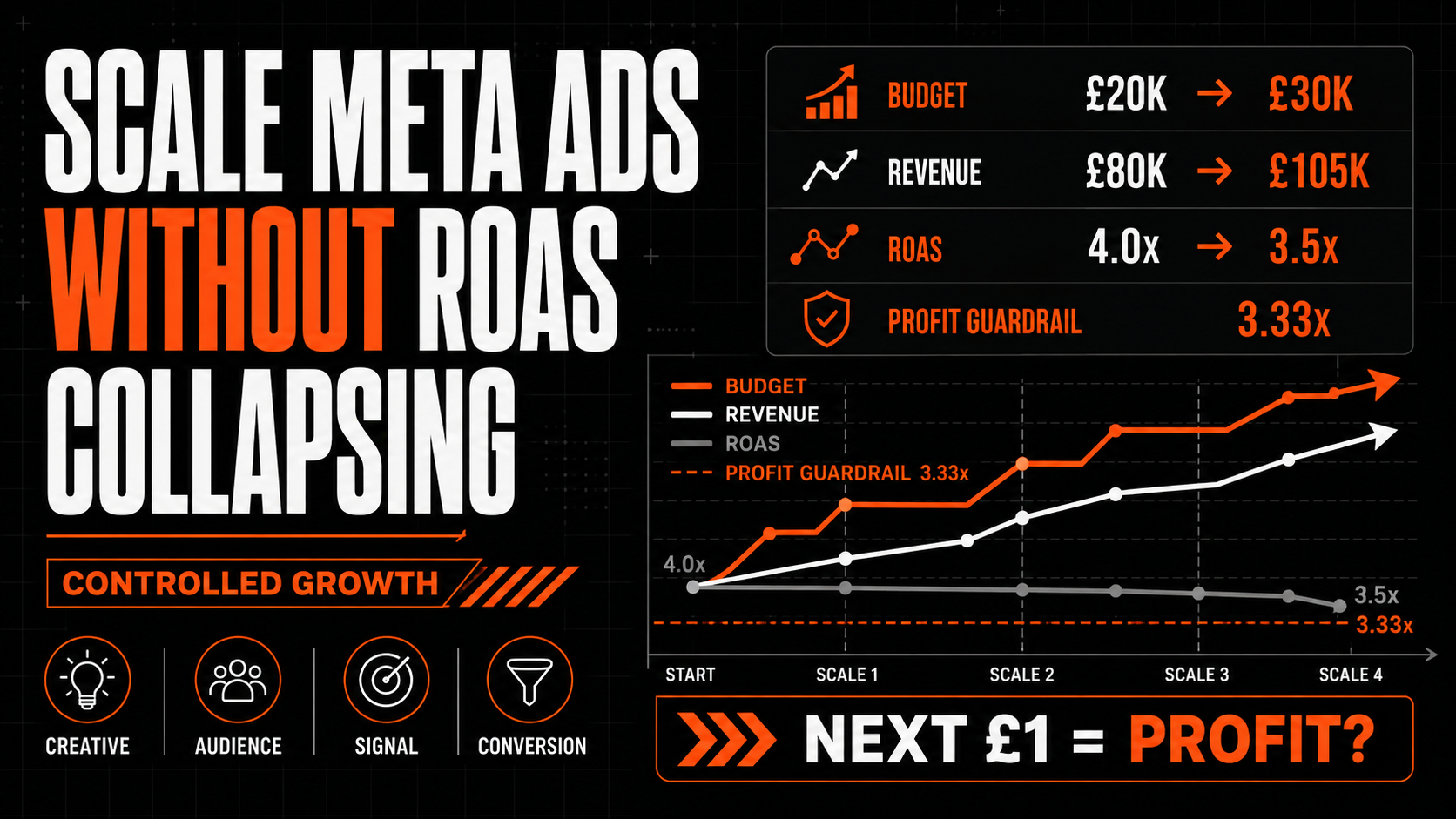
Target ROAS = £100 ÷ £30 = 3.33x
This is a commercial guardrail, not a generic Meta benchmark. The correct target varies by margin, return rate, customer value, cash flow and required payback.
If repeat purchasing is strong and reliably measured, the business might accept a lower first-order ROAS. That decision should be supported by customer-level data showing:
- Repeat-purchase rate.
- Customer lifetime contribution profit.
- Time to second purchase.
- Acquisition-cohort retention.
- Cash payback period.
- Differences between customer segments and product categories.
Do not use an optimistic lifetime-value forecast to excuse permanently unprofitable first orders.
Understand why ROAS usually falls during scaling
Meta does not contain an unlimited supply of customers at one acquisition cost. As spend increases, several effects can combine:
| Scaling pressure | Likely commercial effect |
|---|---|
| More auction participation | CPM and cost per result may rise |
| Broader delivery | The next audience segment may have weaker purchase intent |
| Higher frequency | Existing users see the same ads more often |
| Creative fatigue | CTR and conversion rate decline |
| Product-mix changes | Spend shifts towards lower-margin or lower-AOV products |
| Saturated retargeting | Meta repeatedly reaches customers who may buy anyway |
| Website constraints | Additional traffic exposes conversion or fulfilment weaknesses |
This is diminishing marginal return. The first £10,000 of spend may generate a 4x ROAS while the next £5,000 produces 2x. The account-wide average can still look healthy, but the next pound may already be below the business’s required return.
Measure the marginal result:
Marginal ROAS = Additional attributed revenue ÷ additional Meta spend
If spend rises from £20,000 to £25,000 and attributed revenue increases from £80,000 to £87,500:
Marginal ROAS = £7,500 additional revenue ÷ £5,000 additional spend = 1.5x
The account’s new average ROAS is 3.5x, but the additional budget returned only 1.5x. The marginal figure should guide whether the next increase is commercially sensible.
Scale campaigns only after they are stable
Do not scale because a campaign had one unusually profitable day. Meta performance can fluctuate with auction conditions, conversion delay, day of week, stock and normal statistical variation.
Look for:
- Stable CPA and conversion value across at least one or two representative weeks.
- Sufficient purchase volume to provide a meaningful optimisation signal.
- Consistent stock, price and promotional conditions.
- Creative that is not showing obvious fatigue.
- Reliable website conversion rate and checkout performance.
- Acquisition cost below the allowable threshold after variable costs.
- Evidence of new-customer or incremental value rather than retargeting alone.
- No recent tracking, site or catalogue problems.
The appropriate observation period depends on conversion volume and purchase delay. A high-volume retailer may learn more in several days than a lower-volume brand learns in a month. Use a window that contains enough purchases to avoid reacting to noise.
Increase budgets in controlled steps
A conservative operating approach is to increase stable budgets gradually, often by around 10–20%, then allow delivery to stabilise before making the next decision. This is practitioner guidance rather than a guaranteed Meta threshold. The safe change depends on the campaign’s scale, purchase volume, audience and current delivery.
Meta states that significant edits can cause an ad set to re-enter the learning phase, potentially producing less stable performance and a higher cost per result. Changes to budget, bid strategy, optimisation event, audience or creative may be significant depending on their scale and context.
A controlled vertical-scaling process is:
- Select a campaign with stable contribution profitability and remaining demand.
- Increase its budget modestly.
- Keep the audience, offer, creative and landing page stable.
- Allow enough purchases and conversion lag for the result to become interpretable.
- Compare marginal CPA, marginal ROAS and contribution profit with the pre-change baseline.
- Continue only while the additional spend meets the commercial guardrails.
- Hold or reduce the budget if deterioration persists beyond normal variation.
Do not change the budget, replace all the creative, alter targeting and redesign the landing page simultaneously. If performance changes, the team will not know which intervention caused it.
When a larger increase may be justified
A larger budget change can sometimes be reasonable when:
- A major promotion has created genuinely additional demand.
- Stock and fulfilment capacity can support the increase.
- A new product or market materially expands the addressable audience.
- The campaign has consistently been constrained by budget while meeting profit targets.
- The business accepts a temporary learning or efficiency cost for a defined commercial reason.
The decision should still have a stop-loss condition and a measurement window.
Scale horizontally as well as vertically
Vertical scaling means increasing spend within existing activity. Horizontal scaling creates additional opportunities rather than depending entirely on the same audience and creative.
Potential horizontal levers include:
- New creative concepts and formats.
- Broader but commercially relevant prospecting.
- Adjacent customer segments.
- New geographic markets.
- Additional product categories or bundles.
- Creator, expert or customer-led content.
- Different offers for different levels of awareness.
- Landing pages matched to specific customer problems.
- Separate acquisition and retention objectives.
- New catalogue groupings based on margin and stock.
Do not mechanically duplicate a profitable campaign and assume the copy represents new scale. Duplicate campaigns can compete in similar auctions, fragment conversion data and reach the same customers at a higher frequency.
Horizontal expansion should introduce a meaningfully different creative idea, product, audience need, geography or commercial opportunity.
Creative is the main source of scalable demand
In mature Meta accounts, creative is not merely an ad-production task. It determines which customer problems, motivations and stages of awareness the campaign can address.
A single winning advert rarely scales indefinitely. More spend increases reach and frequency, eventually exhausting the most responsive audience for that message.
Monitor signs of creative fatigue:
- Rising frequency within the relevant audience and attribution window.
- Increasing CPM without a matching improvement in customer quality.
- Falling video hold rate, thumb-stop rate or link CTR.
- Declining landing-page views relative to clicks.
- Lower website conversion rate from the advert.
- Rising CPA as reach and spend increase.
- Comments indicating repetition, irrelevance or offer confusion.
Meta provides creative-fatigue diagnostics and recommendations in Ads Manager. Treat them as useful signals rather than automatic instructions; confirm the problem using commercial performance and audience context.
Build a creative pipeline before performance falls
A scalable creative programme should continuously test:
- Different customer problems and desired outcomes.
- Product demonstrations and comparisons.
- Customer testimonials, reviews and user-generated content.
- Founder, expert or creator explanations.
- Offers, bundles and threshold incentives.
- Objections about quality, value, delivery and returns.
- Hooks for unaware, problem-aware and product-aware customers.
- Static images, short-form video, carousels and catalogue formats.
- Alternative opening seconds, headlines and calls to action.
Keep strong ads live while challengers are tested. Avoid replacing every winner at once because the team needs a stable performance foundation.
Creative volume alone is not diversification. Ten minor edits to the same hook may reach the same customer mindset. Test distinct commercial ideas.
Broaden audiences without abandoning relevance
Meta’s delivery system can often find customers efficiently within broader audiences when it receives accurate purchase signals and enough conversion volume. Broader targeting creates room for scale, but it does not eliminate the need for commercial discipline.
Expansion can include:
- Broader demographic targeting where the product has wide appeal.
- New locations with viable shipping, price and demand.
- First-party customer lists and exclusions.
- Value-based or customer-quality signals where supported.
- Adjacent customer needs expressed through creative rather than narrow interests.
- Product-specific campaigns for distinct audiences.
Assess broadening by new-customer CPA, product margin, contribution profit and incremental lift—not by reach alone.
Maintain exclusions where commercially necessary. Existing customers, employees, recent purchasers or unsupported locations should not consume acquisition budget unless that is intentional.
Consolidate enough to support learning
Fragmented account structures can prevent campaigns from collecting sufficient conversion data. If spend is divided across too many ad sets and ads, each component may struggle to learn.
Meta recommends combining ad sets and managing ad volume to help activity receive enough conversions. The platform also describes “learning limited” as a state in which an ad set is unlikely to receive around 50 optimisation events in the week after its last significant edit.
This does not mean every business should force exactly 50 purchases into every ad set regardless of economics. It means the structure should reflect available conversion volume.
Practical consolidation principles include:
- Avoid separate campaigns for minor audience differences without a commercial reason.
- Keep enough budget behind each meaningful test.
- Separate activity where margins, markets, products or objectives genuinely differ.
- Avoid excessive ads that spread spend too thinly.
- Give Meta enough stable data before judging delivery.
The best structure is neither maximally broad nor maximally granular. It is the simplest structure that preserves the commercial controls the business actually needs.
Improve the purchase and value signals
Scaling amplifies tracking problems. If Meta receives duplicated purchases, incorrect values or low-quality conversion events, more budget allows the system to optimise more aggressively towards the wrong outcome.
Before scaling, confirm:
- Purchase fires only after a completed order.
- Dynamic order value and currency are accurate.
- Meta Pixel and Conversions API events are deduplicated.
- Product and catalogue IDs match.
- Refunds, cancellations and returns are included in commercial reporting.
- Purchase is the correct optimisation event.
- New and returning customer value can be separated where possible.
- Consent and server-side tracking operate consistently.
- Test transactions do not inflate production reporting.
Meta’s guidance explains that the same browser and server events need to be deduplicated. Meta also offers value optimisation designed to maximise conversion value, but it depends on reliable value signals supplied through the Pixel and Conversions API.
Value-based optimisation cannot repair bad economics or inaccurate data. It helps only when the values represent what the business genuinely wants more of.
Protect product-level profitability
ROAS can remain stable while contribution profit falls because the mix of products and customers changes during scaling.
Segment results by:
- Product margin.
- Return and cancellation rate.
- Average order value.
- Stock availability.
- Discount level.
- Shipping and fulfilment cost.
- New versus returning customers.
- Subscription versus one-off purchase.
- Geography and currency.
- First-order versus lifetime value.
A 2.5x ROAS on a high-margin, low-return product can create more profit than a 4x ROAS on a heavily discounted product with expensive fulfilment.
Use catalogue sets or reporting labels to identify:
- High-margin products suitable for scaling.
- Bestsellers with sufficient stock.
- Low-stock products that should not absorb acquisition spend.
- High-return items requiring a higher ROAS target.
- Products with strong repeat-purchase behaviour.
- Clearance inventory with different commercial objectives.
The campaign objective should reflect these differences rather than treating every pound of revenue as equal.
Improve the website before buying more traffic
Scaling fails when the media budget grows faster than the website’s ability to convert demand.
Review:
- Mobile page speed and product-page usability.
- Price competitiveness and promotional clarity.
- Stock and variant availability.
- Delivery costs and delivery dates.
- Returns information and customer reassurance.
- Product reviews and social proof.
- Checkout errors and payment methods.
- Landing-page alignment with each creative promise.
- Bundles, upsells and cross-sells.
If conversion rate improves from 2% to 2.5%, the store generates 25% more orders from the same traffic volume. Alternatively, it can tolerate a higher cost per click while maintaining the same CPA.
Increasing conversion rate, average order value and repeat purchase enlarges the amount the business can afford to invest in acquisition. This creates more sustainable scaling headroom than simply changing campaign settings.
Measure marginal and incremental performance
Average Meta ROAS is a lagging summary of all spend. Scaling decisions should focus on the return from the additional budget.
Track:
- Marginal CPA.
- Marginal attributed ROAS.
- New-customer CPA and revenue.
- Incremental orders and incremental ROAS.
- Contribution profit after advertising.
- Total-store revenue.
- Blended MER.
- Customer lifetime value and payback.
- Return rate and product mix.
Meta Conversion Lift uses test and holdout groups to estimate the incremental effect of advertising. Meta states that Conversion Lift results should not be compared directly with ordinary Ads Manager reporting because the experiment and attribution reports answer different questions.
Incremental ROAS = Revenue caused by Meta advertising ÷ Meta ad spend
For the strongest investment measure:
Incremental contribution profit = Incremental revenue − cost of goods − fulfilment − payment fees − discounts − returns − Meta spend
If attributed revenue rises after scaling but total-store revenue, new customers and contribution profit do not, the additional spend may be receiving credit rather than creating genuine growth.
A practical Meta scaling framework
| Stage | Action | Stop or review condition |
| Validate | Confirm tracking, economics, stock and website conversion | Data is unreliable or first-order economics are unacceptable |
| Stabilise | Run proven audience and creative combinations without frequent edits | CPA and conversion rate remain highly volatile |
| Scale vertically | Increase stable budgets in controlled steps | Marginal CPA exceeds the allowable threshold |
| Scale horizontally | Add meaningful creative, product, audience or market opportunities | New activity duplicates or cannibalises existing delivery |
| Refresh | Introduce new concepts before fatigue becomes severe | Frequency rises while CTR and conversion rate decline |
| Improve conversion | Strengthen landing pages, offer, AOV and checkout | More traffic does not produce proportional order growth |
| Test incrementality | Establish whether additional sales were caused by Meta | Attributed growth does not appear in total-store outcomes |
| Reallocate | Fund the channel or activity with the strongest marginal profit | The next pound produces more contribution elsewhere |
A 30-day controlled scaling plan
Days 1–7: Validate
- Reconcile Meta purchases with Shopify and GA4.
- Calculate allowable CPA and target contribution ROAS.
- Identify stable acquisition campaigns.
- Segment products by margin, return rate and stock.
- Audit creative fatigue and website conversion.
Days 8–14: Make the first increase
- Increase one stable campaign modestly.
- Keep other major variables unchanged.
- Launch new creative challengers separately from the budget test.
- Record the exact time and size of the change.
Days 15–21: Evaluate marginal performance
- Allow for purchase lag.
- Compare incremental spend with additional revenue and orders.
- Review new-customer CPA, contribution profit and product mix.
- Check whether frequency, CPM or conversion rate deteriorated.
Days 22–30: Expand or reallocate
- Continue scaling only where marginal economics remain acceptable.
- Add a meaningfully different creative or product opportunity.
- Hold campaigns showing persistent deterioration.
- Plan an incrementality test for material budget increases.
This process will not remove normal volatility. It makes each decision more interpretable and commercially accountable.
Common scaling mistakes
- Increasing budget because yesterday’s ROAS was unusually high.
- Applying the same percentage increase to every campaign.
- Changing budget, creative, targeting and landing pages simultaneously.
- Duplicating campaigns without creating new demand.
- Waiting for creative performance to collapse before producing replacements.
- Optimising to revenue when product margins vary sharply.
- Allowing retargeting and existing customers to inflate acquisition ROAS.
- Ignoring refunds, cancellations and fulfilment costs.
- Fragmenting the account across too many low-volume ad sets.
- Treating platform-attributed ROAS as incremental profit.
- Continuing to scale after marginal performance falls below the allowable return.
Frequently asked questions
How quickly should you increase a Meta Ads budget?
There is no universal percentage. Gradual 10–20% increases with time for delivery to stabilise are a common conservative operating approach, but they are not a guaranteed Meta rule. Use smaller changes when conversion volume is low or the audience is constrained. Judge the result using marginal contribution profit.
Why does Meta Ads ROAS fall when budget increases?
The campaign may enter more expensive auctions, expand into less responsive demand or increase frequency against the existing audience. Creative fatigue, product mix and website conversion can also worsen. Some decline may be acceptable if total profit grows.
Should you duplicate a winning Meta campaign to scale it?
Not automatically. A duplicate can compete with the original and fragment learning. Duplicate only when it supports a distinct test, market, product, objective or audience opportunity—not as a substitute for a scaling strategy.
How often should Meta creative be refreshed?
Use performance rather than a fixed calendar. Maintain a continuous creative pipeline and introduce challengers before fatigue becomes severe. Refresh when frequency and cost rise while engagement and conversion weaken, accounting for audience size and normal variation.
Is broad targeting better for scaling Meta Ads?
Broader targeting can create more room for delivery when purchase signals, creative and conversion volume are strong. It is not automatically more profitable. Compare new-customer CPA, contribution margin and incremental value with more controlled approaches.
Should the business protect ROAS or maximise profit?
Protect the minimum return required by the business, then maximise absolute incremental contribution profit within cash-flow and payback constraints. An extremely high ROAS can indicate that profitable scale is being left unused.
The practical answer
ROAS collapses when spend increases faster than qualified demand, creative and audiences become saturated, or Meta optimises towards incomplete value signals. Sustainable scaling comes from controlled budget increases combined with new creative demand, relevant audience expansion, stronger offers, improved conversion rates and accurate commercial measurement.
The KPI to protect is not the highest historic account ROAS. It is the incremental contribution profit generated by the next pound of Meta spend.
Book a Strategy Call
If you want to scale Meta Ads without sacrificing profitability, Clubbish can audit your tracking, campaign structure, creative performance and unit economics—then build a controlled scaling plan based on incremental contribution profit.