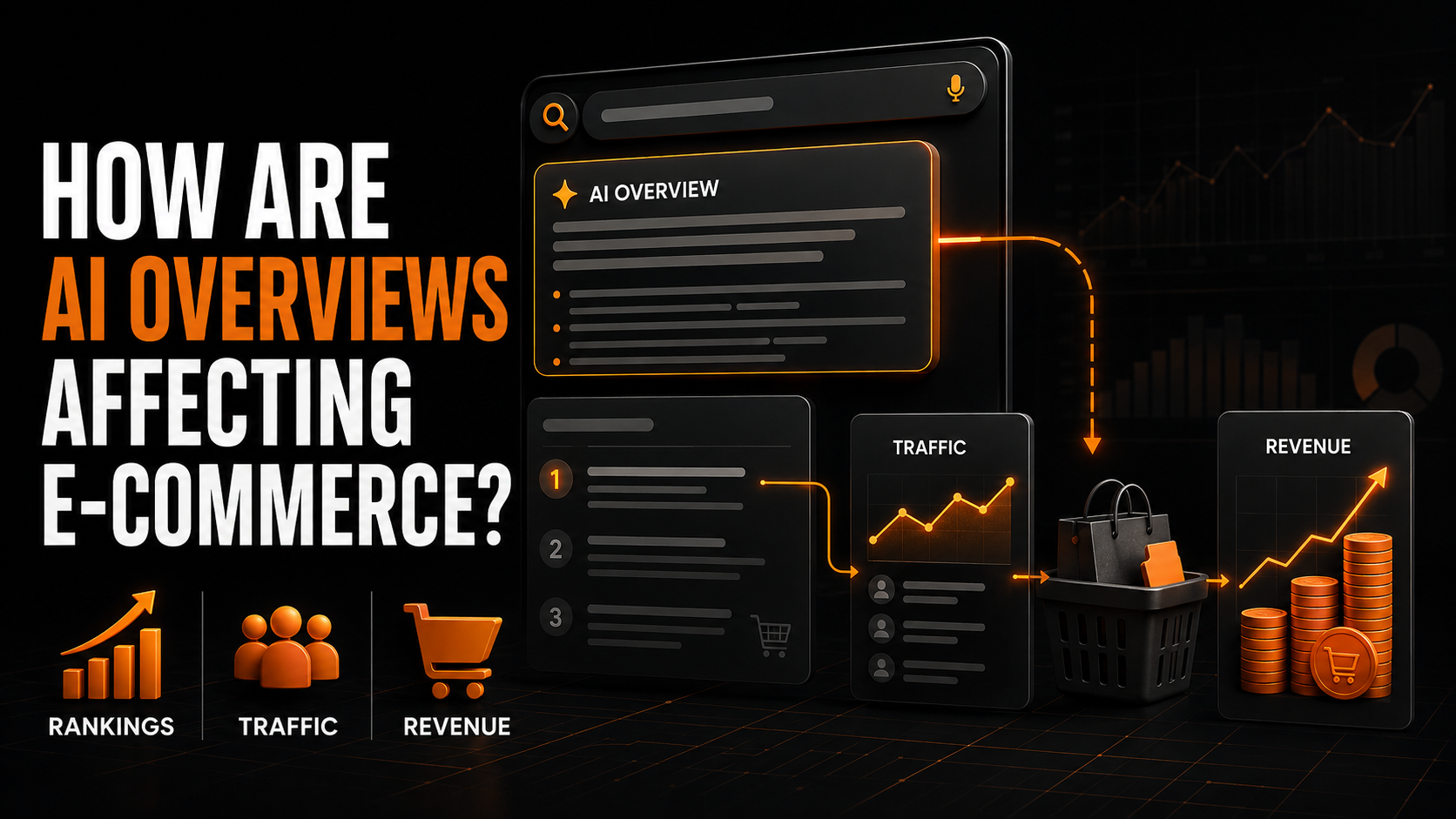
Google’s AI Overviews are changing how shoppers move from a search query to an e-commerce website.
The most immediate effect is likely to be lower click-through rates from informational and research-led searches when Google provides an answer directly within the results page. Traditional rankings still matter, but ranking first no longer guarantees the same volume of traffic when an AI-generated summary appears above or around the conventional organic listings.
For e-commerce businesses, the commercial effect is more complicated than “AI Overviews reduce SEO traffic.” High-intent shoppers still need live prices, stock, variants, reviews, delivery information and somewhere to complete the transaction. The greater risk sits earlier in the journey, where buying guides, FAQs and comparison content have historically introduced customers to the retailer.
If fewer shoppers visit during that research stage, the immediate loss may appear as lower informational traffic. The revenue impact can arrive later through fewer assisted conversions, email sign-ups, return visits and branded searches.
The practical conclusion is:
Google’s AI Overviews are creating a new visibility layer for e-commerce brands, but retailers must measure that visibility separately from clicks and build content that gives shoppers a genuine reason to visit, compare and buy.
What are Google AI Overviews?
AI Overviews are AI-generated summaries that Google may display in response to a search. They can combine information from multiple sources and provide links to supporting pages.
Google describes AI Overviews as a way to help people understand the essence of a complicated question more quickly and then explore further through relevant links. Google also explains that its AI features may use a “query fan-out” technique, issuing several related searches across subtopics and data sources while generating a response.
For an e-commerce query, this could mean that one customer question is expanded into several underlying considerations, such as:
- Product suitability
- Materials or specifications
- Compatibility
- Budget
- Common use cases
- Advantages and disadvantages
- Alternative products
- Care or maintenance
The resulting summary may answer a meaningful part of the customer’s question without requiring an immediate click.
How are AI Overviews affecting e-commerce traffic?
The emerging evidence indicates that AI summaries can reduce clicks to external websites.
A Pew Research Center analysis of browsing activity from U.S. adults found that users clicked a traditional search result in 8% of visits where an AI summary appeared, compared with 15% where one did not. A cited source within the AI summary received a click in only 1% of visits containing a summary.
This research was not limited to e-commerce and should not be treated as a universal conversion forecast. However, it provides strong evidence that user behaviour changes when an answer is available directly in the search results.
Ahrefs later reported that the presence of an AI Overview correlated with a 58% lower average click-through rate for the top-ranking page in its December 2025 analysis. Ahrefs compared large groups of informational keywords with and without AI Overviews. This is correlation rather than proof that every lost click was caused by the Overview, but the scale of the difference is commercially significant.
For retailers, the most exposed content types include:
- Buying guides
- “How to choose” articles
- Product-care guides
- Definition-led content
- Comparison articles
- Suitability questions
- Size and fit advice
- Compatibility content
- Frequently asked questions
- Broad “best product” queries
These pages have traditionally helped retailers acquire customers before they are ready to purchase.
Which e-commerce searches are most exposed?
AI Overviews are particularly capable of addressing questions such as:
- What are the best running shoes for flat feet?
- How do I choose a coffee grinder?
- What size wetsuit should I buy?
- What type of tent is best for winter camping?
- Are dolls houses suitable for five-year-olds?
- What is the difference between cast iron and stainless-steel cookware?
The shopper may receive definitions, selection criteria and a summarised comparison without leaving Google.
The risk is not only that a blog visit disappears. That visit may previously have led to:
- A category-page visit
- Product comparison
- Newsletter sign-up
- Saved basket
- Return visit through branded search
- Purchase several days later
If the retailer measures only last-click organic revenue, the lost commercial influence may remain hidden.
Which searches may be more resilient?
High-commercial-intent searches are more difficult to satisfy with a general summary because the customer still needs current transactional information.
Examples include:
- Exact product names
- SKUs or model numbers
- “Buy” terms
- Current price queries
- Product availability
- Delivery-date questions
- Local stock searches
- Colour or size variants
- Replacement-part searches
- Compatibility with a specific model
- Brand and product combinations
A shopper looking for a particular size, colour, price or delivery date normally needs to interact with a live retailer or marketplace.
Commercial traffic is not immune. Google’s search layouts and shopping features continue to change, and AI responses may influence comparison. However, product, category and transactional pages retain a stronger reason for the customer to click.
This suggests that e-commerce SEO investment should increasingly prioritise pages that combine search visibility with live commercial usefulness.
The likely effect on traffic, rankings and revenue
| Area | Likely effect | Commercial implication |
|---|---|---|
| Informational organic traffic | Lower CTR where an AI Overview answers much of the query | Expect pressure on broad “what”, “how”, comparison and suitability searches |
| Traditional rankings | Rankings remain relevant, but the same position may deliver fewer clicks | Measure position alongside SERP features, AI Overview presence and page-level CTR |
| AI Overview citations | Additional visibility without guaranteed traffic | Evaluate citation quality and commercial relevance, not citation counts alone |
| Commercial organic traffic | Potentially more resilient where shoppers need live product information | Prioritise product, category, brand, compatibility and comparison pages |
| Direct organic revenue | May remain resilient if click losses are concentrated in low-intent traffic | Segment by landing-page type and query intent |
| Assisted revenue | May weaken later if fewer customers discover the brand during research | Measure email capture, assisted journeys, branded demand and returning customers |
| Paid Search | May become relatively more important on affected results pages | Review impression share, CPC, incrementality and organic-paid overlap |
Are AI Overviews changing rankings?
AI Overviews do not make traditional organic rankings irrelevant. A page must still be discoverable, indexable, relevant and eligible to appear in Google Search to be considered as a supporting link.
Google states that pages appearing as supporting links in AI Overviews and AI Mode must be indexed and eligible to appear with a snippet. There are no additional technical requirements specifically for AI features.
Rankings remain important because they reflect the broader strength and relevance of the page. They can also influence the pool of information and pages considered for search features.
However, the economics of a ranking have changed.
A retailer can retain position one while experiencing:
- Stable or rising impressions
- A lower organic click-through rate
- Fewer organic sessions
- Similar conversion rates among the remaining visitors
- Reduced top-funnel discovery
The ranking itself has not necessarily deteriorated. The opportunity to win a click has changed because the search-results page now answers more of the question.
Why position one can no longer be interpreted in isolation
Historically, a move from position three to position one could be modelled using an expected increase in click-through rate. AI Overviews make that model less reliable.
The same nominal ranking can generate different results depending on:
- Whether an AI Overview appears
- The size and placement of the Overview
- Whether the retailer is cited
- The number of supporting links
- Device type
- Paid and shopping features on the page
- The query’s intent
- The strength of the brand
- Whether the customer needs live product data
Ranking reports should therefore add a search-results-page context layer. A position without information about the surrounding result is an incomplete commercial metric.
Can AI Overview citations replace organic clicks?
Being cited can create valuable exposure. It may associate the retailer with expertise, introduce the brand to a new audience and generate highly qualified visits where the user needs more depth.
However, citation visibility should not be valued as though it were a website session or sale.
A citation can have several possible outcomes:
- The customer sees the brand and clicks immediately.
- The customer sees the brand but does not click.
- The customer remembers the brand and searches later.
- The customer receives the answer and ends the journey.
- The customer chooses a competitor cited alongside it.
Citation reporting should therefore consider:
- The query and its commercial relevance
- The cited URL
- The type of page cited
- Competitors appearing in the response
- Resulting clicks where observable
- Subsequent branded-search demand
- Assisted and returning-user behaviour
Raw citation counts can create the same problem as raw ranking counts: they show visibility but not commercial value.
How AI Overviews may affect e-commerce revenue
The revenue impact depends on where AI Overviews remove clicks from the customer journey.
Scenario 1: low-value informational traffic declines
A retailer may lose visits to generic definition pages that rarely influenced a purchase. Traffic falls, but revenue and gross profit remain stable.
This is not necessarily a commercial loss. The remaining organic audience may be smaller but more qualified.
Scenario 2: assisted discovery declines
A buying guide previously introduced customers to the brand. Visitors explored products, joined an email list or returned later through branded search.
If the AI Overview satisfies the initial question, last-click organic revenue may appear stable for a period while assisted conversions and future branded demand weaken.
This is a more serious risk because the commercial effect is delayed.
Scenario 3: the retailer becomes a cited authority
The brand’s testing, product expertise or comparison data is cited. Traffic may be lower than historical informational search volume, but the visitors who do click could be highly engaged.
Google says it has observed that clicks from search pages containing AI Overviews can be higher quality, with visitors more likely to spend longer on the destination site. This is Google’s own observation rather than a guaranteed outcome for every retailer, so businesses should validate it through their analytics.
Scenario 4: transactional traffic is displaced
If AI-supported search features increasingly help customers compare products, prices or sellers directly within Google, the effect can move closer to the purchase.
Retailers should monitor high-intent query groups, product-page traffic, paid impression share and shopping performance rather than assuming transactional demand is permanently protected.
Measure gross profit, not only traffic
The correct response is not to maximise visits at any cost. It is to protect and grow profitable customer acquisition.
For each affected page or content cohort, monitor:
- Organic sessions
- New users
- Engagement
- Product views
- Email sign-ups
- Assisted conversions
- Orders
- Revenue
- Gross profit
- New-customer acquisition
- Repeat purchasing
A 25% traffic decline combined with stable gross profit is a different commercial situation from a 5% traffic decline that removes a high-value acquisition journey.
Why rankings alone are no longer enough
AI Overviews can create a reporting pattern that looks contradictory:
- Impressions rise.
- Average position remains stable or improves.
- Clicks and CTR fall.
- Organic sessions decline.
- Direct organic revenue holds temporarily.
- Assisted conversions weaken later.
This should be treated as a search-results economics problem rather than automatically as a ranking problem.
The page may still be highly visible. The customer simply has less need—or less opportunity—to click.
SEO reporting should explain whether a performance change came from:
- Lost ranking visibility
- Reduced search demand
- Lower CTR on an altered results page
- A change in query mix
- Stock or pricing problems
- Lower website conversion
- Fewer assisted research journeys
Without that diagnosis, a business may rewrite pages or pursue links when the primary change is occurring on Google’s interface.
What Google recommends for AI features
Google does not recommend a separate “AI SEO” technical standard.
Its current guidance is to continue applying foundational SEO practices:
- Allow crawling through robots.txt and hosting infrastructure.
- Make content discoverable through internal links.
- Provide a strong page experience.
- Ensure important information is available in text.
- Support content with useful images and video where appropriate.
- Make structured data match the visible page content.
- Keep Merchant Center and Business Profile information current.
- Create helpful, reliable, people-first content.
Google also states that no special AI text file, schema type or additional machine-readable markup is required for inclusion in AI Overviews or AI Mode.
The practical implication is that retailers should improve the quality, clarity and commercial usefulness of their existing search assets rather than chase unsupported technical shortcuts.
How e-commerce brands should respond
1. Protect high-intent landing pages first
Prioritise pages where the shopper still needs to visit:
- Product pages
- Category and collection pages
- Brand landing pages
- Compatibility pages
- Detailed comparisons
- Delivery and returns information
- Product availability
- Size, fit and specification tools
- “Best for” use-case pages linked to live products
These pages should combine useful information with current commercial data.
2. Replace generic information with decision support
Content that merely defines a topic is easy to summarise.
Instead of publishing “What is a 3D printer?”, create a resource that helps the shopper decide:
- Which printer fits the budget
- Which materials are suitable
- How much space is required
- Which models match the user’s experience
- Which in-stock products meet the need
- What ongoing costs to expect
Interactive selectors, calculators, comparison tables and compatibility tools give the customer a reason to visit the site.
3. Add first-party evidence
Retailers can create information that is difficult to reproduce convincingly without their experience.
Examples include:
- Original product testing
- Expert commentary
- Real measurements
- Side-by-side comparisons
- Use-case photography
- Demonstration video
- Customer review analysis
- Product failure or durability observations
- Clear advantages and limitations
- Advice based on returns or customer-service questions
First-party evidence strengthens trust for both search systems and customers.
4. Make product data unambiguous
Keep the following accurate and consistent:
- Product names
- Prices
- Availability
- Variants
- Specifications
- GTINs and identifiers
- Images
- Delivery information
- Merchant Center feeds
- Relevant structured data
Structured data must match what the customer can see on the page. It should clarify content rather than compensate for incomplete or misleading information.
5. Connect research content with products
Every research page should provide a clear next step.
Use internal links and calls to action such as:
- Compare suitable models
- Check compatibility
- View available colours
- See today’s prices
- Explore the category
- Find the correct size
- Check current stock
The article should not become an isolated information endpoint.
6. Strengthen brand demand
Generic search discovery is more exposed to answer substitution than direct brand demand.
Build reasons for customers to remember and return through:
- Social content
- Digital PR
- Creators and experts
- Communities
- Strong customer service
- Loyalty programmes
- Distinctive products and propositions
This does not replace SEO. It makes organic acquisition less dependent on winning a click from every informational query.
7. Audit content by commercial contribution
Classify content into:
- Strong direct-revenue pages
- Valuable assisted-conversion pages
- Email or audience-building pages
- Authority-supporting content
- High-traffic pages with weak commercial contribution
- Outdated or duplicative pages
Upgrade or consolidate content that receives visibility but provides little unique value or commercial pathway. Do not delete content simply because traffic falls; first determine its role in authority, assistance and customer journeys.
A measurement framework for AI Overview impact
Google includes traffic from AI features within Search Console’s overall Web search reporting. At present, businesses should not assume Search Console provides a clean, standalone AI Overview traffic channel.
This makes external SERP observation and query segmentation important.
Create three monitored groups:
- Queries and pages where AI Overviews are frequently observed
- Comparable queries and pages where AI Overviews are not observed
- High-commercial-intent queries and landing pages
Track them over consistent periods.
Search visibility metrics
- Impressions
- Clicks
- CTR
- Average position
- Query type
- Landing page
- Device
- Country
- Observed AI Overview presence
- Citation presence and cited URL
On-site commercial metrics
- Organic sessions
- Engaged sessions
- Product views
- Add-to-basket activity
- Conversion rate
- Orders
- Revenue
- Gross profit
- Refunds and cancellations
Lagged and assisted metrics
- Newsletter sign-ups
- Account creation
- Assisted conversions
- Returning users
- Branded-search growth
- Direct traffic
- Repeat purchases
- Customer lifetime value
Paid Search metrics
- Impression share
- Cost per click
- Conversion rate
- New-customer acquisition cost
- Incremental ROAS
- Query overlap with affected organic searches
The purpose is to understand whether AI Overviews are changing visibility, click behaviour, customer discovery or actual profit.
How to analyse the impact without overstating causality
AI Overviews are not the only reason traffic changes.
Control for:
- Seasonality
- Product availability
- Price changes
- Promotions
- Competitor activity
- Website releases
- Google algorithm updates
- Paid-media investment
- Wider query demand
- Changes in tracking or consent
Use eight-to-twelve-week windows for directional commercial analysis rather than reacting to daily movements.
Where possible, compare:
- Similar page groups with different AI Overview exposure
- Periods before and after consistent feature appearance
- Device and market differences
- Informational and commercial query cohorts
- Cited and non-cited pages
The conclusion should be expressed as an evidence-based estimate, not certainty that every lost session was caused by AI.
A monthly director-level dashboard
| Question | Metric or analysis |
| Where are AI Overviews appearing? | Query and page cohorts with observed AI Overview presence |
| Are rankings changing? | Position trends by cohort |
| Are searchers clicking less? | Clicks and CTR adjusted for impressions and query demand |
| Are we being cited? | Citation frequency, cited URLs and competitor inclusion |
| Is traffic quality changing? | Engagement, product views and conversion by landing-page group |
| Is revenue affected? | Direct and assisted revenue, gross profit and new-customer orders |
| Is brand discovery weakening? | Branded search, direct visits, email sign-ups and returning users |
| Is Paid Search filling the gap? | Impression share, CPC, incrementality and marginal profit |
| What should we change? | Content, product data, landing-page and channel actions |
The dashboard should lead to decisions rather than simply documenting feature appearances.
What should happen to the SEO content strategy?
E-commerce content should move from generic information production towards decision support and first-party evidence.
Before commissioning an article, ask:
- Can an AI Overview answer this adequately without the customer visiting us?
- What unique information or experience can the retailer add?
- Does the content help someone choose, compare or use a product?
- Is there a clear route into relevant categories and products?
- Can the commercial influence be measured?
- Will the resource remain useful as search interfaces change?
The strongest future content is likely to combine expert information, first-party experience and live product relevance.
Should retailers try to block AI Overviews from using their content?
Google provides established snippet controls such as nosnippet, data-nosnippet and max-snippet, as well as noindex for removing a page from Search. These controls can affect how content appears across Search and should not be applied casually.
Blocking snippets may reduce potential citation visibility and could damage ordinary organic performance. Before changing controls, assess:
- The traffic and revenue currently generated by the page
- Whether the page is frequently cited
- The commercial value of those citations
- The risk to traditional search appearance
- Whether improving the page would be more valuable than restricting it
For most retailers, improving content and measurement will be a more productive first response than attempting to withdraw from AI features indiscriminately.
Questions e-commerce directors should ask
- Which query and landing-page groups are most exposed to AI Overviews?
- Are rankings falling, or is CTR declining despite stable visibility?
- Which lost visits previously contributed to purchases or customer acquisition?
- Are we being cited for commercially relevant searches?
- Which competitors appear alongside us—or instead of us?
- Do our product, category and comparison pages give customers a reason to click?
- Is first-party testing or expertise visible on the site?
- Are product feeds, structured data, price and availability accurate?
- Is Paid Search becoming more expensive on affected searches?
- What changes will be tested over the next eight to twelve weeks?
These questions move the conversation from speculation about AI towards measurable commercial action.
The bottom line
Google’s AI Overviews are most likely to reduce e-commerce traffic from informational and research-led searches where the answer can be provided directly within the results page.
Traditional rankings remain important, but they no longer explain the full economic value of search visibility. A retailer can maintain its rankings while losing CTR, sessions and early-stage customer discovery.
The revenue effect depends on the commercial role of the lost traffic. If low-value visits disappear while profit remains stable, the business may simply have a smaller but more qualified audience. If buying guides and comparisons previously introduced valuable customers, the effect may emerge later through lower assisted revenue, branded demand and repeat visits.
Retailers should respond by protecting high-intent pages, strengthening product data, adding first-party evidence and building resources that help customers make decisions—not merely repeat information that an AI summary can provide.
The strategic goal is to become a source Google can understand and customers can trust, while ensuring the website still offers something valuable enough to earn the click and the sale.
Frequently asked questions
Do Google AI Overviews reduce organic traffic?
Evidence indicates that AI summaries are associated with lower click-through rates, particularly for informational searches. The effect varies by query, device, market, layout and customer intent.
Do rankings still matter when an AI Overview appears?
Yes. Pages must still be indexable and eligible for Search, and strong organic visibility remains valuable. However, the same ranking may produce fewer clicks when an AI Overview answers much of the question.
Can an e-commerce site appear in an AI Overview?
Yes. Google says there are no additional technical requirements beyond being indexed, eligible for a search snippet and compliant with standard Search requirements and policies.
Is special AI schema required?
No. Google states that no special schema.org markup or additional AI-specific machine-readable file is required. Existing structured data should accurately match visible page content.
Can Search Console show AI Overview traffic separately?
Google includes traffic from AI features within the Performance report’s overall Web search type. Retailers should combine Search Console with SERP monitoring, analytics and page-group analysis to estimate the effect.
Are product pages safer than blog content?
Product and category pages may be more resilient because shoppers need current price, stock, variants, reviews and delivery information. However, all search layouts can change, so commercial landing pages should still be monitored.
Should retailers stop producing informational content?
No. Informational content can support authority, discovery and assisted conversion. The emphasis should shift towards original evidence, expert guidance, tools, comparisons and clear commercial pathways.
Build an AI-search strategy around commercial outcomes
If your rankings appear stable but organic clicks or assisted revenue are declining, Clubbish can help identify whether AI Overviews, changing demand, website performance or another factor is responsible.
Our outcome-driven approach connects search visibility with traffic quality, customer acquisition, revenue and profit—giving marketing and e-commerce directors a clearer view of what is changing and what to do next.
Book a strategy call to protect and grow your e-commerce performance as AI reshapes Google Search.