
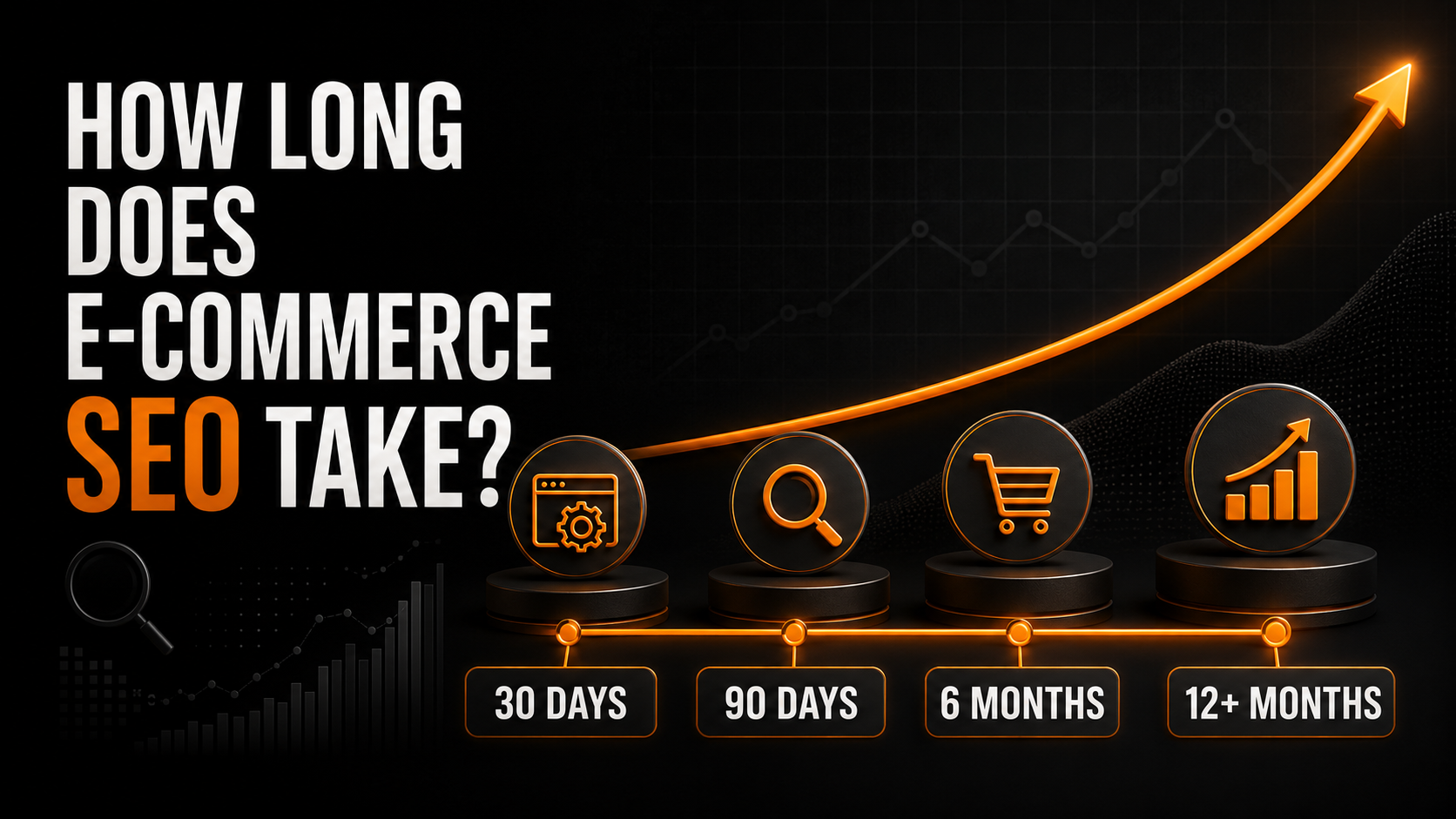
E-commerce SEO can sometimes produce measurable revenue within weeks, particularly when high-impact technical or conversion problems are corrected on pages that already have search visibility. However, a reliable and repeatable uplift in organic revenue commonly requires three to six months.
For a new domain, a highly competitive product category, a major content programme or work intended to strengthen authority across the site, businesses should normally allow six to twelve months or longer before judging the full commercial outcome.
The most useful expectation for a marketing or e-commerce director is:
Look for early evidence within 30–90 days, but treat six months as the first fair checkpoint for evaluating commercial return.
That does not mean every SEO programme deserves six months regardless of performance. Progress should be visible throughout the process. The business should know what has been delivered, whether priority pages are being crawled and indexed, whether non-brand visibility is improving and whether those gains are beginning to influence orders, revenue and gross profit.
This article explains what should happen at each stage, why timelines differ and how to judge whether an e-commerce SEO programme is gaining momentum or simply consuming time.
The short answer: when should you expect results?
Google advises that changes made to a website take time to be reflected in Search. Some changes may take effect within hours, while others can take several months. Google generally recommends waiting a few weeks before assessing whether a change has helped in search results.
For commercial planning, the typical timeline looks like this:
| Timeframe | What may happen | What to measure |
|---|---|---|
| Weeks 1–4 | Baselines are established; crawl, indexation, canonical, redirect, internal-linking, sitemap and tracking problems begin to be corrected | Indexed pages, crawl errors, impressions, priority-page visibility, organic landing-page sessions and accurate purchase tracking |
| Months 1–3 | Existing category, product and editorial pages may gain impressions and clicks; lower-competition queries can begin moving | Non-brand impressions and clicks, visibility by page group, organic conversion rate, assisted revenue and last-click revenue |
| Months 3–6 | Stronger visibility can translate into a more consistent trend in orders and revenue, especially across established high-intent category pages | Incremental organic revenue, gross profit, new-customer orders, SEO CAC and early ROI |
| Months 6–12+ | Larger content, technical, international and authority-building programmes have had time to compound; more competitive categories may become viable | Cohort revenue lift, contribution-margin ROI, repeat purchases and organic LTV |
This is a planning framework rather than a guarantee. A technical correction can recover lost revenue quickly. A new site attempting to compete with established national retailers may require considerably longer.
What counts as a measurable SEO result?
The answer depends on the stage of the programme.
In the first few weeks, a measurable result could mean that previously blocked category pages are now indexed or that Google is discovering priority products more efficiently. These are important signs, but they are not yet a commercial return.
Within the next few months, measurable progress may include:
- More impressions for relevant non-brand searches
- Growth in clicks to priority category and product pages
- Improved visibility across a defined page cohort
- More new users arriving through organic search
- Higher organic conversion rates on optimised landing pages
- Additional orders and revenue above a credible baseline
For an established programme, measurable success should ultimately mean incremental revenue and gross profit.
Examples of a commercially meaningful result include:
- An optimised category group generates £8,000 more organic revenue than its seasonally adjusted baseline over eight weeks.
- Organic orders increase by 15% while conversion rate, average order value, stock availability and promotional activity remain broadly stable.
- A group of improved pages outperforms a comparable, untreated page group.
- Incremental organic gross profit exceeds the monthly cost of SEO for several consecutive reporting periods.
Rankings and traffic help explain what is happening. They should not be mistaken for the final result.
Measure progress against a baseline
Before SEO work begins, record the existing position of the business. Without a baseline, it becomes difficult to separate genuine improvement from seasonality, promotions, brand activity or wider changes in demand.
Where possible, capture at least eight to twelve months of historical data covering:
- Organic revenue and orders
- Organic gross profit or contribution margin
- Organic sessions and conversion rate
- Average order value
- New and returning customers
- Brand and non-brand clicks
- Search impressions and click-through rate
- Visibility by category and landing-page group
- Stock availability
- Promotional periods and discounts
- Paid-media investment
- Major website changes or migrations
The baseline should be segmented. A site-wide organic total can conceal meaningful differences between categories, brands, product types and markets.
For example, one category may be gaining profitable non-brand customers while another is losing visibility because important products are unavailable. Blending the two together makes it harder to decide where further investment should go.
The difference between implementation, visibility and revenue
SEO progress occurs in stages:
- The work is completed. A technical fix, internal-linking change or content improvement is deployed.
- Google discovers and processes the change. The relevant URLs are crawled and, where appropriate, reindexed.
- Search visibility changes. Impressions, rankings, search-result coverage or click-through rate improve.
- More relevant visitors arrive. Organic landing-page sessions increase.
- Commercial performance changes. Orders, revenue, margin or new-customer acquisition improve.
- The result becomes repeatable. The uplift persists for long enough to be distinguished from normal variation.
A programme may therefore be working before a large revenue change is visible. Equally, completing a long list of SEO tasks does not prove the programme is working if those changes never influence relevant search demand or commercial performance.
Good reporting makes the stages visible and shows where progress is accelerating—or becoming blocked.
Why e-commerce SEO timelines vary
1. The existing strength of the website
An established retailer with a trusted domain, strong category pages and years of search visibility can often realise improvements faster than a new e-commerce site.
If a well-performing category page is being held back by weak internal linking or poor on-page targeting, a focused correction may produce a relatively quick response. A new site must first establish crawlability, relevance, quality and authority before competing consistently.
2. The competitiveness of the market
Broad commercial searches are usually more difficult than specific long-tail searches.
For example, a retailer may gain traction sooner for a highly specific product attribute, specialist brand combination or use case than for a broad category searched thousands of times each month.
Competition should influence forecasts. A realistic plan normally combines quicker opportunities with more ambitious long-term categories rather than placing the entire business case on a small number of difficult head terms.
3. Technical health
Technical problems can prevent otherwise strong products and categories from performing.
Common e-commerce issues include:
- Duplicate or uncontrolled faceted URLs
- Weak canonical implementation
- Accidental
noindexdirectives - Redirect chains and broken internal links
- JavaScript rendering problems
- Index bloat
- Poor pagination or infinite-scroll implementation
- Unavailable products dominating crawl activity
- Slow or unstable page templates
- Inconsistent international targeting
- Important pages sitting too deep within the site structure
Where technical problems suppress pages that already have demand, resolving them can create some of the fastest gains. Large platform or template changes, however, can take longer to design, approve, develop and validate.
4. Crawl and indexation
A page cannot generate organic-search revenue until it can be discovered, crawled, indexed and surfaced for relevant searches.
Search Console should be used to monitor indexation and understand search performance through impressions, clicks, queries, pages, countries and devices.
Larger e-commerce sites often experience a delay between publishing a change and seeing it processed across every relevant URL. The time required depends partly on site size, internal linking, crawl demand, technical quality and how frequently priority pages change.
5. The page type being improved
Different assets mature at different speeds.
- Existing category pages: Often the quickest commercial opportunity because they may already rank and target high-intent demand.
- Product pages: Can respond quickly for specific searches but are affected heavily by availability, duplication and product life cycles.
- New category pages: Need to be discovered, indexed and establish relevance before generating consistent sales.
- Buying guides and editorial content: May take longer to gain visibility and often influence research or assisted journeys before last-click revenue.
- Digital PR and authority-building: Usually requires a longer horizon because results compound across future crawling, links, brand discovery and competitive searches.
Evaluating every workstream against the same short timeline is rarely sensible.
6. Content and merchandising quality
SEO cannot be separated from the customer experience on an e-commerce site.
Pages are more likely to generate commercial value when they provide:
- Clear product selection and categorisation
- Useful filters
- Accurate availability
- Competitive pricing
- Delivery and returns information
- Original product details
- Reviews and trust signals
- Helpful comparisons and buying guidance
- Strong mobile usability
- A clear route from discovery to purchase
An increase in organic traffic will not produce the expected revenue if visitors reach weak, confusing or poorly stocked landing pages.
7. Development and approval speed
SEO recommendations only create value after they are implemented.
A technically sound audit may identify important opportunities in the first month, but if development work remains in a backlog for four months, the results timeline starts when changes go live—not when the recommendation was written.
Reporting should therefore separate:
- Recommendations made
- Work approved
- Work in development
- Changes deployed
- Changes crawled and indexed
- Performance after implementation
This prevents SEO itself from being blamed for delays created by internal execution constraints.
8. Stock, pricing and demand
Organic performance is influenced by trading conditions.
A category may gain visibility while revenue falls because bestselling products are out of stock. A promotion may make SEO appear unusually successful. Brand advertising can increase branded searches, while a decline in consumer demand can suppress clicks even when rankings remain stable.
Review SEO alongside:
- Product availability
- Pricing changes
- Promotional activity
- Competitor behaviour
- Paid-media changes
- Seasonal demand
- Website conversion rate
Search performance and commercial performance must be interpreted in the context of how the business was trading.
Expected timelines by SEO workstream
Technical remediation: days to several months
Technical SEO can produce fast results when it restores access to pages that previously performed or should already have demand.
Examples include:
- Removing an accidental block from commercially important pages
- Correcting damaging canonical tags
- Restoring redirects after a migration
- Repairing internal links to profitable categories
- Resolving a template issue that prevents content from rendering
Google may process individual changes quickly, but large technical programmes can take longer because of development, testing, recrawling and the number of affected URLs.
Early measurement should focus on crawlability, indexation and search impressions before expecting a reliable revenue trend.
Existing category-page optimisation: one to three months
Optimising already-indexed category pages can be one of the fastest ways to influence e-commerce revenue.
The work may include:
- Improving targeting and page structure
- Strengthening internal links
- Adding useful supporting content
- Resolving duplication
- Improving titles and search-result appeal
- Aligning the product selection with search intent
If the page already receives impressions and ranks within reach of stronger positions, changes may become measurable relatively quickly. Evaluate groups of pages rather than relying on isolated keyword movements.
Product-page optimisation: one to four months
Product pages can gain traction for precise searches, particularly where the retailer offers strong availability, original information and competitive propositions.
Results are less predictable when products have short life cycles, frequently go out of stock or use manufacturer copy duplicated across many websites.
Measure performance by brand, product type and availability status rather than treating every product URL equally.
New category or content development: three to six months
New landing pages and buying guides need time to be discovered, indexed and evaluated for relevant searches.
Early evidence may include impressions and long-tail visibility. Revenue often arrives later, especially when content supports research rather than completing the sale in the same session.
Use page cohorts based on publication date and measure their development after 30, 90 and 180 days.
Digital PR and authority-building: six to twelve months or more
Authority-building rarely behaves like a paid campaign with an immediate switch-on date.
Coverage and links may support the performance of multiple pages over time. The commercial value can appear gradually as competitive categories become more viable and new content is launched into a stronger domain environment.
Measure the programme through relevant coverage, earned links, visibility across strategic page groups and eventual incremental revenue—not through the number of links alone.
New domains and major market expansion: six to eighteen months
A new site or a retailer entering a new country must establish far more than individual page relevance.
The business may need to build:
- A crawlable and coherent website structure
- A meaningful catalogue of useful pages
- Localised commercial information
- Trust and authority
- Links and brand awareness
- Operational credibility in the target market
Some long-tail results can appear earlier, but the full commercial case should be built on a longer planning horizon.
How to calculate when SEO becomes commercially worthwhile
Traffic is an early signal. The investment decision should eventually be based on incremental profit.
Use:
Incremental gross profit = Organic revenue above baseline × applicable gross-margin rate
Then calculate:
SEO ROI = (Incremental gross profit − SEO cost) ÷ SEO cost × 100
Suppose an SEO programme costs £8,000 per month. After six months, the business estimates that improved page groups generate £160,000 in incremental organic revenue. The applicable gross margin is 40%.
Incremental gross profit = £160,000 × 40% = £64,000
Total SEO investment = £8,000 × 6 = £48,000
SEO ROI = (£64,000 − £48,000) ÷ £48,000 × 100 = 33.3%
The programme has generated £16,000 in estimated return beyond the SEO investment at the six-month checkpoint.
This is more defensible than claiming all attributed organic revenue as return. A sound analysis should adjust for existing brand demand, seasonality, promotions, stock and sales that would likely have occurred without the work.
A sensible SEO reporting plan
Before launch: establish the commercial baseline
Record historical revenue, orders, margin, conversion rate, average order value, brand and non-brand performance, stock, promotions and paid-media activity.
Agree:
- Priority categories and product groups
- The workstreams being funded
- Leading and commercial KPIs
- Reporting and attribution rules
- Expected implementation dates
- 90-day and six-month review points
At 30 days: confirm foundations and implementation
Review whether:
- Tracking is reliable
- Priority pages are crawlable and indexable
- Critical technical fixes have been deployed correctly
- Search Console is showing expected page and query data
- The initial page cohorts and tests are defined
- Development blockers have been documented
Do not make a final ROI judgement at this stage. The first month should demonstrate control, prioritisation and technical progress.
At 90 days: look for directional evidence
Review:
- Non-brand impression and click trends
- Visibility across priority page groups
- Category and product-page cohorts
- Organic conversion rate
- Orders and attributed revenue
- Delivery against the agreed roadmap
Early winners can be expanded, while weak tests should be improved or replaced.
At 180 days: make the first fair ROI assessment
Assess:
- Incremental organic revenue
- Incremental gross profit
- SEO ROI
- New-customer acquisition cost
- Brand versus non-brand performance
- Results by technical, category, product, content and authority workstream
- Forecast versus actual performance
Reallocate effort towards the areas producing the clearest commercial lift.
Weekly, monthly and quarterly measurement
Google Search Console offers hourly, daily, weekly and monthly views. Weekly and monthly groupings are particularly useful for smoothing daily fluctuations, weekends and holidays.
Use each reporting cadence for a different purpose.
Weekly: diagnostics
- Crawl and indexation problems
- Technical deployments
- Material visibility changes
- Impressions and clicks
- Stock issues on priority pages
- Sudden conversion-rate changes
Monthly: trading performance
- Organic sessions
- Orders and revenue
- Conversion rate
- Average order value
- Brand and non-brand trends
- New-customer performance
- Category and page-cohort results
Quarterly: commercial return
- Incremental revenue and gross profit
- SEO ROI
- SEO CAC
- Repeat purchases
- Organic LTV
- Forecast versus actual results
- Budget allocation by workstream
Weekly data is useful for finding problems. Monthly and quarterly windows are more reliable for investment decisions.
Warning signs that SEO is taking too long
“SEO takes time” should never be used to excuse a programme without evidence of progress.
Warning signs include:
- No agreed commercial baseline
- No prioritisation by revenue opportunity
- Recommendations remain unimplemented for months
- Reports focus only on rankings or task completion
- No separation of brand and non-brand performance
- No page-group or category-level analysis
- Organic traffic grows but conversion and revenue do not
- Content is produced without a clear search or customer need
- Technical problems repeatedly return after releases
- Stock, pricing and merchandising are excluded from analysis
- The strategy remains unchanged despite weak evidence
- There is no defined 90-day or six-month decision point
A credible programme should provide early evidence even if the full revenue return has not matured.
When should a business stop or change its SEO strategy?
Do not stop simply because a competitive keyword has not reached page one within a few months. Equally, do not continue indefinitely because SEO is assumed to be slow.
Change direction when the evidence shows that:
- The targeted search opportunity was overstated
- The pages do not match customer intent
- Implementation constraints make the plan unrealistic
- The category economics cannot justify the investment
- Strong visibility is not converting into profitable sales
- Another workstream consistently produces a better return
- Tests repeatedly fail against reasonable controls or forecasts
The goal is not to prove that SEO works in principle. It is to identify where SEO can create profitable growth for this particular business.
What should directors ask after six months?
At the six-month review, senior stakeholders should ask:
- What was implemented, and when did it go live?
- Which priority page groups gained non-brand visibility?
- How did clicks, conversion, orders and revenue change?
- What commercial impact is estimated to be incremental?
- How much gross profit did the programme generate?
- Which workstreams produced the strongest and weakest returns?
- What role did stock, price, promotions and demand play?
- What is the SEO cost of acquiring a new customer?
- What should be scaled, changed or stopped?
- What return is forecast for the next six months?
If those questions cannot be answered, the problem is not necessarily that SEO needs more time. The measurement and strategy may need to improve.
The bottom line
E-commerce SEO does not have one fixed results timeline.
Technical fixes on established pages can produce measurable movement within weeks. Existing category and product pages may show meaningful gains within one to three months. Larger content, authority and market-expansion programmes commonly require six to twelve months or longer.
The sensible stakeholder expectation is:
- 30 days: confirm tracking, priorities, technical progress and implementation.
- 90 days: expect directional evidence across priority search and page cohorts.
- Six months: complete the first fair review of incremental revenue, gross profit and ROI.
- Twelve months: assess the compounding commercial value of larger and more competitive workstreams.
Businesses should neither expect instant SEO nor accept endless activity without commercial evidence. A strong programme shows a measurable progression from implementation to visibility, qualified traffic, orders and incremental profit.
Frequently asked questions
Can e-commerce SEO generate results within one month?
Yes, particularly when correcting serious technical problems or improving pages that already rank. However, one month is usually too short for a reliable judgement on total revenue impact or ROI.
Is six months always enough for SEO?
No. Six months is a useful first commercial checkpoint, not a universal completion date. New domains, major migrations, international expansion and competitive categories may require twelve months or longer.
Why can rankings improve before revenue?
The improved queries may have limited commercial intent, the pages may not convert effectively, products may be unavailable or the movement may not yet generate enough additional clicks. Visibility must connect with the right demand and a strong buying experience.
Should SEO performance be reviewed every week?
Technical health and leading indicators can be monitored weekly. Revenue and ROI decisions should normally use monthly and quarterly windows to reduce the effect of daily fluctuations.
What is the best early indicator of e-commerce SEO progress?
For established sites, growth in relevant non-brand impressions and clicks across priority commercial page groups is a useful early indicator. It should later translate into new customers, revenue and profit.
When should an SEO agency be challenged on results?
From the beginning. The agency should explain priorities, implementation status and early evidence throughout the programme. At around six months, it should be able to connect the work with commercial performance or provide a clear evidence-based reason for changing direction.
Build an SEO programme around commercial outcomes
If your current SEO plan promises long-term growth but does not show how progress will be measured at 30, 90 and 180 days, Clubbish can help create a clearer commercial framework.
Our outcome-driven approach connects technical SEO, content, authority and e-commerce performance with the metrics that matter to marketing and e-commerce directors.
Book a strategy call to identify where SEO can generate measurable and profitable growth for your business.