
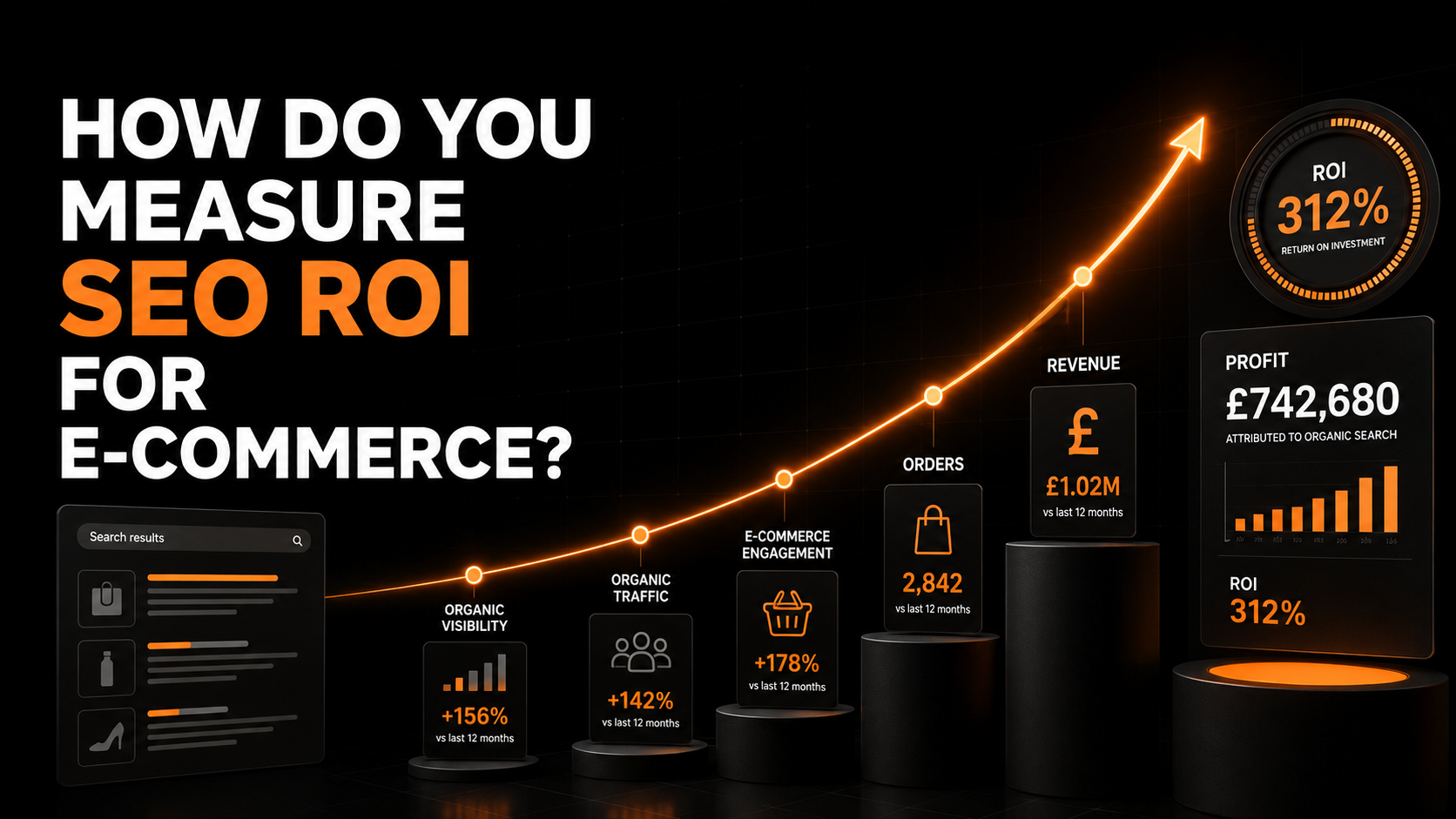
Measure Your SEO Return on Investment
For an e-commerce business, SEO should ultimately be judged by the additional profit it creates—not by rankings, traffic or revenue viewed in isolation.
The most commercially defensible definition is:
SEO ROI is the incremental gross profit generated through organic search, minus the full cost of SEO, divided by that SEO cost.
The crucial word is incremental. Not every sale attributed to Organic Search was necessarily caused by SEO. Some customers may already have known the brand, searched for it by name and purchased regardless of the work undertaken. If that revenue is all counted as SEO-generated growth, the reported return can be substantially overstated.
This article explains how marketing and e-commerce directors can build a more credible SEO ROI model—one that connects search visibility to new customers, revenue, margin and sustainable commercial growth.
The SEO ROI formula
The core calculation is:
SEO ROI = (Incremental organic gross profit − SEO investment) ÷ SEO investment × 100
For example, if an SEO programme costs £60,000 and generates an estimated £135,000 in incremental gross profit:
SEO ROI = (£135,000 − £60,000) ÷ £60,000 × 100 = 125%
This means the programme generated £2.25 in incremental gross profit for every £1 invested. Once the original £1 cost is deducted, the net return is £1.25.
That is very different from saying the programme generated £300,000 in organic revenue. Revenue may sound more impressive, but it does not account for product cost, fulfilment, discounts, returns or whether those sales would have happened anyway.
Why revenue alone is not a reliable measure of SEO return
Organic revenue remains a useful management metric. It allows a business to monitor direction, compare trading periods and identify changes by landing page or product category. However, it should not automatically be treated as profit or incremental value.
An e-commerce retailer can grow organic revenue while generating a disappointing commercial return if:
- The additional sales come from low-margin products.
- Discounting is required to convert the traffic.
- Return rates are unusually high.
- Fulfilment and payment costs consume much of the margin.
- Organic traffic has shifted towards existing customers rather than new customer acquisition.
- Branded searches are taking credit for demand created by other marketing activity.
- SEO investment has risen faster than the profit generated.
For board-level investment decisions, use gross profit or contribution margin wherever the underlying data is available.
Depending on the business, the calculation may need to account for:
- Cost of goods sold
- Promotions and discounts
- Product returns and cancellations
- Payment-processing fees
- Pick, pack and fulfilment costs
- Delivery subsidies
- Marketplace or platform fees
- Variable customer-service costs
The aim is not to create a theoretically perfect model that takes months to build. It is to use a measure close enough to commercial reality that the company can compare SEO with paid search, Meta advertising, affiliates, email and other growth investments on a sensible basis.
What should be included in the cost of SEO?
SEO is sometimes described as “free traffic” because organic clicks do not carry a direct media charge. That description is misleading. Acquiring and maintaining organic visibility requires investment.
The SEO cost should include all material resources required to deliver the programme:
- Agency or consultancy fees
- Salaries and employment costs for relevant in-house team members
- Content research, writing and editing
- Design, photography and video production
- Technical development and quality assurance
- Website migrations, structural changes and performance improvements
- Digital PR and legitimate link-acquisition activity
- SEO, analytics and reporting tools
- A fair allocation of management and analytics overhead
If internal labour and development time are excluded, SEO may appear artificially efficient compared with channels where costs are more visible.
It is also important to match the investment period to the return period. An extensive technical project or category-content programme may continue generating value for several years. Judging it only against revenue in the month the work was completed would understate the return. Equally, claiming years of organic revenue while including only one month of cost would overstate it.
Start with reliable e-commerce measurement
An SEO ROI model cannot compensate for poor transaction data. Before calculating return, confirm that the analytics implementation records purchases accurately and reconciles reasonably with the commerce platform.
GA4 e-commerce tracking should record the purchase event with a unique transaction ID, transaction value, currency and item data. Refund events should also be captured or imported so that cancelled and returned revenue does not remain in performance reporting indefinitely. Google’s current e-commerce documentation recommends transaction and item information for both purchases and refunds.
At a minimum, validate:
- Whether duplicate transactions are being recorded
- Whether revenue includes or excludes tax and shipping consistently
- Whether cross-domain checkout journeys are breaking attribution
- Whether payment providers are appearing as referral traffic
- Whether currency conversion is handled correctly
- Whether consent settings create known reporting gaps
- Whether refunds and cancellations are represented
- Whether GA4 revenue can be reconciled with the commerce platform
GA4 should not be expected to match the back-office system perfectly. Consent choices, ad blockers, browser restrictions and implementation differences can create gaps. The commerce platform or finance system should remain the source of truth for total orders and revenue; analytics provides the channel and behavioural view.
For a stronger profit model, combine analytics data with product margin, customer and order data in a warehouse or business-intelligence platform.
Use Search Console and GA4 for different questions
Google Search Console and GA4 should be used together, but they do not measure the same stage of the journey.
Search Console provides the pre-click search view, including:
- Search impressions
- Search-result clicks
- Click-through rate
- Average position
- Queries
- Landing pages
- Country and device
GA4 provides the on-site and commercial view, including:
- Organic sessions and users
- Product and category engagement
- Add-to-basket and checkout behaviour
- Purchases
- Revenue
- Conversion rate
- New and returning users
Google explicitly notes that Search Console and Analytics use different systems and metrics, so their figures will not match completely. The value comes from using them to answer different questions.
If organic revenue falls, Search Console can help establish whether demand, visibility or click-through rate changed. GA4 and the commerce platform can then show whether the visitors who arrived converted, what they purchased and how much commercial value they generated.
The e-commerce SEO ROI scorecard
A useful scorecard combines leading indicators with commercial outcomes.
| Metric | Calculation | Why it matters |
|---|---|---|
| Organic revenue | Revenue attributed to Organic Search | Tracks the top-line channel outcome |
| Organic conversion rate | Organic orders ÷ organic sessions | Shows traffic quality and landing-page effectiveness |
| Average order value | Organic revenue ÷ organic orders | Identifies changes in basket value and product mix |
| Incremental gross profit | Incremental organic revenue × applicable gross margin | Connects SEO growth to commercial value |
| Gross-profit SEO ROI | (Incremental organic gross profit − SEO cost) ÷ SEO cost | Provides the primary investment-efficiency measure |
| SEO customer acquisition cost | SEO cost ÷ incremental new organic customers | Enables comparison with paid acquisition |
| Organic LTV | Organic-customer lifetime value ÷ SEO CAC | Incorporates repeat-purchase value |
| Non-brand organic revenue | Revenue from non-brand organic discovery | Reduces overstatement from existing brand demand |
| Assisted organic revenue | Revenue where organic search appeared earlier in the journey | Recognises multi-touch research and return visits |
The scorecard should also be segmented by product category, landing-page type, device, country and new versus returning customer. A blended total can conceal highly profitable areas as well as categories where traffic is growing without worthwhile commercial value.
Separate branded and non-branded organic performance
One of the most important adjustments is to separate searches for the company or product brands from generic searches expressing category, problem or product intent.
Branded organic demand can increase because of:
- Paid search or Meta advertising
- Television, radio or out-of-home activity
- Email and CRM campaigns
- PR and influencer coverage
- Retail distribution
- Seasonal demand
- Existing customer loyalty
- Word of mouth
SEO may help the site capture that demand effectively, but it may not have created it.
Non-brand organic growth is generally more indicative of SEO expanding discovery among customers who were not already looking for the retailer. Examples include category searches, product-type searches, comparison queries and questions relating to a customer need.
This does not mean branded SEO has no value. Protecting branded search results, improving sitelinks, managing indexation and presenting the right landing pages can all influence conversion. The point is that branded and non-branded performance should not be treated as though they prove the same thing.
Attribution is not the same as incrementality
Attribution determines which touchpoint receives credit for a conversion. Incrementality asks whether the conversion happened because of the marketing activity.
Consider this customer journey:
Meta ad → non-brand Google search → organic category page → branded Google search → purchase
Different attribution models may allocate the revenue differently. A last-click view could give the final branded organic visit all the credit. A data-driven model may distribute credit across several touchpoints. Neither model alone proves what would have happened without the SEO work.
Use at least two reporting views:
- Organic last-click revenue: a clear operational view of sales completed through organic search.
- Multi-touch or data-driven attributed revenue: a planning view that recognises organic research and assisted journeys.
Keep the attribution model, lookback window, refund treatment and reporting dates consistent when comparing periods. Otherwise, a change in reported performance may simply reflect a change in methodology.
The attribution view tells you where credit was assigned. A separate incrementality model is needed to estimate what SEO added.
How to estimate incremental SEO revenue
Perfect SEO incrementality testing is difficult because organic search cannot always be switched off cleanly for a control group. However, a credible estimate is far better than assuming every attributed sale was caused by SEO.
1. Compare treated and untreated page groups
Apply SEO improvements to one group of comparable category or product pages and retain a similar group as a control for an agreed period.
Compare changes in:
- Search impressions and clicks
- Organic sessions
- Conversion rate
- Orders and revenue
- Gross margin
Control for stock, pricing, promotions, seasonality and paid-media activity. The difference between the groups provides a more credible estimate than a simple before-and-after comparison.
2. Analyse page cohorts
Group new or optimised pages by launch month and monitor their performance after three, six and twelve months.
This is particularly useful for large e-commerce sites publishing category content, buying guides, product-support content or new brand pages. Cohort reporting makes it easier to see how quickly different types of SEO investment mature and whether returns persist.
3. Compare forecast with actual performance
Build a baseline forecast using historic organic performance, seasonality and known business changes. Compare the actual result after implementation with the forecasted result without intervention.
If actual incremental revenue exceeds the baseline, apply the relevant gross margin before calculating ROI.
The baseline must be documented before the result is known. Rewriting the counterfactual after performance is available makes the estimate less credible.
4. Adjust for changing search demand
An increase in clicks can come from stronger visibility or simply from more people searching for the products.
Use Search Console impressions and query patterns alongside other demand indicators to distinguish:
- Increased market demand
- Improved rankings or search-result coverage
- Higher click-through rate
- Growth in branded interest
- Expansion into new non-brand searches
If impressions rise across the market while rankings and click-through rates remain unchanged, not all revenue growth should be credited to SEO execution.
5. Use geographic or phased rollouts where practical
Some localised retailers can introduce content, store pages or digital PR activity in selected regions first and compare the result with matched regions.
This is not suitable for every business, but it can provide stronger evidence where regional demand and operational conditions are sufficiently comparable.
A worked SEO ROI example
Assume an e-commerce retailer invests £60,000 in SEO over six months. This includes agency fees, content, technical development, digital PR and internal management time.
During that period, Organic Search records £900,000 in attributed revenue. However, the full £900,000 should not be claimed as SEO-generated revenue.
After separating brand demand, comparing optimised and untreated page cohorts, adjusting for seasonality and reviewing forecast performance, the business estimates that £300,000 was incremental.
The applicable gross margin is 45%:
Incremental gross profit = £300,000 × 45% = £135,000
The ROI calculation is:
SEO ROI = (£135,000 − £60,000) ÷ £60,000 × 100 = 125%
The programme therefore generated:
- £300,000 in estimated incremental revenue
- £135,000 in incremental gross profit
- £75,000 in return after the SEO investment
- A gross-profit SEO ROI of 125%
This provides a much more useful investment case than reporting that organic revenue reached £900,000 or that traffic increased by a particular percentage.
Account for customer lifetime value carefully
SEO may acquire customers whose value extends beyond the first order. If organic customers demonstrate meaningful repeat purchasing, first-order profit can understate long-term return.
Calculate SEO CAC using incremental new organic customers rather than every customer attributed to Organic Search:
SEO CAC = SEO investment ÷ incremental new organic customers
Compare this with predicted or realised customer lifetime value. Keep the calculation conservative:
- Use contribution margin rather than lifetime revenue where possible.
- Separate new customers from returning customers.
- Compare repeat behaviour by acquisition cohort.
- Use realised value until the predictive model has been validated.
- Apply the same LTV definition across marketing channels.
Lifetime value is helpful for strategic planning, but it should not be used to disguise weak first-order economics.
How frequently should SEO ROI be reported?
SEO develops over a longer timeframe than many paid campaigns, but that does not mean it should disappear into an annual report. Use different cadences for different questions.
Weekly: risk and leading indicators
- Indexation and crawling problems
- Search visibility and ranking movements
- Impressions, clicks and click-through rate
- Technical releases or website errors
- Stock availability on priority landing pages
- Material conversion-rate changes
Monthly: trading performance
- Organic sessions and users
- Orders and revenue
- Conversion rate and average order value
- New versus returning customers
- Brand versus non-brand performance
- Product-category and landing-page performance
- Returns or cancellations where available
Quarterly: investment return
- Estimated incremental revenue
- Incremental gross profit
- SEO ROI
- New-customer acquisition cost
- Repeat-purchase performance
- LTV
- Page and content cohort returns
- Forecast versus actual performance
Weekly reporting helps identify problems. Monthly reporting shows trading outcomes. Quarterly analysis is normally the most appropriate level for evaluating incremental profit and investment return.
Common SEO ROI reporting mistakes
Treating all organic revenue as incremental
This ignores existing brand demand, returning customers and revenue that would have occurred without the programme.
Reporting rankings or traffic as ROI
Rankings, impressions and sessions are leading indicators. They help explain performance, but they are not a financial return.
Ignoring product margin and returns
Two categories producing identical revenue can generate very different profit.
Excluding internal costs
Ignoring content, development and management time makes SEO look artificially inexpensive.
Comparing inconsistent attribution models
Changing models or lookback windows can change credited revenue without changing actual sales.
Using a reporting window that is too short
Technical improvements and new content often take time to mature. A one-month view may penalise valuable long-term work.
Ignoring commercial factors outside SEO
Stock shortages, pricing, promotions, delivery propositions, site conversion and competitor activity can all affect organic revenue.
What should an e-commerce director ask in an SEO review?
A commercially focused review should be able to answer:
- How much organic revenue and gross profit did we generate?
- How much of the change is estimated to be incremental?
- What happened to non-brand discovery and new-customer acquisition?
- Which categories and landing-page cohorts generated the strongest return?
- What did SEO cost when internal and external resources are included?
- How does SEO CAC compare with paid channels?
- Did stock, margin, pricing, promotions or site conversion affect the outcome?
- Which assumptions in the ROI model are observed facts and which are estimates?
- What should we invest in next, and what commercial result is forecast?
The purpose of SEO reporting is not to defend activity. It is to help the business decide where the next pound of marketing investment is most likely to create profitable growth.
The bottom line
The most credible e-commerce SEO ROI model connects search performance to incremental gross profit.
Use Search Console to understand how visibility, demand and clicks changed. Use GA4 and the commerce platform to measure customer behaviour, orders and attributed revenue. Add product margin, refunds and customer data to understand actual commercial value. Then use controls, cohorts or a documented forecast to estimate how much of that value SEO caused.
Rankings and traffic still matter, but as diagnostic indicators—not the final outcome.
When SEO is measured against incremental profit, new-customer acquisition and long-term value, directors can make a clearer decision about whether to maintain, reduce or scale the investment.
Frequently asked questions
What is a good ROI for e-commerce SEO?
There is no universal benchmark. A good return depends on margin, growth stage, cash flow, the maturity of the programme and the returns available from alternative investments. Compare SEO on a consistent profit basis with the company’s required return and other acquisition channels.
How long does it take to measure SEO ROI?
Leading indicators can change within weeks, but a commercially useful ROI assessment often needs at least a quarterly view. Major technical, authority-building and content programmes may require six to twelve months to show their mature return.
Should SEO ROI use revenue or profit?
Revenue is useful for operational reporting. Gross profit or contribution margin is better for investment decisions because it accounts for the economics of the sales generated.
Can GA4 calculate SEO ROI automatically?
GA4 can report attributed organic conversions and revenue, but it does not automatically determine incrementality or incorporate every SEO cost and margin component. A defensible ROI model normally combines analytics, commerce, finance and SEO investment data.
How should branded organic revenue be treated?
Report it separately. Branded organic revenue has value, but demand may have been created by other marketing, existing customers or brand awareness. Non-brand growth is generally stronger evidence that SEO expanded product discovery.
Turn SEO reporting into a commercial growth model
If your SEO reports show rankings and traffic but do not explain incremental revenue, profit or customer acquisition, Clubbish can help you build a clearer measurement framework.
Our outcome-driven approach connects SEO strategy with analytics, trading performance and the commercial metrics that matter to marketing and e-commerce directors.
Book a strategy call to review how SEO is contributing to measurable and profitable growth.