
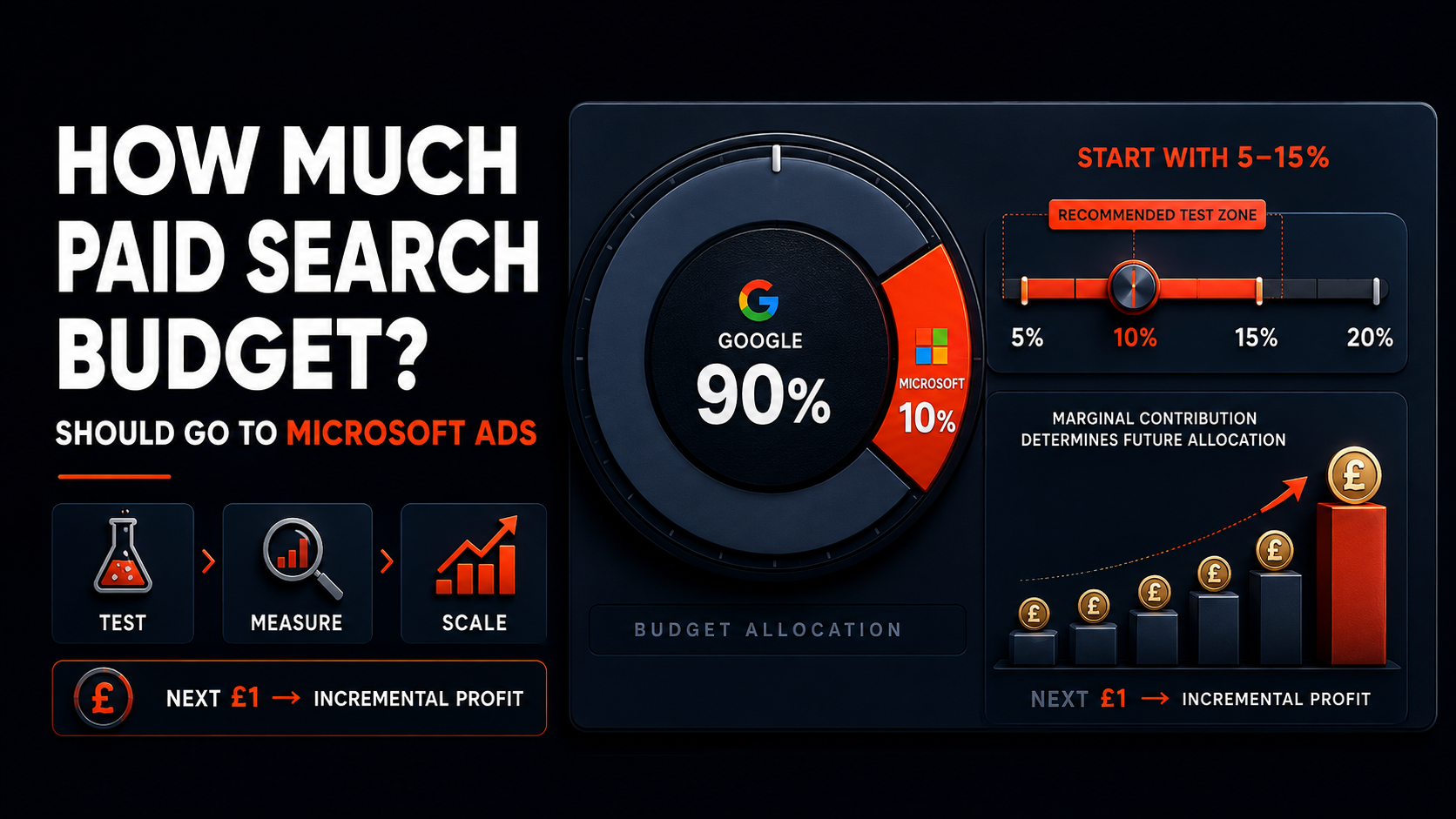
For most e-commerce businesses new to Microsoft Advertising, a sensible starting allocation is 5–15% of the total paid-search budget. Begin nearer 5–10% when Microsoft is unproven, and consider 10–20% when the retailer has a desktop-heavy audience, higher average order values or strong evidence that Microsoft can reach profitable demand not captured through Google.
That percentage is a testing framework—not a permanent rule. The final Microsoft Ads allocation could be 0%, 7%, 14% or 25%. The correct level is the point at which the next pound spent on Microsoft generates at least as much incremental contribution profit as the next pound available to Google.
The short answer
A practical starting structure is:
| Business situation | Starting Microsoft share | Why |
|---|---|---|
| First controlled Microsoft test | 5–10% | Limits exposure while validating tracking, query quality and available demand |
| Mature, profitable Google account | 10–15% | Provides enough budget for meaningful data without unnecessarily restricting Google scale |
| Desktop-led, high-AOV or considered purchase | 15–20% | Microsoft’s search opportunity is materially stronger on desktop |
| Mobile-first consumer retailer | 0–10% | Microsoft’s mobile search footprint is much smaller |
| Microsoft proven profitable and budget-constrained | Increase gradually | Let marginal contribution profit determine the ceiling |
| Microsoft fails profitability or incrementality tests | Reduce to 0–5% or stop | Channel diversity is not a reason to fund unprofitable spend |
An 80/20 Google-to-Microsoft split is often discussed as a simple planning model. It can be a valid upper-end test for suitable retailers, but it is not a universal benchmark and should not override the economics of the individual account.
Why the budget should normally remain Google-first
Google has considerably more search demand. StatCounter estimated that in July 2026 Google held 91.31% of worldwide all-device search share, compared with 4.47% for Bing. On desktop, Bing’s share was higher at 8.84%, while its worldwide mobile share was only 0.61%.
These figures do not map directly to advertising revenue, conversions or the ideal budget split. They do explain why Google normally remains the core paid-search investment and why Microsoft is usually an incremental channel.
If a retailer assigns 50% of its paid-search budget to Microsoft simply to create an equal platform split, the available qualified demand may be insufficient. The platform could then expand into weaker queries, broader placements or less profitable products merely to spend the budget.
Budget should follow commercially useful demand—not organisational symmetry.
Do not allocate budget from market share alone
Search-engine share indicates the potential audience pool. It does not tell a Marketing Director where the next pound will create the most profit.
Microsoft can deserve a higher share than Bing’s market share when it delivers:
- Lower CPCs on commercially relevant searches.
- A conversion rate comparable with or better than Google.
- Stronger average order value.
- A valuable desktop customer mix.
- New customers not already reached by Google.
- Profitable impression-share headroom.
- Lower return or cancellation rates.
- Better contribution profit after advertising.
Conversely, even a 5% allocation is excessive if Microsoft is simply receiving attribution credit for existing customers or generating orders below the retailer’s required margin.
The budget decision must use the account’s actual economics.
The marginal-profit rule
Do not ask only:
Should Microsoft receive 10% of our paid-search budget?
Ask:
Is the next £1 spent on Microsoft likely to generate more incremental contribution profit than the next £1 spent on Google?
Incremental ROAS is:
Incremental ROAS = incremental revenue ÷ additional media spend
For e-commerce, a stronger decision measure is:
Incremental contribution profit = incremental revenue − cost of goods − fulfilment − payment fees − returns − additional ad spend
This avoids three common problems:
- Treating attributed revenue as profit.
- Using historic average ROAS to justify future spend.
- Assuming the platform credited with an order necessarily caused it.
Scale Microsoft while its marginal contribution profit remains positive and meets the business’s required payback. Reallocate budget when Microsoft’s next-pound return falls below an available Google opportunity.
A worked £100,000 monthly allocation
Suppose an established retailer invests £100,000 per month in paid search and is considering Microsoft for the first time.
A conservative test allocation could be:
| Platform | Monthly allocation | Share |
| Google Ads | £90,000 | 90% |
| Microsoft Ads | £10,000 | 10% |
| Total | £100,000 | 100% |
The £10,000 Microsoft budget should not be divided equally across every Google campaign. It should initially fund the strongest test candidates:
| Microsoft test area | Allocation | Purpose |
| Non-brand Search | £3,500 | Test proven commercial category and product terms |
| Shopping/Product Ads | £4,500 | Test high-margin, in-stock bestsellers |
| Brand Search | £1,000 | Protect and measure branded demand separately |
| Controlled expansion/testing | £1,000 | Test queries, products or audience opportunities without contaminating the core result |
This is an illustrative structure, not a recommended split for every retailer. The actual mix depends on catalogue size, search demand, CPCs, conversion volume and the risk of brand over-attribution.
Do not starve profitable Google campaigns to fund a test
If Google contains campaigns that are both budget-constrained and profitable at the margin, cutting those budgets to fund Microsoft may reduce overall profit.
Before reallocating, identify:
- Profitable Google campaigns losing impression share because of budget.
- High-margin Shopping product groups with available volume.
- Non-brand Search terms meeting new-customer targets.
- Geographic or device segments capable of scaling.
- Seasonal products approaching peak demand.
Fund the Microsoft test from:
- New growth budget.
- Google spend that is demonstrably below target.
- Overfunded brand or remarketing activity.
- Product groups with weak contribution economics.
- Campaigns whose marginal ROAS has fallen below the required threshold.
The goal is not to give Microsoft a fair chance at Google’s expense. It is to improve the portfolio’s total incremental profit.
Set the minimum viable test budget
A percentage alone may not generate enough data.
Five per cent of a £200,000 monthly paid-search budget is £10,000—potentially enough to test several Microsoft campaign groups. Five per cent of a £2,000 budget is £100, which may produce too few clicks or purchases for a meaningful conclusion.
Estimate the required test investment from:
Required spend = target number of clicks × expected CPC
or:
Required clicks = target number of orders ÷ expected conversion rate
Suppose the business wants at least 40 purchases before making an initial decision:
- Expected conversion rate: 2.5%.
- Required purchases: 40.
- Required clicks: 40 ÷ 0.025 = 1,600.
- Expected CPC: £1.10.
- Estimated spend: 1,600 × £1.10 = £1,760.
If the available monthly test budget is £300, a four-week verdict will be unreliable. The business must either extend the test, narrow it to the strongest products and queries, or acknowledge that Microsoft cannot yet be evaluated properly.
Calculate the break-even point before assigning spend
Set Microsoft’s commercial guardrails from contribution margin.
If a £100 order leaves £35 after product cost, fulfilment, payment fees and expected returns, the pre-ad contribution margin is 35%.
Break-even ROAS = 1 ÷ pre-ad contribution margin
1 ÷ 0.35 = 2.86x
At 2.86x, advertising consumes the full pre-ad contribution. If the retailer requires £8 contribution after advertising on each £100 order, the allowable advertising cost is £27 and the target ROAS becomes approximately 3.70x.
The business should define:
- Break-even ROAS.
- Target ROAS.
- Allowable CPA.
- New-customer CPA.
- Required contribution after advertising.
- Acceptable payback period.
- Maximum test loss.
These guardrails should be established before the first Microsoft campaign launches—not adjusted later to make the results appear successful.
When 5–10% is appropriate
Begin at the lower end when:
- Microsoft has never been tested.
- Tracking has only recently been implemented.
- Search demand appears limited.
- The business is mobile-led.
- Margins are tight.
- Google still offers significant profitable scale.
- The catalogue has only a small number of suitable products.
- The team needs to validate partner traffic and query quality.
A focused 5–10% test can establish whether there is a viable channel before expanding operational complexity.
The limitation is data. A small percentage must still produce enough conversion volume to support a decision. If it cannot, use a longer test window or a more concentrated campaign structure.
When 10–15% is appropriate
This is a practical range for an established retailer with:
- Reliable Google tracking and profitability.
- Proven non-brand Search or Shopping demand.
- A clean Microsoft Merchant Center catalogue.
- A meaningful desktop customer base.
- Enough budget to generate regular Microsoft orders.
- An active requirement for incremental growth.
- The operational capacity to manage another platform.
Ten to fifteen per cent is large enough to gather evidence in many mature accounts without assuming Microsoft can match Google’s scale.
When 15–20% may be justified
A higher starting allocation can make sense when:
- Desktop produces a large share of revenue and profit.
- Average order value is high.
- Customers undertake considered research before buying.
- Microsoft already has historical evidence of efficient sales.
- Search demand forecasts support the spend.
- Google’s marginal return has weakened.
- High-margin products have available Microsoft impression share.
- New-customer acquisition is stronger than on Google.
The 20% figure must still be treated as a hypothesis. If Microsoft cannot absorb the budget profitably, reduce it rather than forcing delivery.
When the right allocation is 0%
Microsoft does not need a permanent place in every paid-search plan.
Zero may be correct when:
- Tracking is unreliable.
- The platform generates insufficient qualified demand.
- Orders are unprofitable after returns and fulfilment.
- The audience is overwhelmingly mobile-first.
- Search queries are persistently irrelevant.
- Google has stronger profitable opportunities available.
- Microsoft sales are mostly existing customers who would have purchased anyway.
- Management cost exceeds the channel’s commercial contribution.
Channel diversification is useful only when the additional channel creates value.
Import proven Google activity carefully
Microsoft’s Google Import capability can reduce setup time and provides options for transferring eligible campaign structures. However, campaign import does not transfer the commercial reality of Google’s audience or auctions.
Review every imported element:
- Campaign and ad-group budgets.
- Bidding strategies and targets.
- Match types.
- Locations and languages.
- Ad schedules.
- Negative keywords.
- Final URLs and tracking templates.
- Audience settings.
- Product catalogue connections.
- Brand exclusions and segmentation.
Do not automatically import every weak Google campaign. Start with high-margin products, commercially strong non-brand queries and stable landing pages.
Microsoft tracking must be independent
Campaign structures can be imported; reliable measurement still needs to be configured and tested for Microsoft.
Use Microsoft’s Universal Event Tracking framework and appropriate conversion goals to record purchase activity. Confirm:
- A purchase fires once per completed order.
- Transaction value and currency are correct.
- Test purchases are excluded from commercial reporting.
- Consent implementation is functioning as intended.
- Customer-status reporting is reconciled with commerce data.
- Microsoft revenue is compared with actual store transactions.
If the platform is optimising towards incorrect values or soft actions, any budget recommendation will be unreliable.
Keep Search and broader audience activity separate
When possible, isolate high-intent Search and Shopping/Product Ads from lower-intent audience activity during the test.
This makes it easier to determine:
- Whether Microsoft Search demand itself is profitable.
- Whether product ads attract qualified buyers.
- Whether broader placements improve new-customer acquisition.
- Which activity is consuming incremental budget.
Do not let a strong brand campaign hide weak prospecting, or allow remarketing to inflate the apparent efficiency of new-customer acquisition.
Increase budgets progressively
Once Microsoft meets the initial target, do not jump from 10% to 30% immediately.
Use a staged progression:
- Confirm tracking and feed accuracy.
- Establish stable query and product performance.
- Increase the daily budget gradually.
- Allow sufficient conversion volume for results to stabilise.
- Compare marginal CPA, ROAS and contribution profit.
- Continue only while the next spend meets the commercial threshold.
Daily budgets should be intentional. Translate the agreed monthly allocation into campaign-level daily controls, while allowing for normal daily variation and the platform’s budget behaviour.
A marginal allocation example
Assume Google receives £90,000 and Microsoft £10,000 each month.
Current results:
| Platform | Spend | Revenue | ROAS | Contribution profit after ads |
| £90,000 | £360,000 | 4.0x | £36,000 | |
| Microsoft | £10,000 | £45,000 | 4.5x | £7,100 |
Microsoft has the better average ROAS but much lower scale. The team then forecasts the return from an extra £5,000:
| Next £5,000 | Incremental revenue | Marginal ROAS | Incremental contribution after ads |
| £16,000 | 3.2x | £600 | |
| Microsoft | £21,000 | 4.2x | £2,350 |
In this example, the next £5,000 should go to Microsoft, moving the allocation from 10% towards approximately 14%. That does not mean Microsoft deserves every later increase. Repeat the assessment after the additional demand has been captured.
Measure incrementality before making the split permanent
Attributed conversions do not prove that advertising caused the order.
The risk is highest in:
- Brand Search.
- Remarketing.
- Existing-customer activity.
- Promotional peaks.
- Searches close to an inevitable purchase.
Compare Microsoft’s launch against:
- Total-store revenue.
- New customers.
- Direct and organic revenue.
- Branded search trends.
- Blended marketing efficiency ratio.
- Contribution profit.
Where volume permits, use geographic, audience or time-based controls to estimate the sales that would not have occurred without Microsoft.
The monthly allocation dashboard
| Metric | Microsoft | Portfolio total | |
| Spend | |||
| Revenue | |||
| Orders | |||
| CPC | |||
| Conversion rate | |||
| CPA | |||
| ROAS | |||
| New-customer CPA | |||
| Return rate | |||
| Contribution profit | |||
| Marginal contribution return |
Include absolute profit as well as percentages. Microsoft might have a higher ROAS while Google produces significantly more total contribution. The objective is to optimise the combined portfolio.
Common budget-allocation mistakes
Applying an 80/20 split without testing
It is a planning heuristic, not evidence that Microsoft can absorb 20% profitably.
Copying search-market share into the media plan
Market share does not account for CPC, conversion rate, margin, order value or customer quality.
Using average ROAS to allocate the next pound
Average return describes historic spend. Marginal return guides the next investment.
Cutting profitable Google activity too early
Do not sacrifice proven, budget-constrained Google demand merely to establish channel diversity.
Giving Microsoft too little budget to learn
A token allocation that produces two purchases cannot establish whether the platform works.
Forcing Microsoft to spend a fixed percentage
Available profitable demand may be smaller than the allocated budget. Reduce the budget when marginal quality declines.
Ignoring management cost
Feed work, reporting, creative, agency time and analytics are part of the channel investment.
A practical recommendation
For a UK e-commerce business new to Microsoft Ads, start at approximately 10% of the paid-search budget when that amount can fund a meaningful 4–6-week test. Use 5–10% for a cautious first test and 15–20% only where desktop demand, audience value and prior evidence support it.
Keep Google as the baseline, implement independent tracking, separate traffic types and concentrate the test on profitable products and non-brand demand. Review the allocation after sufficient purchases—not after a few cheap clicks.
The final answer to how much of your paid search budget should be allocated to Microsoft Ads is not a permanent percentage. It is the maximum amount Microsoft can use while its next pound produces incremental contribution profit equal to or greater than the next available pound in Google.
Frequently asked questions
Is 10% enough budget for Microsoft Ads?
It is a sensible starting share for many established retailers, provided the cash amount produces enough clicks and purchases for a valid test. Small accounts may need a longer period or more concentrated campaign structure.
Should we use an 80/20 Google and Microsoft split?
It can be a useful planning hypothesis for desktop-oriented retailers, but it is not a universal benchmark. Begin conservatively and validate the split through marginal contribution profit.
Can Microsoft receive more than 20% of paid-search spend?
Yes, if it has enough profitable demand and creates incremental sales. There is no reason to cap a proven channel solely because its search-engine market share is smaller.
Should brand budget be included in the Microsoft allocation?
Yes for total budget reporting, but brand should be shown separately. Its high ROAS can overstate the platform’s ability to acquire incremental customers.
How frequently should the allocation be reviewed?
Review delivery weekly for control and assess commercial allocation monthly or quarterly, depending on conversion volume and seasonality. Avoid reallocating from normal daily volatility.
What metric should determine the final percentage?
Incremental contribution profit on marginal spend is the strongest decision metric. Use ROAS, CPA and revenue as supporting diagnostics.
Need help allocating paid-search investment?
Clubbish helps e-commerce teams allocate Google and Microsoft budgets using contribution profit, customer acquisition and incrementality—not arbitrary platform percentages.
If you need to establish whether Microsoft deserves 5%, 15% or more of your paid-search investment, book a marketing strategy consultation with Clubbish.