Microsoft Advertising is usually worth testing for an e-commerce business that already has a functioning Google Ads programme, reliable conversion tracking and a commercially sound product feed.
It will rarely match Google’s scale, but it can generate additional orders from Bing and Microsoft’s wider search-partner network, while also providing access to Shopping, native, display, video and other Microsoft-owned or partner inventory.
The correct question is not whether Microsoft Advertising is “cheaper than Google” or whether it can automatically produce a fixed percentage of Google Ads revenue. It is:
Can Microsoft Advertising acquire additional customers and contribution profit that the business would otherwise miss?
For some retailers, the platform becomes a reliable secondary source of profitable revenue. For others, search demand is too limited or the audience fit is too weak to justify continued management. The only defensible answer comes from a structured test using the retailer’s own product economics.
The short answer
Microsoft Advertising is most likely to be worth it when:
- Google Search and Shopping already produce profitable sales.
- Conversion tracking and purchase values are reliable.
- The retailer has a clean, accurate product feed.
- Products have established commercial-search demand.
- The audience includes meaningful desktop, professional, older or higher-value customer segments.
- The business has enough margin and budget to run a measurable test.
- Success is judged independently from Google using contribution profit and new-customer acquisition.
It is less likely to be a priority when Google Ads remains structurally unprofitable, the website converts poorly, product data is weak or the category has little Microsoft search volume.
Microsoft should normally complement a successful Google programme—not distract the team from fixing a broken one.
What is Microsoft Advertising?
Microsoft Advertising is the paid-media platform previously known as Bing Ads.
Its Search ads can appear on Microsoft Bing and partner search sites. Microsoft lists partners including Yahoo, AOL, DuckDuckGo and Ecosia, subject to campaign settings and network availability. Microsoft Advertising: Search ads
The wider platform includes advertising formats and inventory across areas such as:
- Search
- Shopping and product ads
- Performance Max
- Audience and native placements
- Display
- Video and connected television
- Retail media
- Microsoft-owned experiences and partner properties
For most e-commerce businesses beginning on the platform, Search and Shopping are the most logical starting points because they capture visible product and category intent. Broader audience or cross-channel formats can follow once measurement and demand capture are established.
How much UK search demand does Microsoft have?
Microsoft’s search footprint is materially smaller than Google’s, but the headline share changes considerably by device.
StatCounter reported the following UK figures for July 2026:
| UK search measurement | Bing | |
|---|---|---|
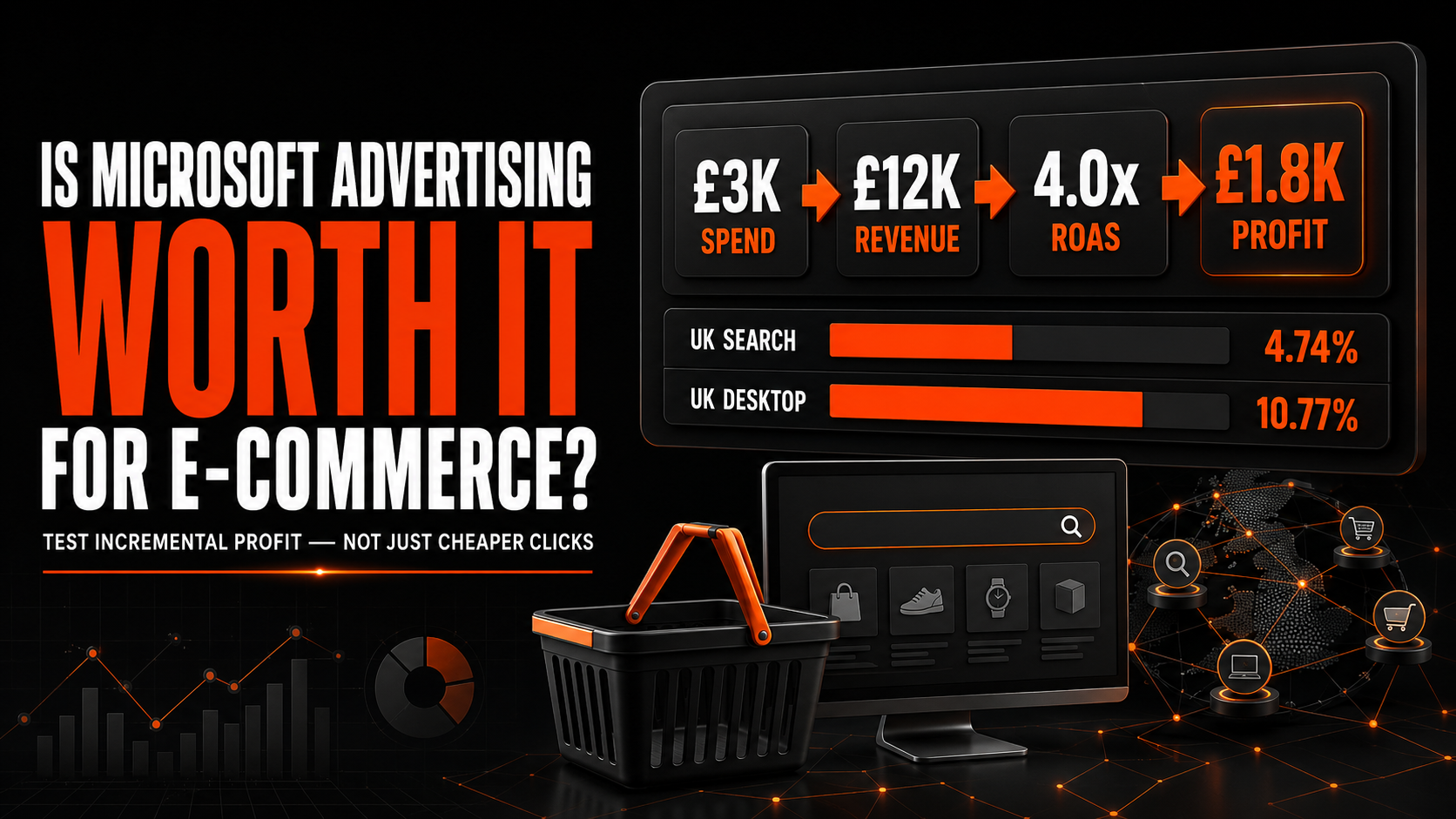
| Desktop and mobile combined | 92.62% | 4.74% |
| Desktop only | 85.55% | 10.77% |
Sources: StatCounter UK desktop and mobile and StatCounter UK desktop.
These figures are estimates derived from StatCounter’s measurement methodology rather than a direct count of every UK search. They also describe search-engine usage—not the precise number of commercially relevant advertising auctions available to one retailer.
The practical conclusion is still useful:
- Google remains overwhelmingly larger overall.
- Microsoft’s position is more material on desktop.
- Audience and category fit can matter more than total market share.
- A smaller platform can still generate commercially meaningful incremental profit.
A retailer should not dismiss a channel simply because it represents a minority of the search market. If that minority contains profitable customers who are not being reached elsewhere, it can be valuable.
Will Microsoft Advertising generate 12–16% of Google Ads revenue?
It might—but 12–16% should be treated as a planning hypothesis, not an industry promise.
A retailer generating £100,000 per month from Google Ads could see:
- Almost no incremental Microsoft revenue in a low-demand category
- A few thousand pounds per month from proven searches
- £12,000–£16,000 under favourable audience and category conditions
- More than that in an unusually strong Microsoft market
The percentage depends on:
- Country
- Product category
- Device mix
- Search demand
- Brand awareness
- Average order value
- Customer demographics
- Feed quality
- Price competitiveness
- How much Google revenue comes from brand and remarketing
- The amount of Microsoft inventory enabled
- The quality of campaign management
If Google Ads revenue is heavily driven by branded search, importing the same structure may produce little truly additional value. Microsoft could report sales from people already looking for the retailer rather than creating new customer demand.
Use any percentage forecast as a scenario for financial planning, then replace it with observed results as soon as the test produces credible data.
Why Microsoft Advertising can add profitable growth
It reaches search demand outside Google
Microsoft Search ads provide access to people searching on Bing and eligible partner sites. Some users will overlap with Google; others may use Microsoft search as a default or principal route.
Even where the same person uses both engines, Microsoft can create an additional opportunity to reach them during a commercially valuable search.
Auction competition may differ
Fewer advertisers in a particular Microsoft auction can create lower CPCs or stronger visibility. That is not universal, and lower CPC does not guarantee a lower customer-acquisition cost.
The correct relationship is:
CPA = CPC ÷ conversion rate
If Microsoft CPC is £0.80 and conversion rate is 2%:
CPA = £0.80 ÷ 0.02 = £40
If Google CPC is £1.20 and conversion rate is 4%:
CPA = £1.20 ÷ 0.04 = £30
Microsoft has the cheaper click but the more expensive order.
Compare complete economics rather than click cost in isolation.
Desktop search can suit certain purchases
Microsoft’s stronger relative desktop position may benefit categories where customers research at work, compare technical products, make considered purchases or prefer a larger screen.
Possible examples include:
- Home and office furniture
- Technology and accessories
- Professional equipment
- High-value gifts
- Jewellery and watches
- Automotive products
- Specialist hobby products
- B2B-adjacent retail
These are hypotheses, not rules. Analyse the retailer’s own device-level conversion and customer data.
Google campaigns can be imported
Microsoft Advertising supports Google Import, allowing advertisers to bring existing Google Ads campaigns into the platform rather than rebuilding everything manually.
This can reduce setup time, but an import is a starting point—not a finished Microsoft strategy.
After importing, review:
- Budgets
- Bids and targets
- Network settings
- Locations
- Ad schedules
- Match types
- Negative keywords
- Tracking templates
- Conversion goals
- Audience settings
- Automated imports
- Assets
Google and Microsoft have different inventory, demand and platform features. A campaign that performs on Google should not be assumed to behave identically after import.
It can diversify acquisition risk
An additional profitable channel reduces complete dependence on Google’s auctions, platform changes and demand patterns.
Diversification has value only when the secondary channel creates profit. Spending on Microsoft purely to claim channel diversity is not a commercial strategy.
When Microsoft Advertising is most likely to work
Google Ads already proves the demand
Profitable Google Search terms and Shopping products provide evidence about what customers search for and buy.
Use that evidence to prioritise:
- High-intent non-brand keywords
- Best-selling products
- Strong-margin categories
- High-converting locations
- Proven advert messages
- Commercial landing pages
Do not import every historic campaign, including paused experiments, weak queries and legacy structures.
Product economics can support a test
Calculate break-even ROAS or allowable CPA before launch.
Break-even ROAS = 1 ÷ pre-ad contribution margin
If a £100 order leaves £35 after product cost, fulfilment, fees, delivery support and expected returns, pre-ad contribution margin is 35%:
Break-even ROAS = 1 ÷ 0.35 = 2.86x
If the business requires £10 contribution after advertising:
Allowable CPA = £35 − £10 = £25
These are better test guardrails than copying the Google Ads target or choosing a generic Microsoft ROAS benchmark.
The feed is commercially strong
Microsoft Shopping depends on a Microsoft Merchant Center store and catalogue feed.
The feed should contain:
- Accurate IDs
- Product titles
- Descriptions
- GTIN, MPN and brand
- Product type and category
- Price and sale price
- Availability
- Variant attributes
- High-quality images
- Shipping information
Microsoft Shopping campaigns allow product filters and product groups, enabling the advertiser to include selected inventory and organise products for bidding and reporting. Microsoft Advertising: Shopping campaigns
The business can measure Microsoft independently
Microsoft should have its own:
- Conversion tracking
- Revenue reporting
- Customer-status reporting
- Product-level performance
- Refund analysis
- Contribution-profit view
Do not merge Microsoft and Google into one “Paid Search” number before assessing each channel’s economics.
There is operational capacity
A smaller channel still requires management. Someone must monitor:
- Search terms
- Search partners
- Feed diagnostics
- Product approvals
- Budgets
- Bids
- Audience traffic
- Conversion tracking
- Imported changes
- Reporting
If Microsoft receives no attention after launch, a poor result may reflect implementation rather than underlying demand.
When Microsoft Advertising may underperform
Google Ads is not yet commercially sound
If Google tracking is unreliable, landing pages convert poorly or the offer is uncompetitive, expanding to Microsoft duplicates unresolved problems.
Fix the foundations where the largest demand already exists.
The audience is overwhelmingly mobile-first
Some categories depend on younger or mobile-led discovery patterns that may be less represented in Microsoft search demand. Test actual volume rather than relying solely on audience stereotypes.
The category has little search volume
A highly specialised product may produce too few Microsoft searches to reach meaningful scale or support automated bidding.
Low volume is not necessarily failure if the channel remains profitable with minimal management. But it may not justify strategic priority.
The retailer expects Microsoft to replace Google
Microsoft is normally a complementary platform. Planning around equivalent scale is unrealistic for most UK e-commerce businesses given the relative search-market sizes.
The team imports and ignores the account
Automatic imports can keep campaigns aligned, but they can also reproduce changes that are unsuitable for Microsoft or overwrite intentional platform-specific adjustments.
Review import schedules, what is included and how conflicts are managed.
Audience traffic is blended with Search
Search intent and audience-led placements can produce different conversion behaviour. Initially separating or clearly reporting these areas makes the economics easier to understand.
Search, Shopping or Performance Max: where should an e-commerce test begin?
Microsoft Search
Begin with proven high-intent keywords and query themes from Google.
Prioritise:
- Product and category terms
- Model or SKU searches
- Brand-plus-product terms
- High-value use cases
- Profitable generic queries
Separate brand and non-brand so existing demand does not obscure customer acquisition.
Microsoft Shopping
Shopping is a logical starting point for retailers with strong product feeds and clear product-search demand.
Use product groups to prioritise:
- Bestsellers
- High-margin products
- High-stock items
- Competitive prices
- Low-return products
- Strategic categories
Microsoft Shopping supports bid strategies including Target ROAS and other approaches, subject to campaign eligibility and configuration. Microsoft Advertising: Shopping campaign setup
Microsoft Performance Max
Performance Max can expand beyond conventional Search and Shopping structures. It may be appropriate after core conversion tracking, product data and economics are reliable.
Do not assume its Google counterpart’s performance will transfer. Treat Microsoft PMax as its own controlled test with separate budget, measurement and success criteria.
Audience and native advertising
Use broader audience placements when the business has suitable creative, sufficient budget and a reason to invest earlier in the journey.
Do not judge prospecting activity against branded Search using the same last-click expectation. Measure new customers, assisted outcomes and incrementality where practical.
A practical Microsoft Advertising test plan
Step 1: Establish the Google baseline
Segment Google performance by:
- Brand and non-brand
- Search, Shopping and PMax
- New and returning customers
- Product category
- Margin band
- Device
- Geography
- Query intent
Select demand that already shows commercial value.
Step 2: Set the test economics
Define:
- Break-even ROAS
- Target ROAS
- Allowable CPA
- Required contribution profit
- New-customer CPA
- Maximum payback period
State whether the target applies to first-order profit or includes future customer value.
Step 3: Implement independent measurement
Confirm:
- Purchase events
- Dynamic order values
- Currency
- Transaction IDs
- Universal Event Tracking
- Consent implementation
- Analytics classification
- Customer-status reporting
Reconcile initial Microsoft orders against the commerce platform.
Step 4: Import selectively
Import proven Search structures, then adapt settings. Build Shopping from a clean Microsoft Merchant Center feed and begin with commercially strong products.
Step 5: Control the networks
Separate or clearly report Microsoft Search, search partners and Audience Network traffic. This allows the team to identify whether strong or weak performance comes from user intent, partner quality or broader audience expansion.
Step 6: Allow sufficient data
Do not judge the platform after a handful of clicks. The test needs enough conversion opportunity to distinguish poor economics from ordinary volatility.
At the same time, use spend limits and search-term monitoring so “learning” does not become uncontrolled waste.
Step 7: Evaluate marginal and incremental profit
Compare:
- Attributed orders and revenue
- New-customer orders
- Contribution after advertising
- Total store revenue
- Blended MER
- Google performance during the same period
- Direct and organic channel movement
Scale only while additional spend meets the commercial threshold.
How much should the initial test budget be?
There is no universal figure.
The budget should be large enough to create a reasonable opportunity for conversions but small enough to protect the business if the hypothesis is wrong.
Use:
Required test budget = Target number of conversions × Allowable CPA
If the business wants at least 40 purchases to form an initial commercial view and allowable CPA is £25:
Test budget = 40 × £25 = £1,000
This does not guarantee 40 purchases. It translates the learning requirement into a risk budget.
If available Microsoft demand cannot spend £1,000 within a sensible period, the account may remain a low-volume but potentially profitable supplementary channel.
A worked commercial example
An e-commerce business generates £100,000 per month in attributed Google Ads revenue. It launches Microsoft with a £3,000 monthly test budget.
| Metric | Result |
| Microsoft spend | £3,000 |
| Attributed revenue | £12,000 |
| ROAS | 4.0x |
| Pre-ad contribution margin | 40% |
| Pre-ad contribution | £4,800 |
| Contribution after ads | £1,800 |
| New-customer orders | 90 |
| Total orders | 150 |
| New-customer CPA | £33.33 |
Microsoft produces revenue equal to 12% of the Google figure, but the decision should not be based on that ratio.
The relevant questions are:
- Is £1,800 sufficient contribution for the management effort?
- Are the 90 new customers genuinely additional?
- Does their repeat value justify the £33.33 acquisition cost?
- Can more spend be added at similar marginal economics?
- Did total store revenue and profit increase?
The 12% outcome is an observation from this example—not a benchmark to promise the next retailer.
How to assess incrementality
Microsoft may reach users not captured through Google Ads, but attributed sales are not automatically incremental.
Over-attribution risk is higher for:
- Brand Search
- Remarketing
- Existing customers
- Promotional periods
- Cross-network activity close to purchase
Compare Microsoft growth with:
- Total store revenue
- New-customer volume
- Branded organic and direct traffic
- Google Ads performance
- Email and affiliate revenue
- Blended marketing efficiency
Where volume permits, use a matched geographic test or controlled budget switchback. Keep promotions, stock and other media stable as far as practical.
The objective is to estimate whether Microsoft created additional sales rather than merely receiving credit for customers already in the journey.
How to report Microsoft alongside Google
Use a shared commercial framework while keeping the platforms separately visible.
| Measure | Google Ads | Microsoft Advertising | Total paid search |
| Spend | Report separately | Report separately | Combined |
| Orders | Attributed and new | Attributed and new | Deduplicated where possible |
| Revenue | Refund-adjusted | Refund-adjusted | Combined attributed context |
| CPA | Overall and new customer | Overall and new customer | Blended |
| ROAS | Attributed | Attributed | Blended |
| Contribution | After media | After media | Total |
| Incrementality | Tested/estimated | Tested/estimated | Business-level view |
Avoid comparing platforms without adjusting for:
- Brand mix
- Product mix
- New-customer rate
- Device
- Attribution windows
- Returns
- Audience versus Search inventory
A lower Microsoft ROAS may still be attractive if it reaches genuinely new customers or higher-margin products.
Common Microsoft Advertising mistakes
Importing the full Google account
This transfers old tests, unsuitable settings and low-value campaigns alongside the winners. Import selectively.
Leaving automated imports unchecked
An import schedule can overwrite Microsoft-specific strategy. Document which changes should sync.
Combining Search and audience economics
Broader inventory can hide the performance of high-intent Search. Segment the reporting.
Using Google budgets and targets unchanged
Demand and auction conditions differ. Recalculate targets from business economics and set budgets for Microsoft’s available volume.
Ignoring search partners
Partner traffic can add scale but should be monitored for query and conversion quality.
Neglecting the feed
An existing Google Merchant Center feed still needs correct transfer, review and Microsoft Merchant Center monitoring.
Judging the channel on CPC
Cheap clicks can convert poorly. Measure CPA, contribution and customer quality.
Expecting Google-scale revenue
Microsoft’s smaller search footprint makes equivalent scale unlikely for most UK retailers.
Reporting attributed sales as incremental
Brand and returning-customer demand can receive credit on either platform. Assess total-business impact.
A 90-day launch framework
Days 1–15: Prepare
- Validate tracking and economics.
- Create or review Microsoft Merchant Center.
- Select proven Google campaigns and products.
- Establish target CPA, ROAS and contribution.
- Define network and brand separation.
Days 16–45: Launch and control
- Launch Search and Shopping tests.
- Monitor query quality and product approvals.
- Reconcile orders and revenue.
- Review device, partner and product performance.
- Exclude obvious waste without overreacting to limited data.
Days 46–90: Optimise and decide
- Calculate contribution after ads.
- Review new-customer acquisition.
- Compare Microsoft with total store growth.
- Expand proven query and product groups.
- Test broader campaign types only where justified.
- Continue, scale, maintain or stop based on marginal profit.
Questions directors should ask
- What unique demand can Microsoft reach for our category?
- Which Google campaigns are genuinely suitable to import?
- What is our Microsoft-specific test budget?
- What are the break-even and target economics?
- How will brand and non-brand be separated?
- How will Search and audience traffic be reported?
- Is the Microsoft Merchant Center feed accurate?
- How many orders are from new customers?
- What is contribution after media and refunds?
- Does total store revenue grow alongside Microsoft attribution?
- What is the marginal return on additional spend?
- At what point will we scale, maintain or stop?
Is Microsoft Advertising worth the management cost?
A low-spend channel can be profitable but still fail to justify excessive manual work.
Include:
- Agency or internal management time
- Feed-management cost
- Creative production
- Tracking and reporting
- Technology and automation
- Opportunity cost
If Microsoft produces £500 monthly contribution but requires £1,000 of additional management, it is not commercially worthwhile in its current form.
Well-designed imports, shared feed processes and consolidated reporting can reduce the incremental workload—provided automation remains supervised.
The practical answer
For an established e-commerce business with profitable Google Ads, sound tracking and a strong product feed, Microsoft Advertising is usually worth a controlled test.
It should be positioned as:
- A complementary source of search demand
- A potential source of profitable new customers
- A diversification opportunity
- A channel with lower but potentially valuable scale
It should not be positioned as:
- A replacement for Google
- Guaranteed cheaper customer acquisition
- A fixed percentage of Google revenue
- Automatically incremental
- A copy-and-paste channel requiring no management
The decision is commercially straightforward:
Keep and scale Microsoft Advertising only while the next pound spent generates acceptable incremental contribution profit.
Frequently asked questions
Is Microsoft Advertising good for e-commerce?
It can be, particularly for retailers with proven search demand, reliable conversion tracking, strong product feeds and audiences with meaningful Microsoft usage. Test it independently rather than assuming Google performance will transfer.
How much revenue can Microsoft Ads generate compared with Google Ads?
There is no reliable universal ratio. A 12–16% planning scenario may be reasonable for some established retailers, but results can be negligible or materially higher depending on category, country, audience and campaign mix.
Are Microsoft Ads cheaper than Google Ads?
CPC may be lower in some auctions because competition differs, but cheaper clicks do not guarantee cheaper customers or greater profit. Compare CPA, conversion rate, contribution and new-customer quality.
Can Google Ads campaigns be imported into Microsoft Advertising?
Yes. Google Import can reduce setup time, but budgets, targeting, tracking, networks, goals and automation should be reviewed after import.
Does Microsoft Advertising include Yahoo and AOL?
Microsoft says Search ads can appear on Bing and eligible search partners including Yahoo, AOL, DuckDuckGo and Ecosia, depending on campaign settings and availability.
Should we start with Microsoft Search or Shopping?
Most e-commerce businesses should test proven high-intent Search terms and commercially strong Shopping products first. Broader audience and cross-channel campaigns can follow once measurement is reliable.
How long should a Microsoft Advertising test run?
Long enough to produce a meaningful number of purchases and account for conversion delay and normal volatility. Define the target conversion count, maximum test spend and decision criteria before launch.
Is Microsoft Advertising incremental to Google Ads?
It can reach demand that Google campaigns do not capture, but attributed Microsoft orders are not automatically incremental. Review new customers and total-store performance, and use a controlled test where volume permits.
Add Microsoft Advertising to your profitable growth mix
If Google Ads already produces meaningful e-commerce revenue and you want to assess whether Microsoft can add another profitable source of customers, Clubbish can build and evaluate a controlled channel test.
Our outcome-driven approach connects Microsoft Search and Shopping with product margin, customer acquisition and incremental contribution—without promising an arbitrary percentage of Google revenue.
Book a strategy call to assess the Microsoft Advertising opportunity for your e-commerce business.